
The Echo Garden
Growing Your Voice in Unexpected Places

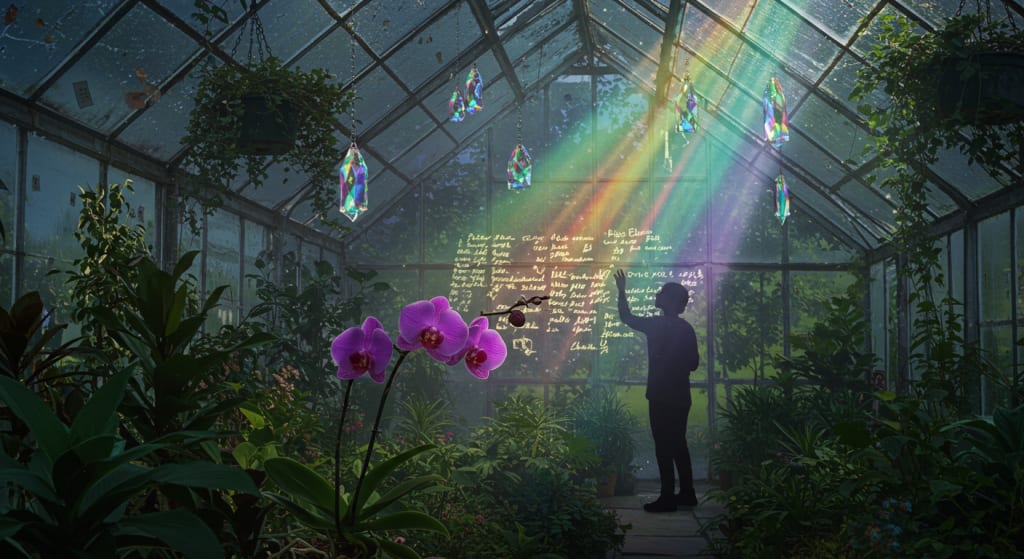
Mia Chen stood frozen at the edge of her middle school cafeteria, lunch tray clutched against her chest like armor, scanning for a single friendly face among the chaos. Six weeks after moving to this new town, she remained invisible—except when she wasn't, like yesterday when her halting class presentation had triggered snickers and today's trending hashtag: #MiaTheStatue.
One deep breath. Two. Three. Then a voice beside her: "The corner table's Switzerland—neutral territory."
The girl who spoke wore mismatched socks and had a camera hanging around her neck. "I'm Eliza," she said, already walking away, clearly not checking if Mia followed.
Mia did follow, though. When you're drowning, you don't question the hand that reaches for you.
That lunch period changed everything, though not in the way most stories promise. Eliza wasn't secretly popular; she didn't transform Mia's social status overnight. But she showed Mia something far more valuable—the abandoned greenhouse behind the science building that Eliza had converted into what she called "The Echo Garden."
"I started it after my dad died last year," Eliza explained, unlocking the rusted door to reveal a space filled with thriving plants, hanging prisms that scattered rainbow light, and walls covered in photographs and handwritten notes. "When everything got too loud inside my head, I needed somewhere my thoughts could echo until they made sense."
The greenhouse—technically off-limits to students but overlooked by administrators—had become Eliza's refuge and project. She'd salvaged discarded plants from the dumpster behind the local nursery, hung solar-powered fairy lights, and created a wall where students could anonymously post notes about their fears, hopes, and secrets.
"People find it when they need it," Eliza said simply. "That's why you're here."
Mia, who had barely spoken three sentences at lunch, found herself asking, "Why did you bring me?"
Eliza adjusted her camera strap. "Because yesterday during your presentation, you kept going even when those jerks started laughing. Your hands were shaking, but you finished. That's brave."
Mia nearly laughed. "That wasn't bravery. I just didn't know what else to do."
"That's exactly what bravery is," Eliza insisted. "Doing the thing anyway when there isn't an easy escape route."
Over the following weeks, The Echo Garden became Mia's sanctuary too. She brought her wilting houseplants from home, nursing them back to health alongside her confidence. She added her own anonymous notes to the wall: I'm afraid I'll always be the new girl, even when I'm eighty. I miss my old friends so much it physically hurts. Sometimes I'm grateful we moved because I can try being someone new.
Slowly, the greenhouse collected more visitors—not many, but enough to form an unlikely community. There was Marcus, a brilliant math student struggling with undiagnosed ADHD; Zoe, whose designer clothes hid a home life falling apart; and Aaron, a star athlete secretly passionate about poetry. Each came for different reasons but stayed for the same one: in The Echo Garden, they could be their unfiltered selves.
Mia's transformation wasn't dramatic. She didn't suddenly become outgoing or popular. But in tending to the garden, she began tending to herself—planting seeds of confidence that grew in their own time. She still stammered during presentations sometimes, but the Garden had taught her that growth doesn't always announce itself loudly.
When the school principal discovered their sanctuary in early spring and declared it a safety hazard scheduled for demolition, the Garden community faced their first real challenge.
"We can't just let them destroy it," Mia said during an emergency meeting, surprising herself by speaking first. Six months ago, she would have silently accepted the loss.
Together, they formulated a plan. While Eliza documented the Garden's impact through photographs, Mia—who still struggled to speak in class—found herself writing a proposal for the principal, outlining how the greenhouse could become an official school project promoting mental health and environmental science.
The night before their presentation to the school board, Mia's doubt returned full-force. "I can't do this," she texted Eliza. "Everyone will be staring at me."
Eliza's response was immediate: Remember the orchid?
Mia did remember. It had been her first Garden project—a discarded orchid with no blooms and yellowing leaves that everyone except Mia had written off as beyond saving. For weeks, she researched and adjusted its care, refusing to accept its apparent failure. Three months later, it produced the most delicate purple bloom.
Some things bloom when they're ready, Eliza had said then. Not when we demand it.
Standing before the school board the next day, Mia's hands trembled as she opened her folder. But when she looked up, she saw Eliza, Marcus, Zoe, and Aaron in the audience, each wearing a small orchid pin—a silent reminder that she had already proven she could nurture something fragile into strength.
Her voice started soft but grew as she shared what The Echo Garden truly was—not just plants and pretty lights, but a testament to what happens when people are given space to grow at their own pace, to fail safely, to root themselves in acceptance.
By the time she finished speaking, Mia realized something profound: the girl who couldn't order pizza over the phone six months ago had just persuaded a room full of adults to save a greenhouse. The Echo Garden had done exactly what its name suggested—it had echoed back to each of them their own capacity for growth.
The school board not only approved the Garden's continuation but provided funding to expand it as an official school program combining environmental science, art, and peer support.
Years later, as Mia prepared to leave for college, she returned to the Garden one last time. It had expanded beyond the original greenhouse, with new generations of students finding their way there. On the wall of anonymous notes, she added her final message: The most important growth happens underground, where no one can see it. Trust the process. You're becoming exactly who you need to be.
That quiet afternoon, Mia realized that finding your voice isn't always about speaking loudly—sometimes it's about creating spaces where others can be heard. The real transformation wasn't in becoming someone new, but in discovering she had been enough all along.
About the Creator
Edmund Oduro
My life has been rough. I lived in ghettos with a story to tell, a story to motivate you and inspire you. Join me in this journey. I post on Saturday evening, Tuesday evening and Thursday evening.
Keep reading
More stories from Edmund Oduro and writers in Motivation and other communities.
The Sixty-Second Rule
The basketball bounced off the rim for the fourteenth consecutive time as Tyler Adams stood alone on the community court, sweat dripping despite the autumn chill. His phone buzzed with messages from friends heading to the movies, but he silenced it without looking. They wouldn't understand why a high school sophomore was spending Friday night shooting the same failed three-pointer over and over in the darkening evening.
By Edmund Oduro9 months ago in Motivation
Are you enough?
The front of my favorite hoodie proclaims in simple letters, "You are enough." Several weeks ago, I began listening to a book during my daily commute. The premise of the book rejects the message on the front of my hoodie. It claims that it is harmful to tell someone, "You are enough," as if saying that puts a burden too much to bear upon him or her. The author says, "'You are enough' means that 'you must be able to bear up in every circumstance without the help of anyone else. How is that a kind idea to convey?'"
By Mack D. Amesa day ago in Motivation
How to Succeed at the Benson Directory®
Congratulations and welcome to the Benson Directory® employee #22391! As our newest call handler, you will have the privilege of speaking with dozens of unique and interesting people on a daily basis as well as the opportunity to earn bonuses for high performance. Contained within this handbook you will find a set of ease to follow instructions designed to help you settle in to your new role and begin paving the way to success.
By S. A. Crawford7 days ago in Fiction




Comments
There are no comments for this story
Be the first to respond and start the conversation.