
🧪 The Dopamine Effect: How to Hack Your Brain for Motivation and Focus
Rewiring Your Brain to Stay Motivated, Focused, and Productive

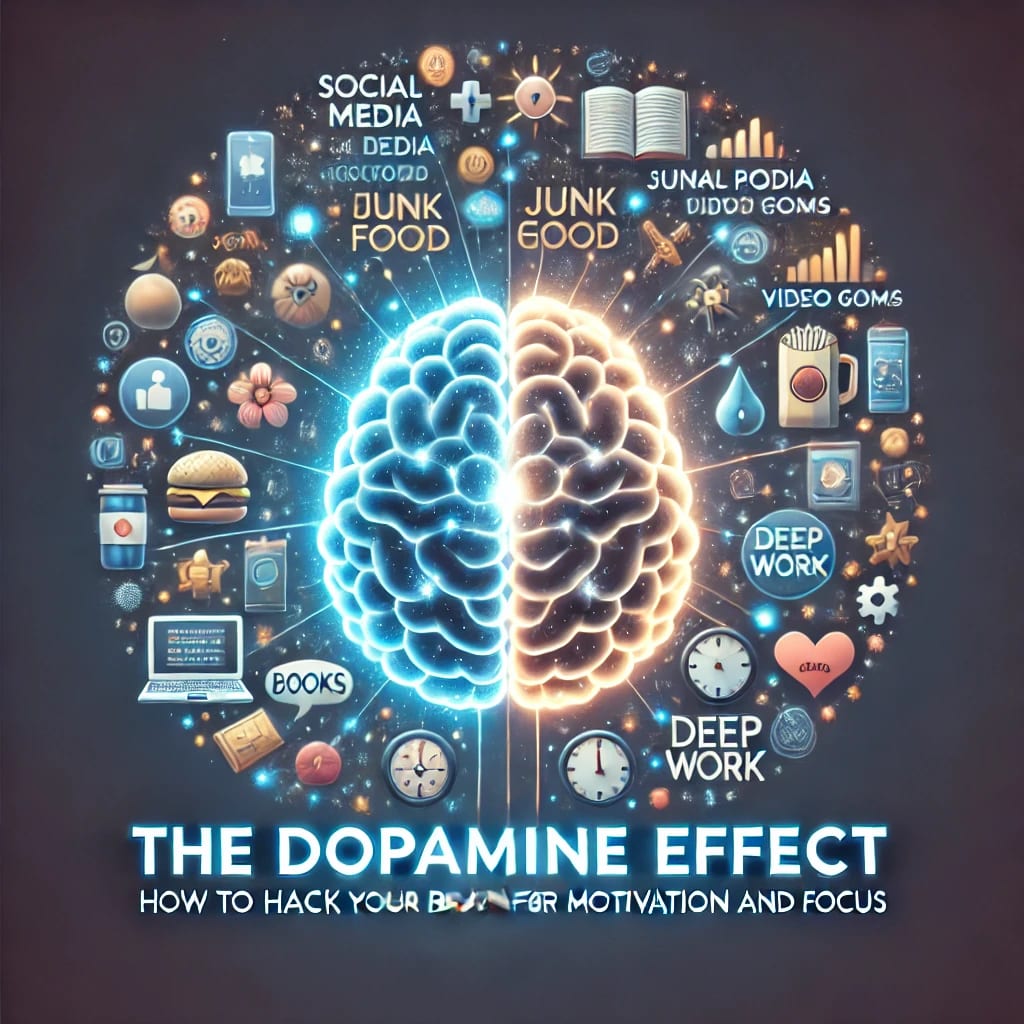
Introduction: How Dopamine Controls Your Life
It starts the same way every time.
You sit down to work, determined to be productive. Five minutes in, you get a notification. You check it. One quick glance turns into 20 minutes of scrolling. Suddenly, you realize you’ve lost your momentum. Why does this keep happening?
The answer? Dopamine.
Dopamine is your brain’s reward chemical. It drives motivation, focus, and pleasure—but it can also lead to distraction, addiction, and procrastination. In today’s world, where instant gratification is everywhere, our brains are overstimulated with bad dopamine triggers. The good news? You can take control.
By understanding how dopamine works, you can rewire your brain to seek out productivity instead of procrastination. This article will show you exactly how to do that.
1. What is Dopamine? The Science Behind Motivation
Dopamine is a neurotransmitter that plays a crucial role in motivation, learning, and habit formation. Think of it as your brain’s internal currency for pleasure and rewards. Every time you accomplish something—big or small—dopamine is released, reinforcing that behavior.
✅ Good Dopamine Release: Finishing a workout, solving a problem, making progress on a goal.❌ Bad Dopamine Release: Scrolling TikTok for an hour, binge-watching Netflix, junk food binges.
The problem is that modern life floods our brains with cheap, easy dopamine hits. These distractions train our brains to crave instant pleasure instead of long-term rewards. The result? A lack of motivation for meaningful tasks.
2. Good vs. Bad Dopamine Triggers: The Hidden War in Your Brain
Not all dopamine is bad—but the source of your dopamine matters. Here’s the difference:
- 🛑 Bad Dopamine Triggers (Instant Gratification):
- Social Media: Endless scrolling hijacks your brain’s reward system.
- Junk Food: Spikes dopamine fast but leads to energy crashes.
- Video Games: Overstimulates dopamine receptors, making real-world tasks feel boring.
- Pornography: Rewires the brain for short-term pleasure instead of real-life relationships.
✅ Good Dopamine Triggers (Long-Term Rewards):
- Exercise: Boosts dopamine naturally and improves focus.
- Deep Work: Long periods of focused work create high-reward dopamine loops.
- Goal Setting: Small achievements trigger dopamine and build momentum.
- Learning New Skills: The brain rewards growth and curiosity.
- Your goal? Reduce bad dopamine triggers and replace them with good ones.
3. The Dopamine Detox: Resetting Your Brain for Motivation
A dopamine detox is a method to reset your brain’s reward system by eliminating instant gratification activities for a period of time. This helps your brain regain sensitivity to natural dopamine sources, making work and deep focus more rewarding.
How to Do a Dopamine Detox:
🔵 Step 1: Identify Your Dopamine AddictionsMake a list of activities that provide cheap dopamine hits (social media, video games, junk food, etc.).
🔵 Step 2: Remove Them for 24-48 HoursCompletely avoid these activities. Expect boredom—this is part of the reset.
🔵 Step 3: Replace with High-Value ActivitiesInstead of scrolling Instagram, go for a walk, read a book, or work on a skill.
🔵 Step 4: Reintroduce SlowlyOnce you complete the detox, limit low-value dopamine activities and prioritize deep work and healthy habits.
After a detox, many people find that they:
✔️ Feel more motivated to work.✔️ Have increased focus and concentration.✔️ Experience a higher sense of accomplishment from real-world tasks.
4. Small Daily Dopamine Tweaks for Long-Term Motivation
You don’t need a full detox to improve your motivation. Try these daily dopamine hacks:
💡 The 5-Minute Rule: If you don’t feel like working, commit to just 5 minutes. Once you start, dopamine kicks in, and you’ll likely keep going.
💡 Use a Habit Tracker: Seeing visual progress (like checking off daily habits) releases dopamine and reinforces consistency.
💡 Delay Gratification: Train your brain to resist instant pleasure by postponing rewards until after productive work.
💡 Morning Sunlight: Natural light exposure in the morning boosts dopamine levels and improves mood.
5. Final Thoughts: Mastering Dopamine for a Focused, Productive Life
Dopamine is neither good nor bad—it’s about how you control it.
By reducing instant gratification and training your brain to crave long-term rewards, you can unlock deep motivation and laser-sharp focus.
So, what’s one bad dopamine trigger you’ll eliminate today? Let me know in the comments!
About the Creator
Ahmet Kıvanç Demirkıran
As a technology and innovation enthusiast, I aim to bring fresh perspectives to my readers, drawing from my experience.
Keep reading
More stories from Ahmet Kıvanç Demirkıran and writers in Motivation and other communities.
The Science of Self-Discipline: How to Train Your Brain for Success
Introduction: The Myth of Motivation We’ve all experienced it. The initial burst of enthusiasm when starting a new habit or chasing a goal, only to watch that energy fade within days or weeks. Whether it’s sticking to a fitness routine, waking up early, or working on a passion project, motivation feels fleeting. That’s because it is.
By Ahmet Kıvanç Demirkıran11 months ago in Motivation
Looking back: 2025 was a beast
It's difficult to know how to start this. I've suggested that it's been a tough one from my title and in many ways, it has; however, there is an argument that it's not been that extraordinary at all, merely this wonderful thing we call "life" with all its climaxes and pitfalls.
By Rachel Deeming25 days ago in Motivation
THE NATURE OF ABUSE
The nature of abuse is fundamentally defined by an imbalance of power and control, where one seeks dominance to achieve obedience within the powerless state of another. The path to restorative peace, emancipation, and freedom must reside within the state of truth. To become a catalyst of change one must force the mask to drop for transparency and accountability to emerge. The façade or persona others may project to the world, often conceals their core real true-self. True character is often revealed within moments of critical crisis, where someone who has experienced grave injustice, torture, ridicule, resistance to help, or silencing is forced to walk without assistance. Within moments of despair one enters into the ascended state of revelation, awakening, and enlightenment of the true self. One must acutely address and recognize where policy, legislation, legal frameworks, leadership, or lack of compassionate care or empathy may not be apparent. What resides or lies beneath, will always emerge to the surface within time, especially when another’s superficial mask drops. What is often revealed is the performative façade is no longer evident. Within the critical moments of relationships, genuine intent is demonstrated by compassion, understanding, support, and a willingness to set aside personal selfish interests for the common good of all. Unfortunately, within the realms of cruelty or manipulative intent, there can be a stark contrast to the reality initially being presented prior by the abuser, as the charm inevitably fades. Survivors of abuse can identify a change in character when loss of control is evident. Within the moments of absence, indifference, apathy, or silence, abusers are often challenged in the sense, that they must confront what they have inevitably become. Abusers are often publicly caught in a lie that they cannot explain away. A turning point emerges for a victim of abuse, when there is a shocking devastating realization that the person they confided in, was engaging in a performance act. This knowledge can be a catalyst for a victim to begin their healing journey and leave an abusive relationship, as it provides certainty, that their instincts and moral judgement were correct all along.
By ELISABETH BABARCI 2 days ago in Motivation
Wild Card Weekend Recap: What Happens Now?
I think I figured out why I love Wild Card Weekend so much. It's because it's the first playoff anything of the calendar year. The NFL season starts in the fall, and once upon a time, the champion was crowned either on or slightly before New Year's. The evolution of the NFL schedule has resulted in the playoffs starting just into the New Year, and currently, the final week of the season falls on the first weekend of the New Year, with Wild Card Weekend coming a week after that. So yes, chronologically, the NFL's Wild Card Weekend serves as the first playoff anything of the calendar year.
By Clyde E. Dawkins4 days ago in Unbalanced




Comments (1)
Love this information ✍️🏆🏆⭐️