
The Bridge Over Mirwan River
When Sweat Meets Strategy, Even Rivers Make Way
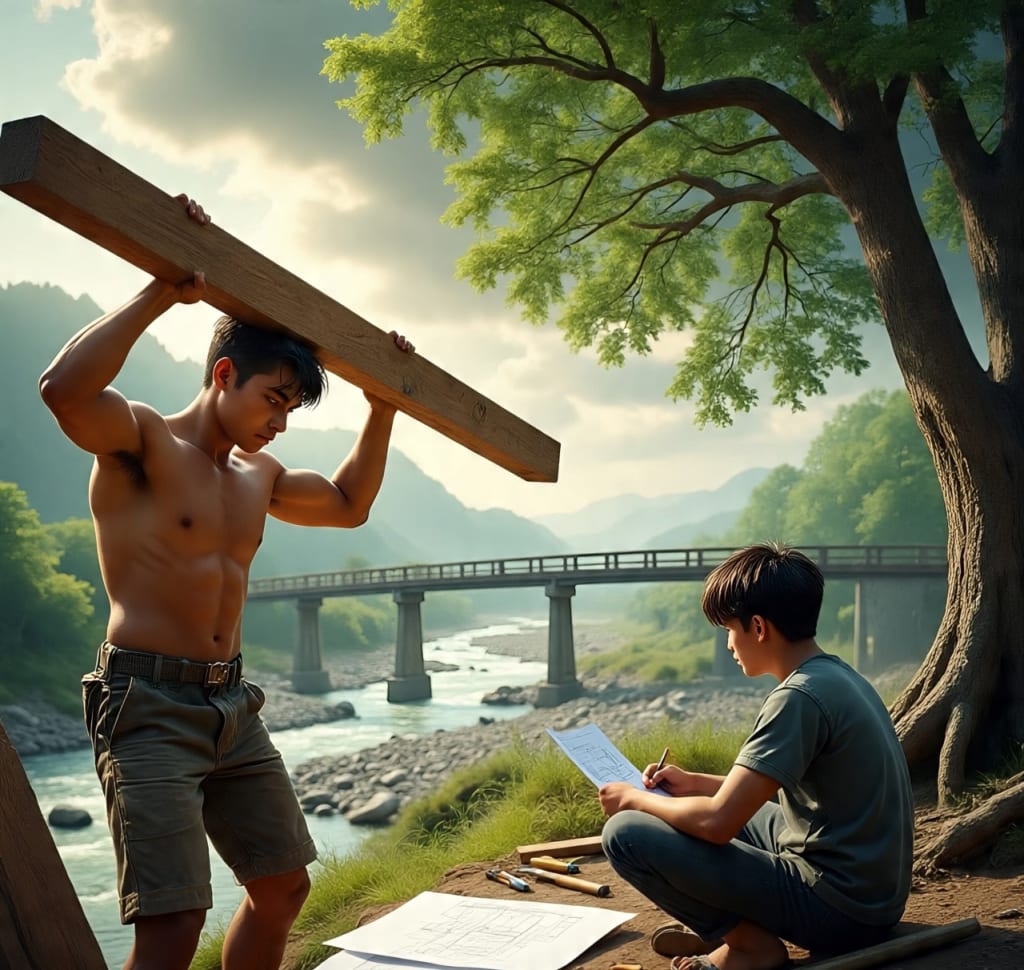
They said no one could cross the Mirwan River when it roared in the monsoon.
They said no boy from the village could ever build a bridge strong enough to stand against it.
But Rauf’s hands were blistered proof that some people don’t listen to “impossible.”
And Salman’s eyes, always scanning the horizon, were proof that hard work alone isn’t enough — you need a mind that dares to see a better way.
This is the story of how two friends, one with muscle and one with a map, turned sweat and strategy into a bridge that changed everything.
Lets start to the story
In a small village nestled between green hills and the gurgling Mirwan River, lived two friends — Rauf and Salman. They were born a week apart, studied in the same school, sat side by side in class, and even dreamed the same dream: to lift their village out of poverty by building a bridge over the Mirwan River.
The river was both a blessing and a curse. It watered their fields, fed their cattle, but during monsoons, it swelled with anger, cutting off the village from the nearby town. Children missed school, the sick waited days for doctors, and traders lost money when they couldn’t cross over with their goods.
One evening, as they sat by the riverbank, staring at the roaring current, Rauf clenched his fists. “We’ll build this bridge ourselves, Salman. No more waiting for promises that never come. No more excuses.”
Salman nodded, his eyes reflecting the moonlight and something more — a glint of curiosity. “Yes, but we’ll have to think this through, Rauf. It’s not enough to work hard. We must work smart.”
Rauf laughed. “Smart? What’s smarter than hard work? We’ll gather stones, logs, rope — the way our fathers built their barns. Sweat and muscle, that’s all we need.”
From the next day, Rauf was up before dawn, hammering logs, gathering stones from the riverbed, dragging them up the muddy bank one by one. The villagers watched in awe. He barely ate, barely slept. His hands blistered, his shoulders burned, but he kept at it like a man possessed.
Salman helped, but less often. Sometimes he sat under the old peepal tree, scribbling on scraps of paper. He’d visit the town library, talk to travelers, ask passing engineers about bridge designs. Rauf scoffed at him. “While you warm your back under the shade, I’m out here making progress.”
Weeks turned to months. The monsoon loomed. Rauf had built half the bridge — a shaky wooden path tied together with rope and hope. One night, a heavy storm arrived like a beast unleashed. The river rose overnight and swallowed Rauf’s half-finished bridge in a single roar. By dawn, it was gone — just splinters floating on the brown water.
Rauf sat on the bank, broken. His hands had worked themselves raw for nothing. Salman sat beside him, silent for a long while. Then he pulled out his notebook. “I found a way,” he said gently. “If you’ll listen.”
Rauf looked at him, too tired to argue. So Salman explained: he had learned about suspension bridges — light but strong, made with cables and steel instead of just wood and rope. He had spoken to a retired engineer in town, who agreed to help design it for free if they could gather the right materials and a small team.
Instead of hauling boulders alone, Salman suggested they reach out to the villagers, pitch in together, pool money to buy durable supplies, and learn basic techniques. They planned the design, mapped out every step, and when the rains subsided, they began again — not with brute force alone but with planning and teamwork.
This time, Rauf’s strength did not go to waste. He organized the workers, lifted the heaviest loads, set the foundation stones in place. Salman guided the design, made sure the cables were strong enough to hold the river’s fury, and taught the others how to anchor them into the rock.
Six months later, the villagers stood at the edge of the Mirwan River, watching the last plank being bolted down. The bridge swayed gently but stood firm. Old men wept. Mothers cheered. Children raced across it, laughing at how easy the river was to conquer now.
Rauf looked at Salman and put his arm around his friend’s shoulder. “I thought hard work was enough. But you were right — it needs a mind behind the muscle.”
Salman smiled. “And muscle behind the mind. Without your strength, the bridge would still be on paper.”
Years later, traders poured into the village. Children crossed daily to attend schools in town. A doctor opened a small clinic on the other side. And at the entrance of the bridge, the villagers put up a wooden sign that read:
“Built by Hard Work and Smart Work — Together.”
________________________________________
Moral:
Hard work lays the bricks. Smart work shows where to place them. When both walk together, they build bridges that last.
About the Creator
Keep reading
More stories from Habib and writers in Motivation and other communities.
The Year I Forgot My Voice, and Found It on the Page
The Year I Forgot My Voice, and Found It on the Page by Habib January 3 I sat at my desk for hours, pen in hand, eyes fixed on the blank page like it might blink first. It didn’t. Neither did I. Writing used to come as naturally as breathing. Now, it feels like I’m suffocating under the weight of everything I haven’t said.
By Habib7 months ago in Motivation
How to Manage Money When Income Is Irregular
Managing money is challenging for anyone, but it becomes especially difficult when your income is irregular. Freelancers, self-employed workers, gig workers, commission-based earners, creatives, and seasonal workers often face months of feast followed by months of famine. Without a fixed paycheck, traditional budgeting advice can feel unrealistic or even useless.
By Emma Adeabout 12 hours ago in Motivation




Comments (1)
Good story