
The Boy Who Built a Future Out of Garbage: The True Story of William Kamkwamba
His village was starving. His school was closed. He had no money, no tools, and no hope. All he had was a book, a bicycle dynamo, and a refusal to die in the dark

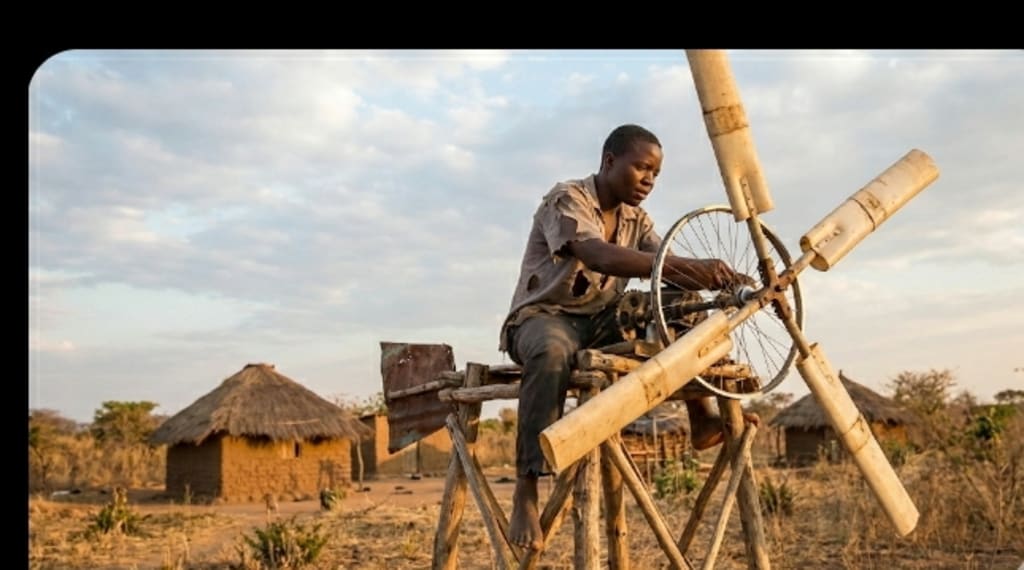
The incredible true story of William Kamkwamba, the 14-year-old Malawian boy who built a windmill from scrap metal to save his village from famine.
Introduction: The Sound of Starvation
Hunger has a sound. It is not a growling stomach. That is the sound of skipping lunch.
Real hunger is silent. It is the sound of a village that has stopped moving. It is the sound of children too weak to cry. It is the sound of fathers sitting in the dust, staring at a sky that refuses to rain.
In 2001, this was the sound of Wimbe, a small village in central Malawi.
A severe drought had struck the region. The maize crops—the lifeblood of the community—withered and died in the fields. The government grain reserves were empty. The price of food skyrocketed.
Families began to eat only one meal a day. Then, one meal every two days.
William Kamkwamba was 14 years old. He watched his father, a proud farmer, shrink. He watched his sisters grow thin. He watched his neighbors die of starvation.
He was supposed to be in secondary school. But his family couldn't afford the $80 annual fee. He was kicked out.
He was a dropout in a dying village. His future was written in the dust: He would become a subsistence farmer, just like his father, praying for rain that might never come.
But William refused to read the script.
This isn’t a story about a genius. This is a story about desperation, scavenged trash, and the kind of ingenuity that only comes when the alternative is death.
Part I: The Library of Last Resort
William didn't want to be a farmer. He wanted to be a scientist. But how do you become a scientist when you don't have electricity, a laboratory, or even a pencil?
You go to the only place that has answers.
The village library was a tiny room with three shelves of donated books. Most of them were outdated textbooks sent from America and Europe.
William couldn't read English very well. He had to use a dictionary to translate almost every word.
One day, he pulled a book off the shelf. It was an American textbook titled Using Energy. On the cover was a picture of a long row of wind turbines—massive, sleek, white towers generating power on a wind farm.
He didn't know what they were. He had never seen one.
He opened the book. He saw diagrams of magnets, coils of wire, and blades. He saw how wind could be turned into electricity. And how electricity could be used to pump water.
Water meant irrigation.
Irrigation meant crops could grow even without rain.
Crops meant food.
Food meant survival.
A switch flipped in his brain.
He didn't have a degree in engineering. He didn't have a mentor. He didn't have tools.
He looked at the picture. He looked at the diagrams. And he decided, with the terrifying confidence of a teenager with nothing to lose:
"I will build a windmill."
Part II: The Scavenger Scientist
Building a windmill requires materials. You need steel, copper wire, ball bearings, a generator, and strong blades.
William had none of these things.
So, he went to the only hardware store he could afford: the village scrapyard.
For months, while other boys were playing soccer or helping in the fields, William was digging through mountains of trash. He was looking for anything that could be repurposed.
* The Tower: He cut down blue gum trees from a nearby forest. The wood was tough and termite-resistant. He lashed the poles together with ropes made from old maize sacks.
* The Blades: He found a PVC pipe in the dump. He cut it lengthwise into four strips. Then, he heated the strips over a fire and bent them into the shape of propeller blades.
* The Generator: This was the hardest part. You can't build a generator from bamboo. He needed magnets and copper. He got lucky. He found an old bicycle dynamo—a small device used to power a bike headlight—on a broken bicycle. It was rusted, but it still spun.
* The Rotor: To connect the blades to the dynamo, he used an old tractor fan blade and a shock absorber from a car.
He didn't have a drill. To make holes in the plastic blades, he heated a nail over a fire and melted his way through.
He didn't have screws or bolts. He used rusted nuts and washers he found in the dirt.
He didn't have wire strippers. He used his teeth.
His hands were constantly cut, blistered, and bleeding. He smelled like rust and burning plastic.
The villagers watched him drag this junk back to his house. They watched him climb the wooden tower, hauling pieces of metal that looked like garbage.
They didn't understand.
They called him misala. Crazy.
They laughed at him. They said he was wasting his time. They said he should be helping his father in the fields, not playing with trash.
Even his mother was worried. She thought he had lost his mind from hunger.
William ignored them. He had a picture in his head, and he wasn't going to stop until the thing in his yard looked like the thing in the book.
Part III: The Flicker in the Dark
It took three months.
The windmill stood 16 feet tall. It was ugly. It looked like a scarecrow made of junk. The blades were uneven. The tower leaned slightly to the left.
It was the most beautiful thing William had ever seen.
On the day of the test, a crowd gathered. They came to watch the crazy boy fail. They came to laugh.
William climbed the tower. The wind was blowing. The blades began to turn—slowly at first, then faster.
Creak. Whir. Creak. Whir.
The tractor fan blade spun. It turned the bicycle dynamo.
Down on the ground, William held two wires in his hand. He had connected them to a small, blackened light bulb he had scavenged.
He touched the wires to the bulb.
Nothing happened.
The crowd started to chuckle.
He adjusted the wires. He scraped the rust off the contacts. He tried again.
And then, it happened.
A spark.
A flicker of orange light inside the bulb.
Then, a steady glow.
The laughter died in their throats. The crowd gasped.
For the first time in the history of Wimbe, a light bulb was glowing without a battery, without kerosene, and without the grid.
It was magic. It was science. It was survival.
One of the villagers, a man who had mocked him for months, shouted: "He has made electric wind!"
Part IV: The Ripple Effect
That single light bulb changed everything.
William didn't stop. He built a circuit breaker out of two nails and a magnet wrapped in copper wire. He wired his house. For the first time, his family could have light at night without burning expensive and smoky kerosene.
But light wasn't the goal. Food was.
William built a second, larger windmill. This one was powerful enough to run a water pump.
He dug a shallow well near his house. He connected the pump.
He turned it on.
Water—clear, cool, life-giving water—began to flow from the ground.
He dug irrigation channels to his father's fields.
While the rest of the village watched their crops die under the sun, William’s family was growing maize, beans, and tomatoes. They were harvesting two crops a year instead of one.
They had food. They had surplus to sell.
The boy who was kicked out of school for lack of $80 had just saved his family from starvation.
Part V: The World Discovers the Windmill Boy
News of the "electric wind" spread. People walked for miles to see the contraption made of garbage that produced light and water.
A local reporter wrote a story about him. That story was picked up by a blogger. That blog post was read by the organizers of the TED Global conference in Tanzania.
In 2007, William Kamkwamba—a 19-year-old who had never been on an airplane, never slept in a hotel, and had rarely left his village—stood on a stage in front of some of the smartest, richest, and most powerful people in the world.
He was nervous. His English was shaky. He showed them a picture of his windmill.
He told them his story in simple, halting sentences:
"I tried, and I made it."
The audience gave him a standing ovation. Investors wept.
They saw something in him that they had forgotten in their world of high finance and technology. They saw pure, unadulterated human ingenuity. They saw the refusal to accept fate.
Conclusion: The Definition of Impossible
Today, William Kamkwamba is an engineer. He graduated from Dartmouth College in the United States. He is an author, a speaker, and an advocate for renewable energy in Africa.
His story was turned into a bestselling book and a hit Netflix movie, The Boy Who Harnessed the Wind.
But the power of his story isn't in the fame or the movie deal.
The power is in the image of a 14-year-old boy in a famine-struck village, holding a piece of PVC pipe and a rusty bicycle part, deciding that he was going to change the rules of his reality.
He didn't wait for the government to build a power plant. He didn't wait for an NGO to dig a well. He didn't wait for permission.
He proved that the most powerful resource on earth isn't oil, or wind, or gold. It is the human mind when it is pushed to the brink of survival.
His story is a brutal mirror to the rest of us.
We have electricity. We have the internet. We have libraries full of books we can read without a dictionary. We have tools.
And yet, what do we build? What excuses do we make?
William Kamkwamba built a future out of garbage.
He proved that "impossible" is just a word used by people who are afraid to dig through the trash.
About the Creator
Frank Massey
Tech, AI, and social media writer with a passion for storytelling. I turn complex trends into engaging, relatable content. Exploring the future, one story at a time
Keep reading
More stories from Frank Massey and writers in Motivation and other communities.
DO YOU THINK LIFE HAS A PURPOSE OR WE CREATE OUR OWN?
There’s a question that trails us through life, shifting shape as we grow: Does life have a purpose, or do we create our own? It’s not a loud question. It doesn’t demand attention. It waits. It lingers in the background of our routines, resurfacing when we’re finally still enough to hear it.
By Pore Camara7 days ago in Motivation


Comments
There are no comments for this story
Be the first to respond and start the conversation.