
The Blind Guitarist Who Healed a Broken City: A Story of Unlikely Resilience
Motivational story

Date: February 27, 2010.
Time: 3:34 AM.
Location: Concepción, Chile.
The world did not just shake; it roared.
If you have ever experienced an earthquake, you know the feeling of the ground betraying you. But the 2010 earthquake in Chile was different. At a magnitude of 8.8, it was one of the most violent seismic events in recorded history. It released energy equivalent to thousands of atomic bombs. In the coastal city of Concepción, the earth churned like an ocean in a storm. High-rises buckled. Bridges snapped like dry twigs. The electricity grid failed instantly, plunging a terrifyingly loud world into absolute, suffocating darkness.
When the shaking finally stopped, a new horror began: the silence.
It wasn't a peaceful silence. It was the heavy, dust-choked silence of a city holding its breath, waiting to hear who was still alive.
In the days that followed, the news cameras arrived. They filmed the flattened neighborhoods, the looting, the desperate search for survivors, and the tearful reunions. They broadcast the statistics of the dead and the billions of dollars in damage.
But the cameras missed the most important story of all.
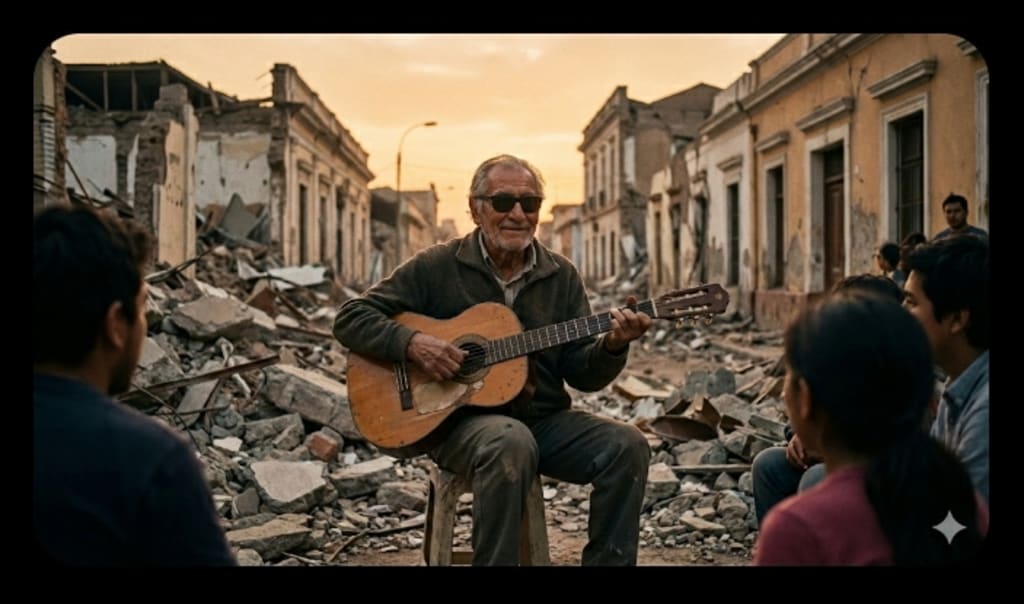
They missed the man who sat on a crate in the middle of a shattered plaza, holding a battered guitar, reminding a city how to breathe again.
The Man Who Saw Through the Dark
His name was Luis Morales, known affectionately to locals as "Lucho."
Lucho was not a hero in the traditional sense. He wasn't a firefighter pulling bodies from the wreckage, nor was he a doctor stitching up wounds in a field hospital. He was a street musician. He was also blind.
For Lucho, the earthquake was a different kind of trauma. He couldn't see the cracked pavement or the toppled statues. He experienced the apocalypse through sound and vibration. He felt the tectonic plates grinding beneath his feet. He heard the terrifying groan of concrete giving way and the collective scream of his neighbors.
Like thousands of others, Lucho lost his home. The modest walls that held his life together crumbled. He lost his possessions. He lost the familiarity of the street corners he had navigated by memory for years.
In the aftermath, Concepción was a place of sensory overload. The smell of gas leaks and pulverized drywall hung in the air. Sirens wailed incessantly. People were paralyzed by a cocktail of adrenaline and grief. The psychological toll was immense; survivors were wandering the streets, shell-shocked, unable to process the magnitude of their loss.
Logic dictates that a blind, homeless musician should focus on survival—finding food, finding water, finding shelter.
But Lucho felt a different kind of hunger around him. He sensed a spiritual starvation. He realized that while the rescue teams were tending to broken bones, no one was tending to broken spirits.
So, three days after the quake, Lucho did something illogical. He navigated his way through the debris-strewn streets to the Plaza de la Independencia. He found a spot where the rubble wasn't too high, sat down on an overturned crate, and took out his guitar.
And he began to play.
The Sound of Normalcy
The first chords rang out against the backdrop of sirens and shouting. It was a jarring juxtaposition. Why play music when the world has ended?
Lucho didn’t play funeral marches. He didn't play sad songs. He strummed the rhythmic, bouncing chords of Chilean folk music—Cueca and classic ballads that every Chilean knows by heart. He sang songs about the countryside, about love, about the simple endurance of the human spirit.
At first, people ignored him. They were too busy rushing to food distribution lines or digging through the remains of their houses. Some perhaps thought he was mad.
But then, a strange thing happened.
A woman, clutching a bag of salvaged clothes, stopped walking. She leaned against a fragment of a wall and closed her eyes. For two minutes, she wasn't a refugee in her own city; she was just a woman listening to a song she remembered from her childhood.
A group of children, terrified by the aftershocks that continued to rattle the city, wandered over. The music was a constant, a steady rhythm in a world that had become unpredictable. They sat at Lucho’s feet.
An old man, who had lost his business in the quake, stopped to listen.
Slowly, the circle grew.
The Psychology of Hope
We often underestimate the utility of art in a crisis. We view food, water, and medicine as the "essentials," and classify music, art, and storytelling as "luxuries."
Lucho proved that hierarchy wrong.
In the middle of a disaster zone, the nervous system remains stuck in "fight or flight" mode. Cortisol floods the body. Sleep is impossible. The mind loops in a cycle of trauma.
Lucho’s guitar acted as a circuit breaker.
Survivors later described the physical sensation of hearing him play.
"It was the first time my shoulders dropped," one woman said.
"I remembered that I was still alive," said another. "Not just surviving, but alive. capable of feeling beauty."
Because Lucho was blind, he couldn't see the destruction surrounding him. He couldn't see the fear in their eyes. When he sang, he sang with a smile, his face turned toward where he felt the warmth of the sun.
That smile was contagious. In a sea of gray dust and grim faces, Lucho was a beacon of defiant joy. He wasn't ignoring the tragedy; he was challenging it. He was asserting that the earthquake could take their houses, but it couldn't take their culture, their songs, or their community.
From Audience to Community
The gathering in the plaza became a daily ritual. It started at dawn.
People began to schedule their days around Lucho’s "concerts." But it wasn't just about the music anymore. The space around Lucho became a hub of information and mutual aid—a spontaneous community center born from a few guitar chords.
Because the music lowered everyone’s defenses, strangers began to talk to one another.
* "Do you know where the water truck is today?"
* "I have extra blankets, does anyone need one?"
* "My brother is missing, has anyone seen him?"
The music created a "safe container" where it was okay to cry, but also okay to laugh. Doctors and aid workers noticed the phenomenon. They started directing people to the plaza, not just for the music, but because they saw that patients who spent time there were calmer, more cooperative, and more resilient.
Lucho, the man who needed help navigating the streets, had become the anchor grounding the entire neighborhood.
The Turning Point: Building the Stage
Weeks passed. The initial shock wore off, replaced by the grueling, exhausting reality of reconstruction. This is the hardest phase of a disaster—when the adrenaline fades and the depression sets in.
The community decided they needed to do something for Lucho. He had given them a sense of normalcy; they wanted to give him a platform.
A group of volunteers—carpenters who had lost their workshops, students who had lost their classrooms—came together. Scavenging wood from collapsed buildings, using tarps and salvaged nails, they built a small, makeshift stage in the plaza.
It was rough. It was jagged. It was beautiful.
They strung up battery-powered lights. They invited Lucho to be the first performer on the "rebuilt" stage of Concepción.
That night, the crowd wasn't just a few passersby. Hundreds gathered. There were no amplifiers, no ticket sales, no VIP section. Just a blind man and his guitar, elevated on a platform made of the very debris that had tried to destroy them.
When Lucho played that night, the crowd didn't just listen. They sang.
Imagine hundreds of voices, cracking with emotion, singing in unison in a dark, ruined city. The sound echoed off the broken skeletons of the buildings. It was a declaration of victory.
The Ripple Effect of Resilience
Lucho’s actions sparked a chain reaction known in psychology as "The Ripple Effect."
When one person demonstrates resilience, it grants permission for others to do the same.
* Inspired by the gatherings in the plaza, other musicians began to come out of hiding. They brought violins, accordions, and charangos to different corners of the city.
* Neighborhoods began organizing "communal kitchens" near the music spots, sharing resources rather than hoarding them.
* The atmosphere of the city shifted from "every man for himself" to "we are in this together."
Lucho never asked for payment. He never asked for fame. When interviewed later, he brushed off the title of "hero." He simply said, "I played because I was afraid, and the music took the fear away. I thought maybe it would do the same for others."
Why This Story Matters Now
We live in a time of different kinds of earthquakes. We face global pandemics, economic instability, political polarization, and a loneliness epidemic that is shattering communities just as effectively as a magnitude 8.8 tremor.
We often feel helpless. We look at the "rubble" of our world—the bad news, the division, the insurmountable problems—and we think, "I am just one person. I have no power. I am not a leader. I have no money."
We wait for the "rescue teams." We wait for the government, the billionaires, or the experts to fix it.
Luis Morales teaches us that we are looking in the wrong direction.
Lucho had every excuse to do nothing. He was marginalized, disabled, homeless, and impoverished. By all metrics of society, he was the one who needed saving.
But he didn't wait to be saved. He reached for the one tool he had—a beat-up guitar—and he used it to serve others.
He teaches us that hope is not a noun; it is a verb. It is an action you take.
He teaches us that you don't need a budget to rebuild a community. You need presence. You need empathy. You need to be willing to sit in the rubble with your neighbors and hum a tune until they are strong enough to sing along.
The Universal Lesson
The rebuilding of Chile took years. But the rebuilding of the Chilean spirit began the moment Lucho struck his first chord.
There is a Japanese concept called Kintsugi, the art of repairing broken pottery with gold lacquer. The idea is that the break, and the repair, make the object more beautiful and valuable than it was before.
Lucho was the gold lacquer for Concepción.
His story poses a question to every single one of us reading this today:
What is your guitar?
* Maybe you can't play music.
* Maybe your "guitar" is baking bread for a sick neighbor.
* Maybe it’s listening to a friend who is grieving.
* Maybe it’s writing a letter, planting a garden, or simply showing up with a smile when everyone else is frowning.
In a world that feels like it is constantly shaking, we don't just need better infrastructure. We need more Luchos. We need people who refuse to let the darkness have the last word.
A Final Note on Legacy
Luis "Lucho" Morales did not become a rock star. He didn't tour the world. He eventually moved into a modest home provided by state reconstruction efforts.
But in the oral history of Concepción, he is a giant.
If you go there today, and you ask the older residents about the earthquake of 2010, they will tell you about the fear. They will tell you about the shaking ground.
But then, their eyes will soften. And they will tell you about the music.
They will tell you about the blind man who saw a future when everyone else saw only ruins.
They will tell you that while the earth broke, the song did not.
Key Takeaways for the Reader
* Resilience is Shared: You cannot heal in isolation. Community is the immune system of the soul.
* Start with What You Have: Lucho didn't wait for a stage. He started with a crate. Do what you can, with what you have, where you are.
* The Power of "Soft" Aid: Emotional support is just as vital as physical aid in times of crisis.
* Hope is Contagious: Your small act of courage can trigger a landslide of positivity in others.
About the Creator
Frank Massey
Tech, AI, and social media writer with a passion for storytelling. I turn complex trends into engaging, relatable content. Exploring the future, one story at a time
Keep reading
More stories from Frank Massey and writers in Motivation and other communities.
One Hard Thing
Stop me if you’ve heard this one before: You have the number, you know your schedule- you’ve even picked out the perfect day and time to make this appointment. Shoot, you’ve even picked out alternative days and times just in case their schedules can’t accommodate you!
By Taylor Rigsbya day ago in Motivation
The Largest Problem With Waiting Until You're Ready Does Not Work
I have talked to many people over the years about the goals they have... For their lives... For their careers... And there is one thing that I have heard more often than anything else.
By Dr. Cody Dakota Wooten, DFM, DHM, DAS (hc)3 days ago in Motivation



Comments
There are no comments for this story
Be the first to respond and start the conversation.