
The Billionaire Who Failed 5,127 Times: The Radical Persistence of James Dyson
Before the global empire, there was a man in a dusty shed, a mountain of debt, and thousands of rejections. Here is why true innovation demands a masterclass in failure

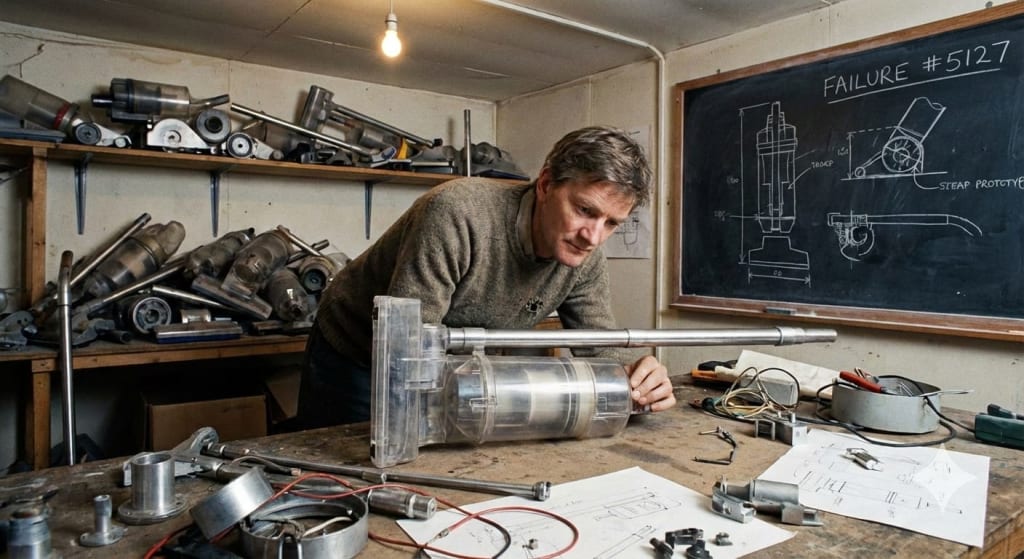
Look around your home, and there is a high probability you will spot a piece of technology that looks like it belongs on a spaceship. It might be a blade-less fan, a supersonic hair dryer, or a sleek, cordless vacuum cleaner humming with a futuristic whine.
Today, James Dyson is a household name. He is the billionaire inventor behind a global technology empire, a modern-day Edison whose products are synonymous with luxury, efficiency, and cutting-edge engineering. His net worth is measured in the billions, and his designs are studied in engineering schools around the world.
But success did not start with wealth, prestige, or a sudden flash of unchallenged genius.
It started with utter frustration, an empty bank account, and a level of stubborn persistence that bordered on absolute madness.
This is the story of a man who failed 5,127 times—and why his journey is the ultimate blueprint for mastering the psychology of success.
The Ordinary Problem Everyone Accepted
The year was 1978. James Dyson, a relatively unknown industrial designer who had previously invented a novel wheelbarrow called the "Ballbarrow," was renovating his home in the English countryside. Like any homeowner, he had chores to do. He bought what was then considered the gold standard of home cleaning: a top-of-the-line Hoover vacuum cleaner.
Almost immediately, Dyson noticed a glaring flaw. As he vacuumed the house, the machine would progressively lose suction. It would roar with power when the dust bag was empty, but within minutes of picking up dirt, its performance plummeted.
Curious, Dyson opened the machine and analyzed the mechanics. The problem was painfully obvious. As the vacuum sucked up dirt, the dust coated the porous fabric of the internal bag. This layer of dust choked the airflow. The motor was working just as hard, but the vacuum was suffocating on its own design.
For decades, the entire world had accepted this flaw. When a vacuum lost suction, consumers simply bought a new bag, threw out the old one, and moved on. It was a mild annoyance, a minor tax on modern living.
But Dyson asked a fundamentally different question: Why does this problem even exist?
He realized that vacuum cleaners didn’t actually need better bags. They needed to eliminate the bag entirely.
The Spark of Obsession
The leap from noticing a problem to inventing a solution rarely happens in a vacuum—pun intended. Inspiration often strikes when we connect two entirely unrelated concepts.
For Dyson, that connection happened at a local sawmill.
While visiting a timber yard, he observed a massive, 30-foot industrial cyclone tower. This towering piece of machinery was designed to extract sawdust from the air. It worked by spinning the air at incredible speeds, using centrifugal force to push the heavy sawdust particles outward and downward into a collection bin, allowing clean, filtered air to escape from the top.
Dyson stood there, staring at the industrial behemoth, and a radical thought crossed his mind. Could this exact same principle—cyclonic separation—be scaled down to fit inside a household appliance?
If he could spin the dirty air inside a vacuum fast enough, the centrifugal force would fling the dirt out of the airflow. No pores to clog. No bags to replace. Zero loss of suction.
It was a brilliantly simple idea.
It was also a nearly impossible execution.
The Era of 5,127 Failures
There is a romanticized version of innovation in our culture. We like to imagine that a brilliant inventor has a "Eureka!" moment, sketches a design on a napkin, builds a working prototype over the weekend, and wakes up a millionaire.
The reality of James Dyson’s life between 1979 and 1984 shatters that illusion.
Dyson retreated to his backyard coach house—a drafty, dusty shed—and began to work. He built his first prototype using cardboard and duct tape. He attached it to his Hoover, turning it on to see if the cyclonic theory held water. It worked, but barely. It was incredibly inefficient, fragile, and far from a consumer-ready product.
So, he built a second prototype. It failed.
He built a third. It failed.
He moved from cardboard to brass, spending hours cutting, welding, and shaping metal.
Prototype 50 was a failure.
Prototype 500 was a failure.
Prototype 1,000 was a failure.
Years began to slip by. The financial strain became crushing. Dyson had no steady income. His savings completely evaporated. To keep the project alive, he had to go to the bank and mortgage his house, placing his family's very shelter on the roulette wheel of his unproven idea.
Imagine the psychological toll. Try to comprehend the sheer mental fortitude required to walk into a freezing shed for the 3,402nd consecutive day, knowing that the previous 3,401 days had ended in failure.
At one point, the Dyson family was surviving almost entirely on the income of James’s wife, Deirdre, who taught art classes and sold illustrations to put food on the table. They grew their own vegetables to save money on groceries. Friends whispered behind his back, questioning his sanity. Investors refused to take his calls.
When you explain to people that your idea will change the world—after you have failed two thousand times—you do not look like a visionary. You look like a madman.
Most people quit after three rejections. Some resilient souls might make it to twenty.
Dyson made it to 5,127.
Finally, after five grueling years of solitary work, isolation, and mounting debt, he cracked the code. Prototype number 5,127 functioned flawlessly. It spun air at supersonic speeds, separating microscopic dust particles from the airflow without losing a single fraction of suction.
He had done it. He had built the world's first functioning bagless vacuum cleaner. He was ready to revolutionize the market and reap the rewards of his labor.
But the world wasn't ready for him. In fact, the world actively fought back.
The Cartel of Rejection
With a working prototype in hand, Dyson approached the biggest appliance manufacturers in the world. He expected them to be thrilled. He was handing them the most significant leap in cleaning technology in half a century.
Instead, he was met with a wall of hostility.
Company after company—including the major players in the UK and America—rejected his invention. But they didn't reject it because the machine didn't work. They rejected it because it worked too well.
At the time, the vacuum cleaner market was built on the "razor and blades" business model. Companies sold the vacuum cleaners at a relatively low margin, but they made a fortune selling the replacement dust bags. The replacement bag market was worth over $500 million annually.
Dyson’s invention didn’t just make their vacuums obsolete; it threatened to wipe out a half-billion-dollar recurring revenue stream overnight.
Executives laughed him out of boardrooms. One major manufacturer famously told him, "If there were a better vacuum, Hoover or Electrolux would have invented it."
He had survived 5,127 engineering failures, only to be entirely locked out of the market by corporate greed and industry protectionism. He had a world-changing product, zero buyers, and a mountain of debt.
A Glimmer in the East
Years passed. Dyson’s patent clocks were ticking, and he was running out of time and money to bring his product to the world.
If the West wouldn't take a chance on him, he decided to look to the East.
In the mid-1980s, Dyson traveled to Japan, a country undergoing a massive technological renaissance and highly receptive to radical new engineering. He pitched his bagless cyclonic vacuum to an obscure Japanese company called Apex Inc.
They were fascinated.
They licensed his technology and manufactured a vacuum called the "G-Force." It was bright pink, looked entirely alien, and was sold exclusively in Japan. It was not cheap—retailing for around $2,000—but the Japanese consumers, who valued high performance and status-symbol technology, loved it. The G-Force became a massive cult hit, eventually winning the 1991 International Design Fair prize in Japan.
For the first time in over a decade, James Dyson had a stream of revenue.
Building the Empire
Most people, after surviving a decade of poverty, rejection, and stress, would have taken the royalty checks from Japan, retired to a comfortable life, and called it a win.
But Dyson was not motivated solely by money; he was motivated by the desire to see his vision realized in his home country and beyond.
Using the licensing revenue from the Japanese G-Force, Dyson decided to stop begging established manufacturers to accept him. If the industry giants wouldn't build his machine, he would build his own factory, hire his own people, and destroy the industry giants himself.
In 1993, he opened a research center and factory in the Cotswolds, England. He spent months refining the design, making it cheaper to produce and more powerful than the G-Force.
The result was the Dyson DC01 (Dual Cyclone).
When he launched the DC01, he used the exact thing the industry hated about his machine as his primary marketing weapon. His television commercials featured a simple, devastating slogan: "Say goodbye to the bag."
The public response was explosive. Consumers were just as sick of buying vacuum bags as Dyson had been fifteen years earlier. The DC01 became a phenomenon. Within 18 months of its launch, the Dyson DC01 became the best-selling vacuum cleaner in the United Kingdom, entirely displacing the massive corporations that had laughed him out of their offices.
Today, Dyson Ltd is a multi-billion dollar technology juggernaut, employing thousands of engineers worldwide and continuously pushing the boundaries of what household appliances can do.
The Anatomy of Failure: The Real Lesson
When we read stories of massive success, it is incredibly easy to focus entirely on the outcome. We live in a highlight-reel culture that celebrates the billionaire status, the sleek products, and the global empire.
But James Dyson’s story is not a story about vacuum cleaners, and it is certainly not a story about overnight genius.
It is a masterclass in the reframing of failure.
In our modern society, the word "failure" carries a heavy, toxic stigma. We are taught from a young age that failing a test, failing a project, or failing in a business venture is a reflection of our inadequacy. Most people experience failure and immediately interpret it as a stop sign—a signal from the universe that they should pack up, go home, and try something safer.
Dyson treated failure entirely differently. He didn't see failure as an emotional defeat; he saw it as an acquisition of data.
Reflecting on his journey, Dyson once noted:
"Failure is interesting—it’s part of progress. You never learn from success, but you do learn from failure. When I created the dual cyclone vacuum, I started out with a simple idea, and by the end, it got more audacious and interesting. I got there through 5,127 failures."
Every single time a prototype exploded, leaked, or lost suction, Dyson did not view it as a personal flaw. He viewed it as the elimination of one more way not to build a vacuum cleaner. His 5,127 failures were not wasted time; they were the grueling, non-negotiable tuition fee he had to pay to achieve mastery.
The Price of Mastery
If you are currently building a business, writing a book, creating art, or trying to solve a problem in your life, you will inevitably hit the wall of failure. You will be rejected. You will feel foolish. People who care about you might gently suggest that you give up and choose a more realistic path.
When that happens, remember the man in the dusty shed in the English countryside.
Remember that true innovation often looks incredibly ugly, isolating, and stubborn long before it looks like genius. Success rarely belongs to the smartest person in the room, the one with the best pedigree, or the one with the most initial funding.
Success belongs to the person who is willing to stay uncomfortable longer than everyone else. It belongs to the individual who can look at their 100th, 500th, or 5,000th failure in the face, pick up the tools, and say, "Alright. Let's try again."
The world does not reward the people who never fail. It rewards the people who refuse to let failure be the final word.
About the Creator
Frank Massey
Tech, AI, and social media writer with a passion for storytelling. I turn complex trends into engaging, relatable content. Exploring the future, one story at a time
Keep reading
More stories from Frank Massey and writers in Motivation and other communities.
The Architecture of a Ghost: How Michael Oher Weaponized His Trauma
The raw, unfiltered true story of Michael Oher. Beyond the Hollywood movie, discover how a homeless teenager surviving the brutal streets of Memphis turned his deepest traumas into an NFL legacy.
By Frank Massey 2 days ago in Motivation
One Hard Thing
Stop me if you’ve heard this one before: You have the number, you know your schedule- you’ve even picked out the perfect day and time to make this appointment. Shoot, you’ve even picked out alternative days and times just in case their schedules can’t accommodate you!
By Taylor Rigsby29 days ago in Motivation




Comments
There are no comments for this story
Be the first to respond and start the conversation.