
The Archive of Forgotten Dreams
In a distant future, lost dreams are stored in a digital archive. One person gains access — and finds their childhood ambition waiting.

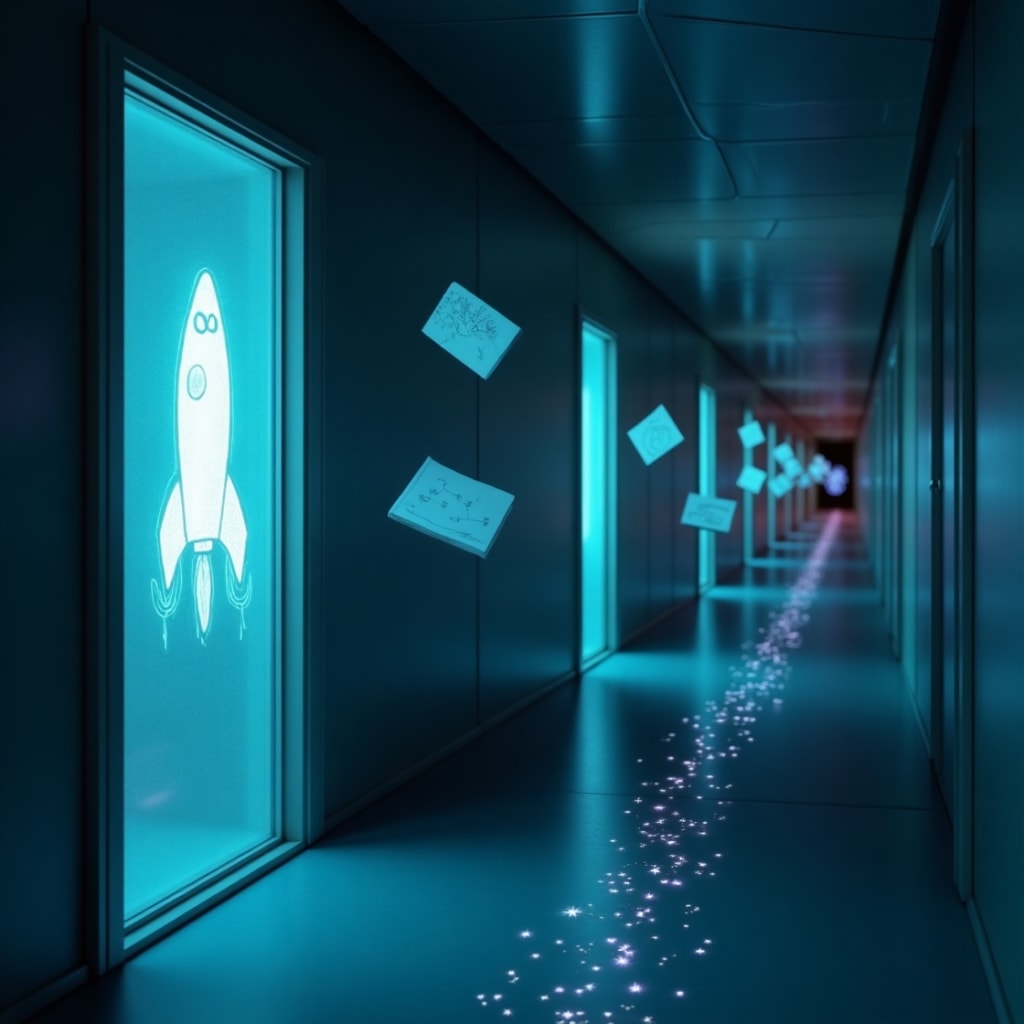
The Archive of Forgotten Dreams
The Archive wasn’t supposed to be accessible to ordinary people. It was hidden beneath layers of encryption, deep within the DreamNet — a digital subconscious that backed up humanity’s hopes, fears, and forgotten ambitions. It was said to be beautiful and dangerous, a graveyard of wishes people once held close and then, for reasons they no longer remembered, abandoned.
But Calla wasn’t ordinary.
She worked as a neuro-librarian at the Memory Institute, restoring fragments of erased memories for trauma patients. That’s where she stumbled upon it — a corrupted neural strand in a man who had no recollection of his wife, but clearly mourned someone he couldn’t name. While decoding his emotional imprint, she found a tag she didn’t recognize: DRM-A034.
Curiosity got the better of her.
After hours of decoding and bypassing layers of bio-encrypted firewalls, she landed in a new interface. The screen shimmered into a 3D landscape — a hallway of translucent doors, each pulsing faintly with a light of its own. No labels. No instructions.
She stepped inside.
Each room she entered felt like slipping into someone else’s soul. One was filled with paintings unfinished, their canvases still wet, but missing hands to complete them. Another, a stage with empty seats and a spotlight glowing over a mic that would never be used. These were not her dreams, but echoes of others who had once dared to imagine.
Until she found Room 3412.
It opened with a warmth she couldn’t describe — like a childhood blanket pulled from storage, still holding the scent of rain and wonder. Inside was a cluttered desk, a stack of notebooks filled with sketches of rockets, diagrams of stars, and stories written in crayon about alien princesses and space-time portals. A child’s voice echoed faintly in the air: “One day, I’ll fly.”
Calla’s breath caught in her throat.
It was hers.
Her hand trembled as she picked up one of the notebooks. Her name was scribbled across the front: Commander Calla Vega – Captain of the Celestial Voyager.
She had forgotten. Somewhere between bills and expectations, between college applications and her father’s heart attack, she had buried her dreams of becoming an astronaut. She’d traded stargazing for spreadsheets. Replaced moon maps with mortgage plans. Somewhere along the way, she convinced herself that dream had never really been hers.
But it had been.
And the Archive remembered.
She spent days — maybe weeks — returning to Room 3412. Each visit unlocked more. The scent of her fourth-grade science fair. The thrill of the first meteor shower she’d watched lying on the hood of her mother’s car. The way she once spoke about the stars as if they were family.
Calla didn’t just remember her dream. She felt it. Like it was breathing inside her again.
But with the awakening came something else: regret. Not the quiet, passive kind. This was sharp and pressing. Because now that she remembered, she could no longer pretend it didn’t matter.
She began to change.
She left her job at the Institute. Enrolled in night classes in aerospace theory. Her friends called it a midlife crisis. Her sister thought she was having a breakdown. But Calla didn’t care.
She had something rare — something most people didn’t realize they’d lost.
She had her dream back.
The Archive, as it turned out, was an accidental byproduct of a failed government project meant to track unconscious biases. It had evolved, as technology sometimes does, into something far more poetic — a collective library of the forgotten parts of ourselves.
Most people never visited.
They didn’t know it existed.
But Calla wondered — what if they did? What if the Archive was opened, not just for researchers and scholars, but for everyone who had ever given up on something too soon?
She proposed it to the Council of Ethical Tech.
They laughed.
But six months later, after a new election and a viral exposé on lost creativity, her proposal was accepted — and funded.
The Archive of Forgotten Dreams went public on September 1st, 2165.
On that day, over a million people logged in. A woman in Nairobi rediscovered her poetry. A retired factory worker in Detroit picked up his saxophone. A child in Buenos Aires found the confidence to draw again.
Calla stood outside the DreamNet headquarters, watching the stars flicker above.
She didn’t make it to space.
But she helped millions launch something far more powerful:
A second chance.
About the Creator
Kine Willimes
Dreamer of quiet truths and soft storms.
Writer of quiet truths, lost moments, and almosts.I explore love, memory, and the spaces in between. For anyone who’s ever wondered “what if” or carried a story they never told these words are for you
Keep reading
More stories from Kine Willimes and writers in Motivation and other communities.
How I Learned to Be Alone
How I Learned to Be Alone An essay about falling apart, and finding peace in the quiet I never planned to be alone. Like most people, I assumed life would unfold in a reliable, upward arc — friendships would linger, lovers would stay, family would always be within reach. But life, as it tends to do, had other plans. And somewhere between a breakup I didn’t see coming, a job I left out of necessity, and a city that no longer felt like home, I found myself alone in a way I hadn’t been since childhood.
By Kine Willimes6 months ago in Motivation




Comments
There are no comments for this story
Be the first to respond and start the conversation.