
Stitches of Fire
From a dusty tailor’s shop to a city skyline—one thread at a time

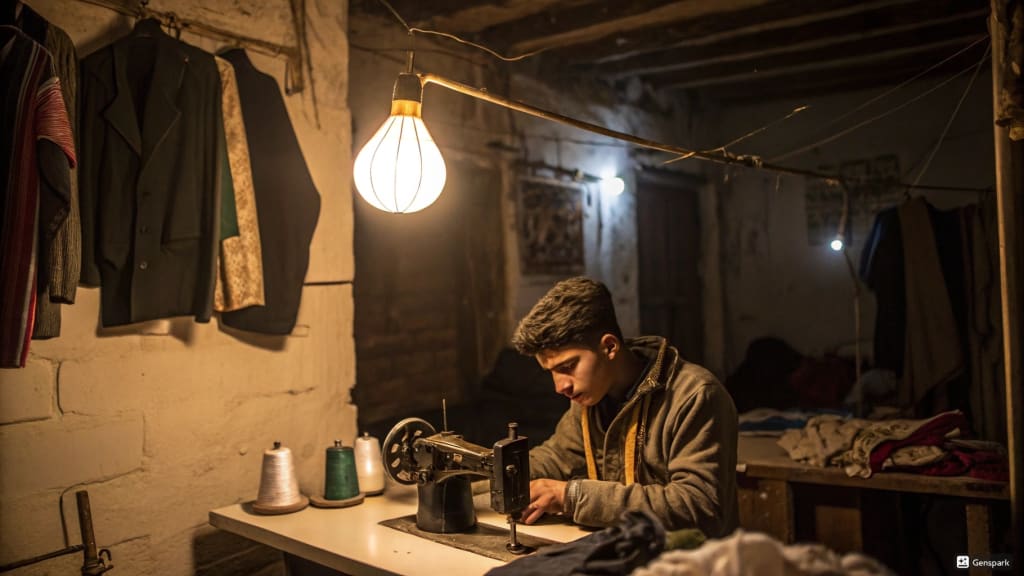
There was a time when Rafiq didn’t have enough money for a second cup of tea.
He lived in the narrow backstreets of Karachi, in a one-room house with his mother and two younger sisters. The roof leaked during monsoons, and rats chewed through their rice bags. But that wasn’t what bothered Rafiq most.
It was his father’s empty chair.
Once a tailor, his father had died of a heart attack when Rafiq was just 14. The old man left behind a broken sewing machine, a few rusted scissors, and a boy with calloused hands and too many responsibilities.
Rafiq quit school the next day.
He told no one. Just walked into his father's shop, opened the rusted shutter, and began sewing. It didn’t matter that he was clumsy or slow. People laughed. “This boy thinks he’s a darzi?” they mocked. His first shirt had uneven sleeves, the second bled dye in the rain.
But Rafiq didn’t stop.
He stitched.
Day after day, night after night.
He pricked his fingers so many times he stopped noticing the blood. He slept on the shop floor when it got late. And every rupee he earned, he handed to his mother without counting.
---
Years passed. Rafiq became better. Much better.
He started getting noticed. A local businessman liked the way his shalwar kameez fit and brought him ten more orders. Then came wedding season. Brides’ brothers, grooms’ cousins—they all came for last-minute fittings. Rafiq’s shop was full. His hands were fast now, precise. He began adding little touches—an extra button, a hidden pocket, a curve in the collar. Things no one asked for, but everyone noticed.
He named his shop “Thread & Honor.”
And still, he saved. Not to buy gold or a motorcycle. But to build something more permanent than luck.
---
When Rafiq turned 23, he rented a bigger space.
At 25, he opened a second branch.
By 28, he had a small team and a dream: his own brand.
One night, sitting on the shop roof under the city’s tired stars, his friend asked, “What’s the point, Rafiq? You're doing fine. Why push more?”
Rafiq looked down at his scarred fingers, then at the lit window of his mother’s room.
“Because I know what hunger sounds like,” he said. “It’s not just the stomach. It’s in the silence of a mother who pretends she’s already eaten.”
---
His breakthrough came by accident.
A popular TV actor came in for a last-minute outfit. The stylist bailed, the designer canceled, and someone whispered, “There’s a guy in Liaquatabad who can fix anything.”
Rafiq didn’t blink. He sewed for 14 hours straight.
The actor wore his outfit at a major award show.
Photos went viral.
By morning, Thread & Honor had over 20,000 new followers on Instagram. Orders poured in from Islamabad, Dubai, even London.
---
Success arrived. Not as a shout, but as a quiet knock.
Rafiq bought a proper house for his mother. He sent his sisters to college. He hired the same boy who once laughed at him to manage deliveries. He drove a modest Corolla, not because he couldn’t afford more—but because he remembered walking to work with holes in his sandals.
---
But money doesn’t silence memory.
One night, at a high-end fashion show in Lahore, Rafiq sat among celebrities, journalists, designers. Everyone clapped as his models walked the ramp in embroidered sherwanis and silk jackets. Flashbulbs popped. Applause echoed.
But all Rafiq could think of… was his father’s old, broken sewing machine back home.
He hadn’t touched it in years. It sat in the corner of their old house, gathering dust like a forgotten ghost.
After the show, he went back. Drove in silence. Parked. Walked inside. It was 2:00 a.m. The street was quiet. The shutters of “Thread & Honor” were pulled down.
He unlocked the old house. Entered the tiny room.
There it was.
The rusted sewing machine.
Still there. Still waiting.
He sat on the stool his father once used and whispered, “I made it, Abba.”
---
Tears came.
Not loud. Not dramatic.
Just soft drops—like rain on cloth.
---
Rafiq’s story is not a fairy tale.
There was no lottery. No rich uncle. No shortcut.
There were only stitches. Thousands of them.
And every one burned.
But he kept going.
Not because he was fearless—
But because he was terrified of going back.
---
Moral:
You don’t rise by chasing wealth. You rise by carrying purpose.
And sometimes, the loudest success… comes from the quietest struggle
About the Creator
Keep reading
More stories from Abdulrehma and writers in Motivation and other communities.
Into the Wild Night
In a small, quiet town on the edge of a vast forest lived a man named Dr. Rizwan Kaleem. He was not a regular man. A zoologist by profession and a seeker of secrets by passion, Dr. Rizwan was fascinated by wild animals—especially those that behaved unusually. His house was filled with books, bones, feathers, and jars of strange specimens. But his most important work was not done in labs or offices. It happened in the forest. At night.
By Abdulrehma 8 months ago in Motivation




Comments
There are no comments for this story
Be the first to respond and start the conversation.