
Simulated Success Era
From achievement badges in apps to fabricated lifestyles online, modern life is turning into a game we think we're winning—but are we really?

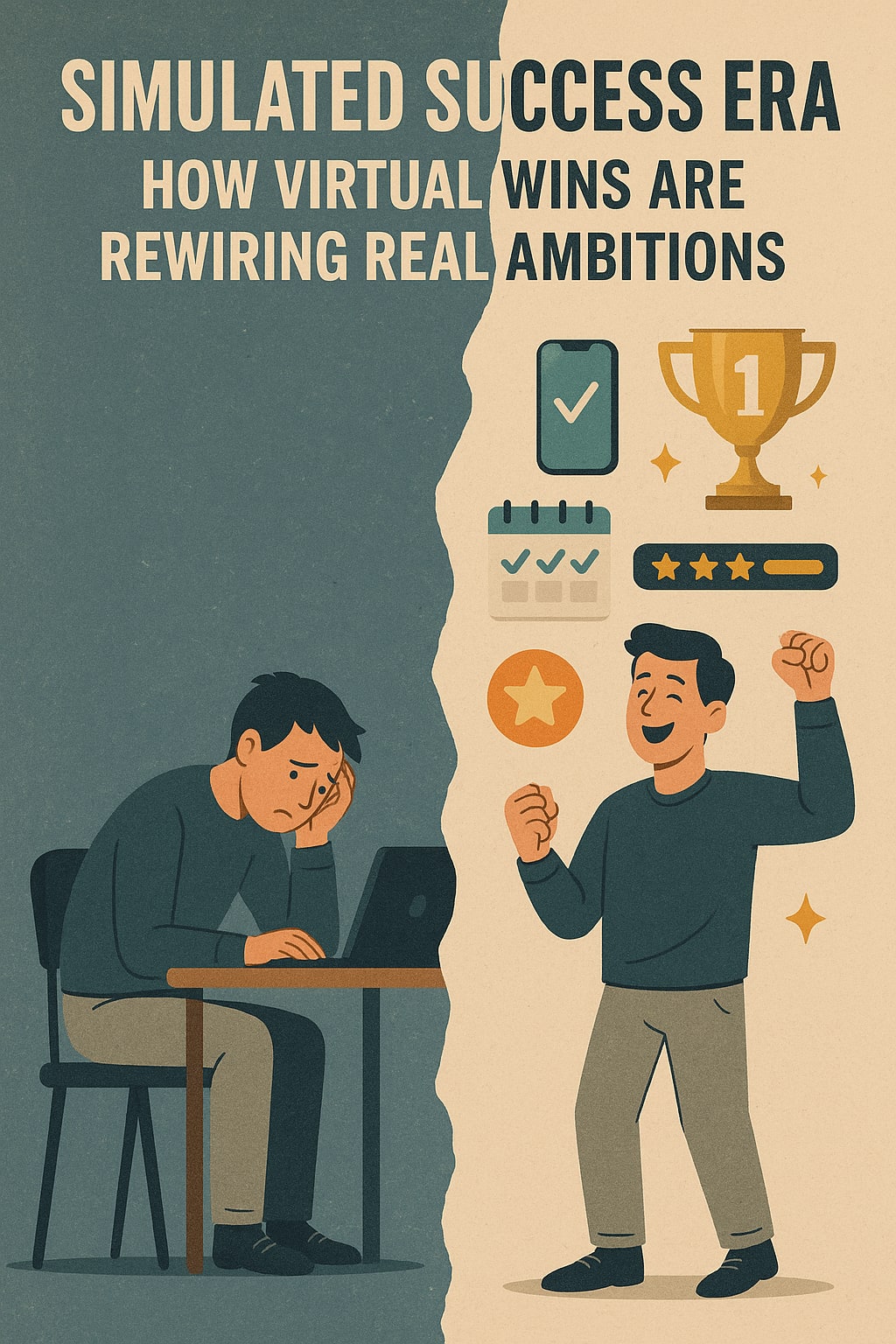
The Illusion of Achievement
You woke up early today. Your smartwatch congratulated you. You closed all your rings by lunchtime. Duolingo sent you a push notification praising your 50-day streak. LinkedIn reminded you that today marks another “work anniversary.” Your last Instagram story has 134 likes, and your budgeting app says you're “on track.”
But something feels off. Beneath all the metrics and feedback, a quiet thought hums: Have I really accomplished anything meaningful today?
Welcome to the Simulated Success Era—a world where our tools and platforms are expertly designed to give us the feeling of success, even if we’re not actually moving forward in any substantive way. In this era, progress is often represented as a pixel-perfect interface, a number, a badge, or an aesthetic—frequently divorced from reality.
It’s not that these things are fake. It’s that they risk becoming substitutes for the messy, slow, and deeply human experience of true achievement.
Digital Dopamine and the Illusion of Progress
Modern interfaces are engineered for engagement. But in doing so, they also simulate success—rewarding not just what we achieve, but how often we return. This is by design.
Duolingo celebrates language learners with streaks and XP points, but you could complete an entire year without ever having a real conversation in Spanish. Productivity apps like Notion or Habitica make you feel “organized” and “disciplined” through clean dashboards and gamified habit tracking—even if you haven’t truly grown or created anything of depth.
These tools satisfy a psychological craving: the need for visible progress. And when life feels uncertain or difficult, they offer a reliable source of affirmation. You may not know if your career path is solid, but hey—at least your morning routine has a 12-day streak.
But there’s a hidden cost.
We begin to confuse representation with reality.
The Performance of Success
In the Simulated Success Era, performance is everything. And nowhere is this clearer than on social media.
The ability to look successful has never been easier to manufacture. With the right presets and angles, a tiny desk in a noisy café becomes a curated “writing retreat.” A few keywords on a LinkedIn bio turn you into a thought leader. A TikTok clip of you “grinding” at 5 AM earns comments praising your discipline—even if your entire day is spent watching Netflix afterward.
These performances are not inherently dishonest. In fact, they often stem from aspiration. But when we spend more time crafting the image than cultivating the substance, we create a dangerous feedback loop. Validation comes from appearing productive, not being productive. From looking inspired, not feeling it.
The result? A world full of people burning out from maintaining identities they haven't fully lived into.
The Gamification of Identity
We’ve gamified almost every aspect of life.
Fitness? Try Apple Fitness+, Strava, Fitbit badges.
Learning? Use Khan Academy streaks, Quizlet levels, or Duolingo’s leaderboard.
Productivity? Earn rewards on Forest for not using your phone.
Money? Apps like Step or Cleo send motivational GIFs every time you save $10.
The irony? The very thing we’re trying to improve—health, knowledge, focus, financial discipline—is often overshadowed by the interface.
This creates a new type of identity: someone who identifies with the aesthetics of growth, not necessarily the experience of it. You are a runner because Strava says you are. You are fluent because your Duolingo tree is complete. You are a minimalist because your Notion workspace looks clean.
When identity is outsourced to digital affirmations, it becomes fragile. If the app disappears, does the identity remain?
Why Real Success Is Often Invisible
Let’s contrast this with real progress.
Real success is slow. Quiet. Frequently ugly. It doesn’t give you a badge every day.
Writing a novel is boring most days. Learning a language demands humility, confusion, and awkward conversations. Getting physically stronger often means pushing through weeks where nothing changes visibly. Real healing—emotional, psychological, spiritual—doesn’t come with daily graphs or charts.
The Simulated Success Era often fails to reward these kinds of efforts. That’s why it’s so tempting to stick to the interface. To keep checking boxes. To optimize. To brand yourself. To track more than you live.
But real growth resists optimization. It’s human. Messy. And beautifully unpredictable.
The Psychological Toll
Simulated success isn’t just distracting—it can be damaging.
When we feel like we’re trying (because the apps say so), but see no real-world change, it leads to frustration, confusion, and eventually burnout. This is the paradox of pseudo-efficacy: the brain thinks it’s making progress, but the life remains unchanged.
This phenomenon is especially common in:
Career growth: People spend hours refining their LinkedIn, yet never upskill or apply for jobs.
Fitness: People follow workout accounts religiously without leaving their sofa.
Learning: People collect certificates but can’t apply the knowledge in conversation or practice.
The result? An exhausted generation that feels behind—despite being busier, more connected, and more productive-looking than ever before.
Rebuilding Ambition in the Age of Simulation
So how do we escape?
We don’t need to abandon our tools. But we do need to change our relationship with them.
1. Audit Your Metrics
Ask: “What am I measuring, and why?” If your progress is only visible on a screen, it's time to reassess. Track things that matter—like how you feel after a workout, or how much of a language you can speak, not just how many days you’ve “shown up.”
2. Value Depth Over Display
Instead of sharing every highlight online, focus on going deeper. Don’t write for likes. Write because you must. Don’t meditate to hit a streak. Meditate to understand your mind.
3. Detach Identity from Interfaces
You are not your streak. You are not your metrics. Let identity grow in the dark, not under the spotlight.
4. Embrace Invisible Wins
Read a book and don’t post about it. Have a great idea and sit with it before sharing. Some of your most powerful moments won’t be shared—and that’s okay.
The Hybrid Future: Simulation as a Starting Point
Let’s not throw the baby out with the app store.
Simulated success can spark real success—when used intentionally. A meditation app can start a lifelong habit. A Duolingo streak can build language confidence. A fitness tracker can save a life. The simulation is not the enemy. Mistaking it for reality is.
In the future, the most fulfilled people may be those who can integrate both worlds: using the tools for momentum, but not mistaking them for meaning.
Because ultimately, a meaningful life can’t be measured in likes, streaks, or badges.
It can only be felt—in quiet progress, real effort, deep connection, and the growth no app can fully capture.
About the Creator
Ahmet Kıvanç Demirkıran
As a technology and innovation enthusiast, I aim to bring fresh perspectives to my readers, drawing from my experience.
Keep reading
More stories from Ahmet Kıvanç Demirkıran and writers in Motivation and other communities.
The Age of Simulated Success: Why We Chase Validation in a World Built on Illusions
In a quiet corner of the internet, a young woman posts a photo of her new car. “Dreams come true,” the caption reads. A cascade of likes and heart emojis flood in. What’s not shown: the crippling debt, the anxiety-ridden nights, the trade-offs she’s made in private. Still, the image tells a complete story—one that feels real, aspirational, and successful.
By Ahmet Kıvanç Demirkıran9 months ago in Motivation
How to Manage Money When Income Is Irregular
Managing money is challenging for anyone, but it becomes especially difficult when your income is irregular. Freelancers, self-employed workers, gig workers, commission-based earners, creatives, and seasonal workers often face months of feast followed by months of famine. Without a fixed paycheck, traditional budgeting advice can feel unrealistic or even useless.
By Emma Adea day ago in Motivation



Comments (2)
Lovely ♦️♦️♦️♦️
Very interesting story and well written.