


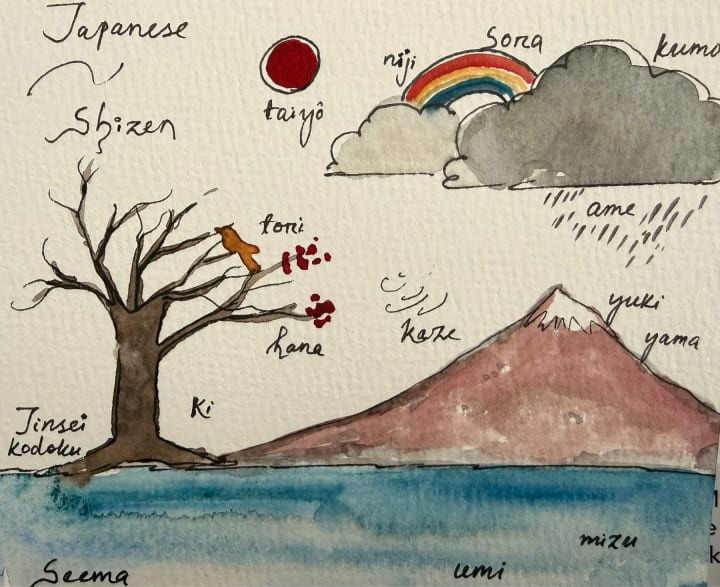
I love language learning and art. So, I decided to work on Japanese words while painting. That made it even more fun. Here you see paintings with different elements and their names in Japanese.
Sun is taiyō. Sky is sora. Cloud is kumo. Rain is ame and rainbow is niji.Ocean is umi and water is mizu. Mountain is yama and snow is yuki.
Tree is ki, bird is tori, flower is hana, wind is kaze. Nature is shizen and life is jinsei. Solitude is kodoku.
Let’s learn a few more. House is ie. Garden is niwa. Temple is tera. Hill is oka. Forest is mori. Bridge is hashi. Fish is sakana. Lotus is hasu. Pond is ike. Peace is heiwa.

Today, I was watching a funny Instagram reel where two men joked about how so many Japanese surnames include the word rice field. It was hilarious! I enjoyed it, shared with my family, and now I’m sharing it with you.
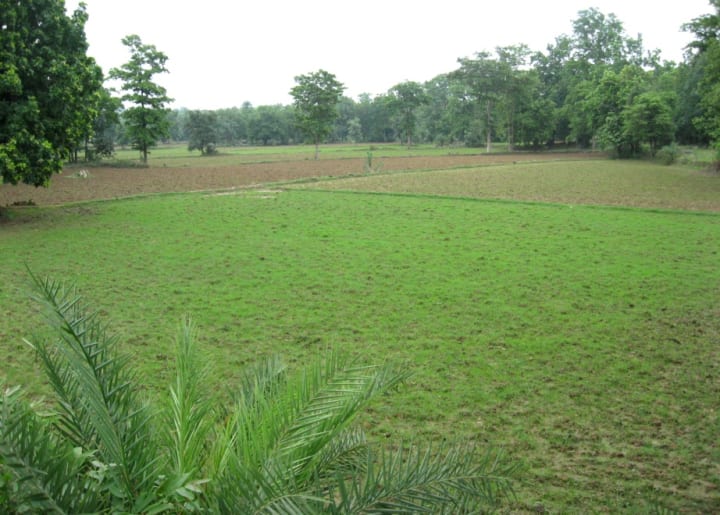
Many Japanese surnames are tied to rice fields, reflecting the agrarian roots of Japanese society. Here are some examples of surnames that are related to rice fields or rice plants.
Tanaka: central rice field (there is a popular farm near my house, in Irvine). Yamada: mountain rice field. Kawada: river rice field. Inada: rice plant field. Honda: original rice field (see the origin of this famous company!). Ueda: upper rice field. Shimada: island rice field. Okuda: inner rice field. Takeda: warrior’s rice field (a big pharmaceutical company). Ina/ Yone, meaning rice. There are also surnames related to rice plants.
Inagaki: rice plant fence; Inamura: rice plant village; Inaba: rice plant leaf; Inoue: above the rice plant; Yoneda: rice rice field; Yonekura: rice warehouse; Yonehara: rice field; plain; Yonebayashi: rice forest; Inehara: rice plant plain.
Let's learn some animal names in Japanese.
At the zoo, we saw a tora (tiger), raion (lion), kuma (bear), zo (elephant), and kirin (giraffe). Ōkami (wolves) live in the jungle.
Saru (monkeys) were our ancestors. Gorira (gorillas) are very similar to us, genetically.
Kyōryū (dinosaurs) are long extinct.
Our backyard barn had ushi (cow) and yagi (goat). We also had niwatori (chickens).
In the USA, inu (dogs) and neko (cats) are very popular pets.
Hebi (snakes) are dangerous — their poison can kill. But ka (mosquitoes) can kill even more people. I have lost relatives to dengue.
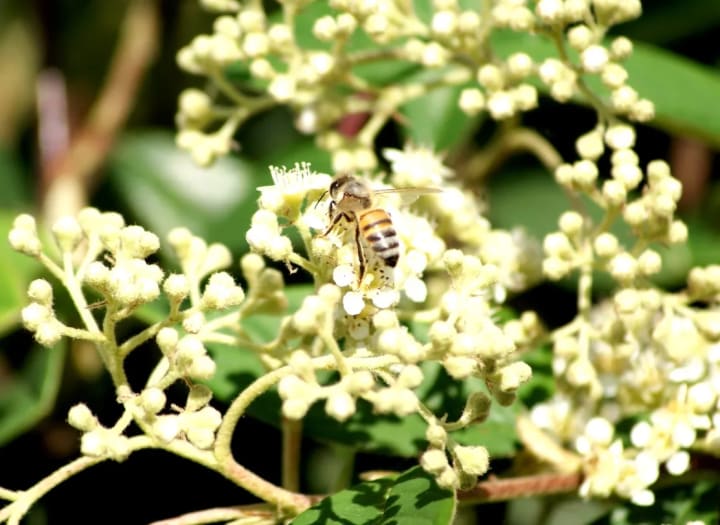
Mitsubachi (honeybees) are very helpful creatures.
We love watching chō (butterflies) flutter. The pond has a variety of sakana (fish).
Pine is matsu, which is also the root of matsutake, a prized edible mushroom. Maple leaves are momiji, and the beautiful act of “autumn leaf hunting” in Japan is called momijigari.
Journey is angya. The land of the dead is meido. The Pure Land (Western Paradise) is Jōdo. The floating world is ukiyo. I learned these terms while reading a Japanese book titled Death Poems.
Festival is matsuri. As a child, I had heard of Hinamatsuri, also known as Doll’s Day — celebrated in March to honor girls and wish for their happiness and health.
That’s a Japanese Garden in Washington State.

Here, I enjoyed tsubaki (camellia), tsutsuji (azalea), fuji (wisteria) shobu (iris), and kiku (chrysanthemum) in the garden. There were ishi (stone), ishidoro (stone lantern), and other toro (lanterns).
Japanese gardens are wonderful places to sit and reflect on philosophies like below:
wabi-sabi (finding beauty in the impermanent and imperfect)
yugen (subtle grace and mysterious depth)
ma (mindful use of space and silence)
shizen (going with nature rather than against it)
kanso (simplicity that still holds meaning)
mono no aware (the gentle sadness or beauty in transience)
chowa (harmony and balance)
shibui (quiet, refined elegance)
gaman (endurance and patience)
kaizen (continuous, gentle improvement)
seijaku (stillness and tranquility)
fudoshin (calmness in chaos)
mushin (state of flow, free from resistance)
I hope, you enjoyed the story. Japanese is truly a graceful and poetic language.
About the Creator
Seema Patel
Hi, I am Seema. I have been writing on the internet for 15 years. I have contributed to PubMed, Blogger, Medium, LinkedIn, Substack, and Amazon KDP.
I write about nature, health, parenting, creativity, gardening, and psychology.
Keep reading
More stories from Seema Patel and writers in Motivation and other communities.
3 Ways To Know Whether You Are Succeeding in Life.
What do we mean by success? It can mean different things to different people. For some it is material wealth - cars, houses, x amount of money in the bank. For others it is peace of mind, a loving family or freedom (whatever that means to them).
By Ugonma E5 days ago in Motivation
The steps to losing a child
Step One: Lose a child. Not what anyone wants to happen and nothing you can do to change it, but you can go through steps to becoming happy again. You can go through steps to loving again. You can go through steps to become a new you because after losing a child you will never be the same person you once were.
By Tabitha Hinkley5 days ago in Fiction


Comments (3)
What a great Japanese lesson and really liked your paintings. Would make a great language lesson for the primary grades.
My nephew studied to be a teacher and went to Japan. Then found a new love in uk on a trip home and ended it all 😢♦️♦️♦️
I only knew a few of the words you've listed here, so I learned a lot of new ones. Thank youuuu!