
Khushal Khan Khattak: The Lion of the Mountains – A Warrior's Pen, A Patriot's Heart
How a Fearless Poet-Warrior United His People with Words Sharper Than Swords
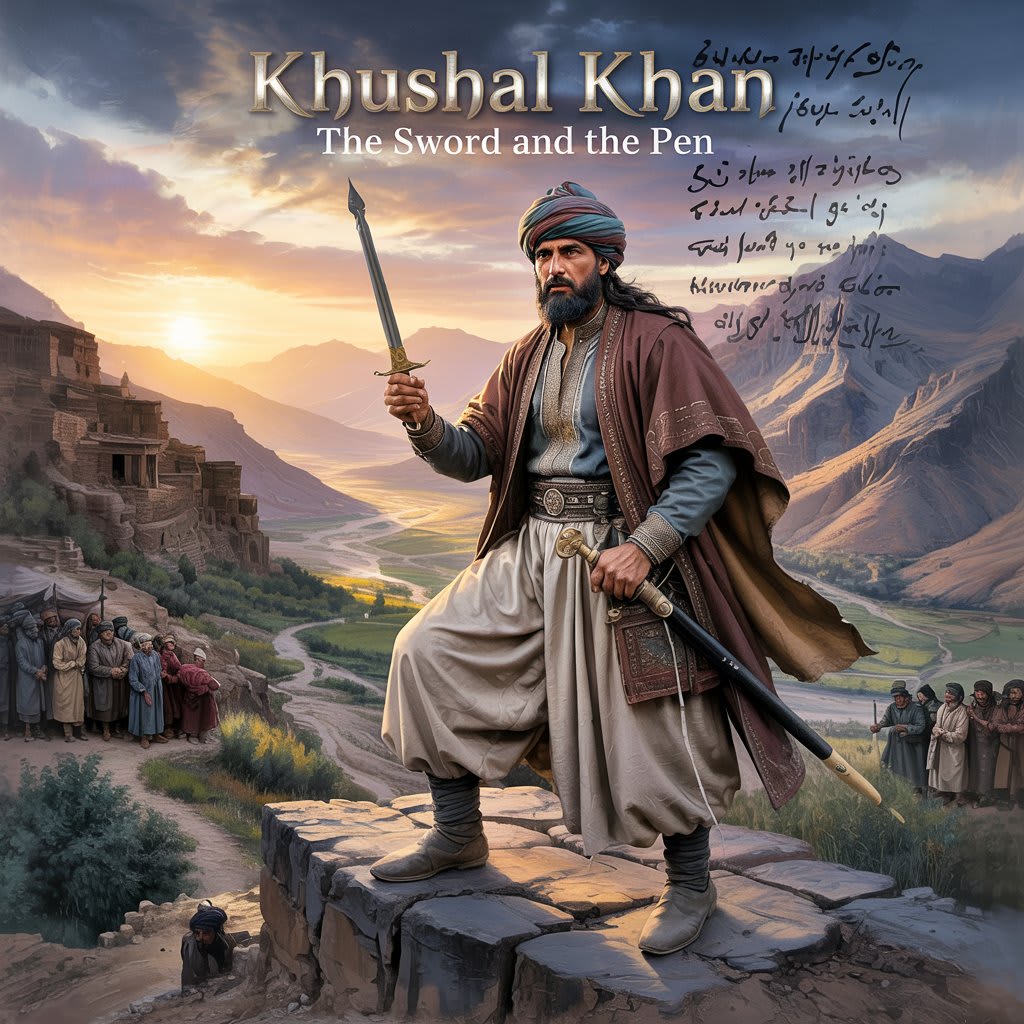
Khushal Khan Khattak: The Lion of the Mountains
In the heart of the rugged mountains of what is now Khyber Pakhtunkhwa, Pakistan, during the 17th century, a child was born into the powerful Khattak tribe. This child was named Khushal Khan Khattak, a name that would one day echo across centuries, not just as a warrior, but as a poet, a leader, and a symbol of resistance and Pashtun pride.
Khushal Khan was born in 1613 into a tribal aristocracy, where honor, courage, and loyalty were more valuable than life itself. His father, Shahbaz Khan, was the chief of the Khattak tribe and served the Mughal Empire loyally. Young Khushal grew up with swordsmanship, horsemanship, and a sharp wit honed by poetic traditions. But what set him apart was not only his strength in battle—but his strength in thought.
From a young age, Khushal had an inquisitive mind. He would sit for hours with tribal elders, absorbing the stories of past warriors, tales of glory and betrayal, and the lessons hidden within ancient Pashto poetry. His heart was both the battlefield and the book, the sword and the pen. This balance of intellect and valor would define his journey.
Rise to Leadership
At the age of 28, after the death of his father, Khushal was appointed by Mughal Emperor Shah Jahan as the chief of the Khattaks and the Mansabdar (military commander). For years, he led his tribe with discipline and honor, earning respect among the Mughal elite. He fought bravely in their campaigns and remained a loyal commander—until betrayal met loyalty with cruelty.
When Aurangzeb ascended the throne, the political dynamics of the empire shifted. Unlike Shah Jahan, Aurangzeb saw powerful tribal leaders as threats rather than allies. On suspicion of rebellion, without a trial or justification, Khushal Khan was arrested and imprisoned in the fortress of Gwalior. He spent several years in solitary confinement, far from the mountains he called home.
Yet it was in prison that his soul truly awakened. The cage that was meant to break him only sharpened his resolve. Denied the sword, he picked up the pen. Deprived of the battlefield, he turned his words into weapons. During this period, Khushal Khan began writing passionate poetry—verse that condemned tyranny, inspired unity, and carried the fire of freedom.
The Rebellion Begins
Upon his release, Khushal Khan was no longer the same loyal commander of the empire. He had seen through the empire's injustice and resolved to liberate his people from Mughal control. He returned to his homeland not as a servant of the crown but as a freedom fighter.
He began rallying Pashtun tribes—not with bribes or power—but with poetry that stirred the blood of even the coldest warrior. His verses were like thunder rolling across the hills:
> “Che da khpal waak tol afghan yee,
Da Har cha pa khidmat khandaan yee?”
(If you're the ruler of your own, O Afghan,
Why do you smile in the service of others?)
He called for unity among the fiercely independent Pashtun tribes—traditionally divided by rivalries, blood feuds, and pride. He believed the real strength of the Pashtuns lay not in their tribal divisions, but in their united spirit.
Khushal did not just preach resistance. He fought. He led raids, defended villages, and inspired thousands to take up arms against oppression. He was wounded, betrayed by his own kin at times, and yet he never lost sight of his mission.
The Poet-Warrior’s Legacy
Khushal Khan Khattak wrote over 45,000 verses in Pashto, Persian, and Arabic. His poetry covered war, love, honor, unity, education, leadership, and philosophy. He became not only the father of Pashto literature, but a mirror to his people’s soul.
He believed deeply in the importance of education and knowledge. In one of his famous couplets, he says:
> “Da pen pa shaan me warza dey da aslaah pa shaan,
Har kala che war zma nawee rang wakhlee.”
(My pen is like a weapon,
Every time it moves, it brings a new force.)
Khushal dreamed of a Pashtun society where justice reigned, where leaders were not tyrants but servants of their people, where poetry and sword worked side by side. He was ahead of his time—a man who understood the power of culture in shaping resistance.
A Life of Sacrifice
Towards the end of his life, Khushal Khan faced heartbreak. His own sons and relatives, tempted by Mughal bribes, turned against him. He was exiled from his tribe. But even in isolation, he remained steadfast in his belief and continued writing. His heart was broken, but his spirit remained unshaken.
He died in 1689 at the age of 76, not as a ruler, not as a commander, but as a legend.
Why His Story Still Matters
Khushal Khan Khattak’s story is not just about tribal pride or historical poetry. It's about a man who stood for truth when it was dangerous, who chose justice over comfort, and who believed that words can shake empires.
He taught that unity among the oppressed is stronger than the weapons of the tyrant. He showed that a poet can lead armies, that a leader must educate, and that real honor lies in serving one’s people, not one's position.
In today’s world, where leaders often fail and divisions grow, Khushal Khan’s message is more relevant than ever:
Stand for truth, even if you stand alone.
Unite your people, even if it costs you your peace.
Speak with power, even if all you have is a pen.
He was a warrior, a poet, a philosopher, and a patriot. But more than anything, he was a lion—not just of the mountains, but of the soul.
About the Creator
Keep reading
More stories from Sajjad Khan and writers in Motivation and other communities.
Elon Musk: From Dreamer to Disruptor – The Man Who Reached for Mars
In a quiet corner of Pretoria, South Africa, a curious boy named Elon Musk immersed himself in books and imagination. While most kids his age played outdoors, Elon spent his time reading science fiction, encyclopedias, and teaching himself computer programming. At just 12, he developed and sold a video game called "Blastar"—a small spark that would later ignite a revolution in the worlds of space, energy, and technology.
By Sajjad Khan9 months ago in Motivation
Influential Women Magazine: Where Power, Purpose, and Legacy Align
In a world where visibility is often mistaken for influence, Influential Women Magazine stands apart. It is more than a publication - it is a purpose-driven platform that celebrates women whose leadership is rooted in substance, values, and long-term impact. Rather than focusing on fleeting trends or surface-level recognition, the magazine amplifies stories that matter stories of women shaping industries, communities, and future generations through intentional leadership.
By influentialwomenmagazine4 days ago in Motivation



Comments
There are no comments for this story
Be the first to respond and start the conversation.