
Elon Musk: From Dreamer to Disruptor – The Man Who Reached for Mars
How a Relentless Visionary Redefined Innovation, One Risk at a Time
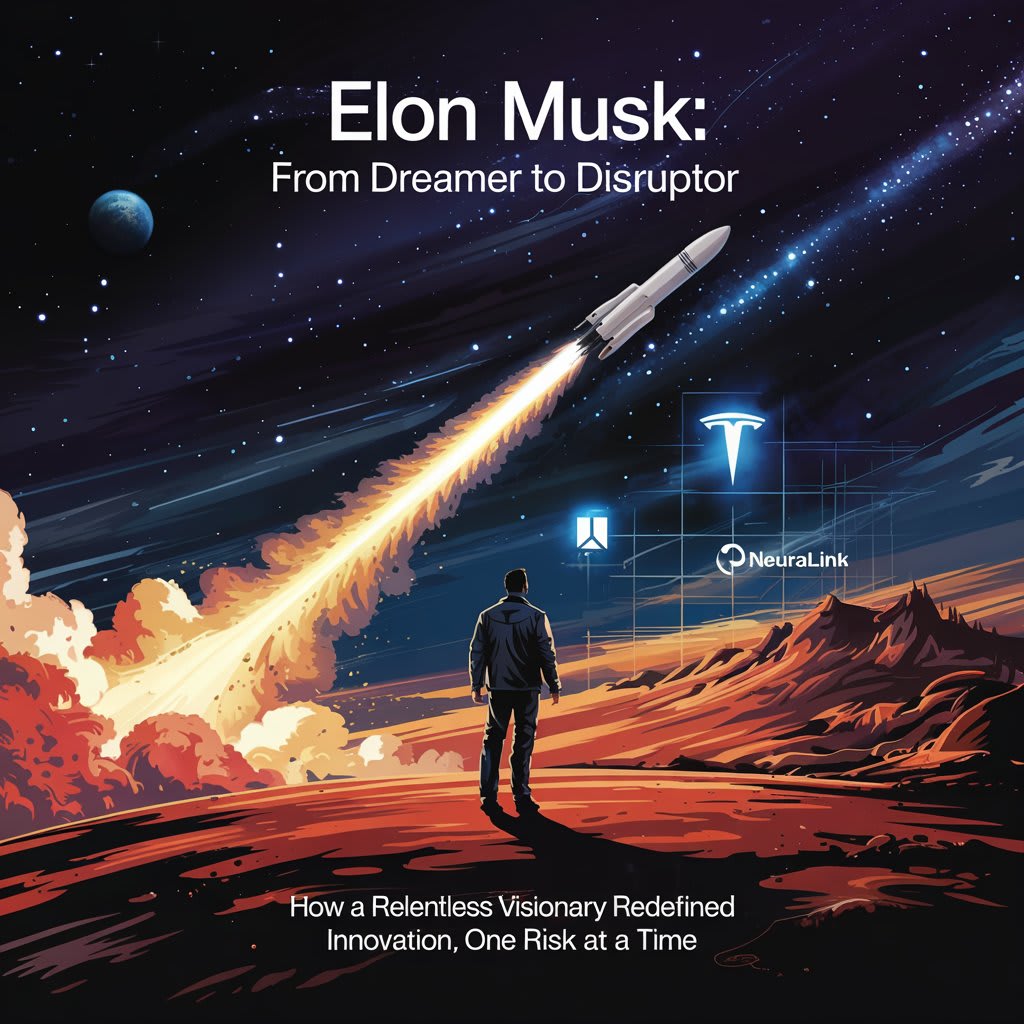
In a quiet corner of Pretoria, South Africa, a curious boy named Elon Musk immersed himself in books and imagination. While most kids his age played outdoors, Elon spent his time reading science fiction, encyclopedias, and teaching himself computer programming. At just 12, he developed and sold a video game called "Blastar"—a small spark that would later ignite a revolution in the worlds of space, energy, and technology.
But Elon's story isn't just one of talent; it's one of vision, relentless effort, and an unshakable belief in the impossible. His journey—from a bullied, introverted child to the world's most daring entrepreneur—offers a roadmap for anyone who dreams of changing the world.
The Leap of Faith
At the age of 17, Elon made a life-changing decision. He left South Africa, seeking freedom, opportunity, and the technological promise of America. First, he went to Canada, working odd jobs—cleaning boilers, cutting logs, and shoveling grain. His grit was unmatched. Eventually, he made his way to the University of Pennsylvania, double majoring in Physics and Economics. Even then, Elon wasn't thinking small. He often spoke about three industries that would shape the future: the internet, sustainable energy, and space exploration.
After college, he dropped out of Stanford’s PhD program in just two days, realizing the internet boom was his real launchpad. In 1995, with his brother Kimbal, he founded Zip2, a city guide software for newspapers. Despite sleeping in the office and showering at the YMCA, Elon worked tirelessly. Four years later, Compaq acquired Zip2 for $307 million. Elon’s share? $22 million.
PayPal and the First Disruption
Flush with cash but hungrier than ever, Elon launched X.com—an online payment company. Though met with skepticism, Elon pushed forward. Eventually, X.com merged with a small company called Confinity to become what we now know as PayPal. In 2002, PayPal was sold to eBay for $1.5 billion in stock. Elon made around $180 million from the sale—but instead of retiring, he put almost all of it back into his dreams.
“I could either watch it happen or be a part of it,” he famously said.
Betting It All
With newfound wealth, Elon didn’t buy yachts or islands. He bet big—on the future.
He founded SpaceX with a radical goal: make space travel affordable and colonize Mars. The early days were brutal. Three failed rocket launches nearly bankrupted the company. Critics laughed. Experts rolled their eyes. Even his own engineers doubted success. But Elon didn’t flinch.
In 2008, with just one launch left before total collapse, SpaceX made history. The Falcon 1 rocket reached orbit—making SpaceX the first private company to do so. That same year, NASA awarded SpaceX a $1.6 billion contract. The gamble had paid off.
But Elon wasn’t done.
Revolutionizing the Road
Simultaneously, Elon had taken over Tesla Motors, a fledgling electric car startup. At a time when people mocked electric vehicles as toys for the rich, Elon envisioned a world where clean energy transportation was not only possible—but superior.
Like SpaceX, Tesla’s journey was anything but smooth. Production issues, financial troubles, and media skepticism plagued the company. Elon put in his own money—so much that he once had to borrow rent from friends. His days were spent at Tesla, nights at SpaceX. He worked 100-hour weeks and slept on factory floors. “Painful” is how he described those years.
But he persevered. And eventually, the world saw results. The Model S stunned critics. The Model 3 made electric cars mainstream. Tesla’s valuation soared, and Elon became one of the wealthiest people on Earth—not from chasing money, but from chasing purpose.
Dreams Bigger Than Earth
With Tesla and SpaceX making headlines, Elon set his sights even higher. He founded SolarCity (later merged with Tesla Energy) to power the world with clean energy. He launched The Boring Company to revolutionize transportation infrastructure. He created Neuralink, aiming to connect the human brain directly with computers. Then came Starlink, a project to provide high-speed internet globally through thousands of satellites.
While most would be content after one success, Elon Musk kept asking: What’s next? What more can be done?
Mindset of a Disruptor
What sets Elon apart isn't just intelligence or wealth—it’s resilience, risk-taking, and obsession with solving humanity’s greatest problems.
He embraces failure. “Failure is an option here,” he once said. “If things are not failing, you are not innovating enough.”
He defies norms. Whether it's launching a Tesla into space or building a rocket that lands itself vertically, Elon breaks rules that seem unbreakable.
He keeps learning. Despite no formal training in aerospace engineering, he taught himself rocket science. His curiosity knows no bounds.
Most importantly, he stays mission-driven. Everything he builds serves a larger goal: advancing humanity.
A Message to Dreamers
Elon Musk's journey is far from over, but the lessons are already clear:
Dare to dream big, even if people laugh.
Work relentlessly, even when results don’t come quickly.
Take risks, even when failure seems inevitable.
Stay curious, even when you think you know enough.
Think of the future, not just the present.
Today, Elon Musk stands as a symbol of what’s possible when vision meets determination. He wasn't born into greatness—he built it, step by step, risk by risk, failure by failure.
He reminds us that the future doesn't belong to the comfortable or the conventional. It belongs to the bold—the ones who see what doesn't exist yet, and then make it real.
So, the next time you're told your dream is too big, remember the boy from Pretoria who wanted to go to Mars.
He’s already halfway there.
About the Creator
Keep reading
More stories from Sajjad Khan and writers in Motivation and other communities.
Atomic Habits: An Easy & Proven Way to Build Good Habits & Break Bad Ones
Author: James clear. Throughout this book, we’ve uncovered the undeniable truth: success isn’t the result of one giant leap, but the product of countless small steps taken with purpose. Just as water shapes stone, not through force but persistence, your habits — those small, daily decisions — are sculpting your future whether you realize it or not.
By Sajjad Khan9 months ago in Motivation
Adversity Made Her Unstoppable
Adversity as a Force for Transformation In life, we all face challenges. Some of us are born into adversity, while others experience it later in life. But regardless of how we come to face it, adversity can be a powerful force for transformation.
By Edward Smitha day ago in Motivation


Comments
There are no comments for this story
Be the first to respond and start the conversation.