
From Rock Bottom to Rising Stars: Untold Stories of Great Minds Who Changed The World
“Great Minds Who Turned Failures into Success”

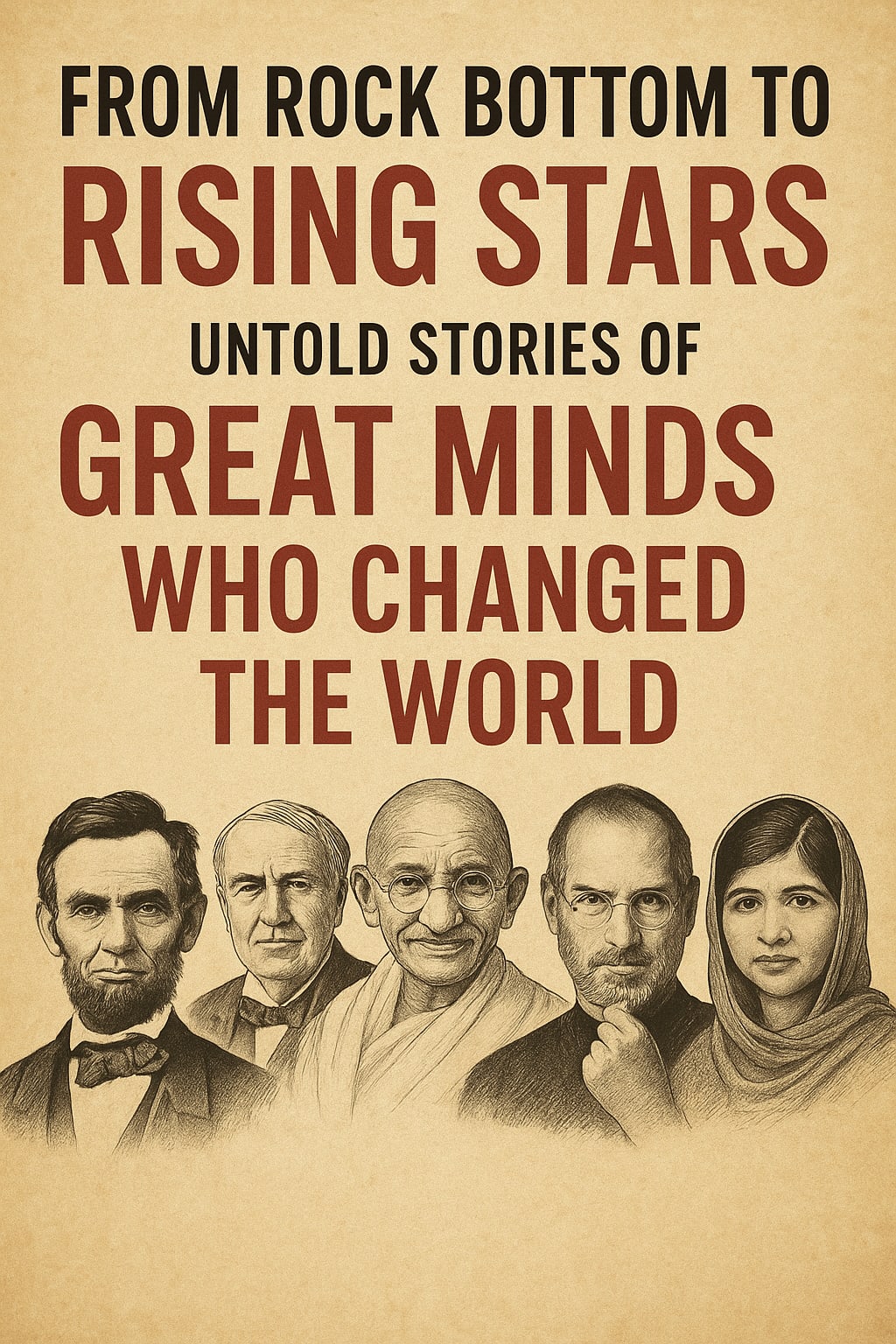
The Universal Language of Struggle
Every human being, no matter where they are born or what they become, goes through struggle. Struggle is a language we all understand. It’s not bound by nationality, wealth, or background—it is universal. The difference between ordinary lives and extraordinary ones often lies not in the absence of failure, but in the way people respond to it.
History is filled with names that shine like stars today, but what most of us forget is that before they became immortal, they were ordinary humans—weak, flawed, rejected, and broken. They walked through storms of despair, endured humiliation, and battled failures that could have destroyed them.
But instead of giving up, they transformed their scars into strength. They rewrote their stories. And in doing so, they rewrote history.
This is not just history—it’s a map for your own journey. If you’ve ever felt like giving up, like failure defines you, then these stories will tell you otherwise.
Chapter 1: Abraham Lincoln – The President Who Failed His Way to Success
Abraham Lincoln is remembered as one of the greatest presidents of the United States, but his journey was anything but smooth. Born into poverty in 1809, he had little formal education and often borrowed books just to teach himself to read. His childhood was filled with hardship; his mother died when he was only nine years old.
Yet, what defined Lincoln’s life most was not poverty, but failure.
He failed in business.
He lost elections—over and over again.
He faced depression so severe that his friends feared for his life.
Here’s a timeline of Lincoln’s failures:
• 1832: Lost his job, defeated in his first run for legislature.
• 1833: Failed in business.
• 1835: The love of his life, Ann Rutledge, died.
• 1838: Defeated for Speaker of the House.
• 1843: Defeated for Congress.
• 1848: Lost renomination.
• 1856: Defeated for Vice President.
• 1858: Lost in a Senate race.
Most people would have quit after such repeated heartbreak. But not Lincoln.
In 1860, he became the President of the United States. And during his presidency, he guided the nation through its darkest time—the Civil War—and abolished slavery.
His story teaches us one eternal truth: “Failure is not the opposite of success—it is the road to it.”
Chapter 2: Thomas Edison – The Man Who Failed 10,000 Times
When we turn on a lightbulb, we rarely think of the man who gave us this gift—Thomas Edison. But Edison’s story is one of relentless perseverance.
As a child, Edison’s teachers told him he was “too stupid to learn anything.” His mother removed him from school and taught him at home. Later, when he started experimenting with inventions, he failed thousands of times.
When asked about his failures, Edison replied:
“I have not failed. I’ve just found 10,000 ways that won’t work.”
That mindset is the very definition of resilience.
Imagine failing not once, not ten times, but ten thousand times, and still waking up the next day ready to try again. That was Edison. His persistence gave the world not only the lightbulb but also the phonograph, the motion picture camera, and more than a thousand patents.
Edison’s life proves that genius is not just talent—it is patience and persistence multiplied by time.
Chapter 3: Mahatma Gandhi – From Timid Child to Father of a Nation
As a boy, Mohandas Karamchand Gandhi was shy, timid, and often afraid to speak in public. He once ran away trembling after failing to deliver a single line in school. Nobody could have predicted that this quiet boy would grow up to lead India’s independence movement and inspire the world.
But Gandhi found his strength in truth and non-violence. He believed that the greatest power lies not in weapons, but in moral courage. Even after being thrown off a train in South Africa for being Indian, even after being imprisoned multiple times, Gandhi did not choose hatred.
He chose peace.
He chose love.
And his choices shook the British Empire.
His story reminds us that true power is not loud—it is silent, steady, and unbreakable.
Chapter 4: Steve Jobs – The Man Who Got Fired from His Own Company
Steve Jobs is celebrated as the co-founder of Apple, a man who changed technology forever. But few remember that in 1985, Jobs was actually fired from Apple, the very company he started.
It was the lowest point of his life. He felt humiliated and defeated. But instead of giving up, he started again. He founded NeXT, which eventually got acquired by Apple, and also Pixar, which revolutionized animation with hits like Toy Story.
When he returned to Apple, he transformed it into one of the most valuable companies in history, creating the iPod, iPhone, and iPad.
Jobs once said:
“Sometimes life hits you in the head with a brick. Don’t lose faith.”
His story proves that setbacks are often setups for comebacks.
Chapter 5: Nelson Mandela – 27 Years Behind Bars
Nelson Mandela spent 27 years in prison for fighting against apartheid in South Africa. 27 years—a lifetime. Many would have left prison bitter, angry, and broken. But Mandela walked out with forgiveness in his heart and unity in his mind.
Instead of seeking revenge, he chose reconciliation. Instead of dividing, he united a nation. In 1994, he became South Africa’s first Black president and a global symbol of peace.
Mandela’s life whispers to us: “Your chains cannot define you—your choices do.”
Chapter 6: Malala Yousafzai – The Girl Who Was Shot for Going to School
In 2012, Malala Yousafzai, a young Pakistani girl, was shot in the head by the Taliban simply because she wanted to go to school. Many thought she would not survive. But Malala did not just survive—she rose.
She became the youngest-ever Nobel Peace Prize laureate, fighting for the right of girls to receive education worldwide.
Her voice became louder than the bullet.
She teaches us that courage is not the absence of fear—it is moving forward even when you are afraid.
What Their Lives Teach Us
What do all these stories have in common?
Not wealth. Not privilege. Not an easy life.
What connects Lincoln, Edison, Gandhi, Jobs, Mandela, and Malala is this: the refusal to quit.
• Lincoln teaches us that failure is the road to success.
• Edison teaches us that persistence is genius.
• Gandhi teaches us that peace is stronger than violence.
• Jobs teaches us that rejection is not the end.
• Mandela teaches us that forgiveness is freedom.
• Malala teaches us that courage can change the world.
So the next time you feel broken, rejected, or hopeless, remember: you are not finished. Your story is still being written. And maybe, just maybe, your scars will become your strength.
Because as history proves again and again—
the people who change the world are not those who never fall, but those who refuse to stay down.
About the Creator
Keep reading
More stories from Md. Muzammal Rahman Pir and writers in Motivation and other communities.
How I Healed My Anxiety Without Pills
I used to think anxiety was just something you “got over.” Until I couldn’t. It started subtly—missed sleep, tightness in my chest, random moments of dread. I brushed it off as work stress. After all, I had a fast-paced marketing job in Chicago, a busy social calendar, and a “keep it together” mindset I’d worn like armor for years.
By Md. Muzammal Rahman Pir6 months ago in Motivation
Plugging Along
Hello friends, hope this finds you well and in good health. I remember seeing this comic strip where an older man with a gut and grey hair saw a “hiring” sign at a fast food restaurant and thought it was a good opportunity. The theme of the strip was that he was a plugger — plugging along.
By Robbie Newport7 days ago in Motivation


Comments
There are no comments for this story
Be the first to respond and start the conversation.