
From paint in my hair to a world inside my head
How chronic illness has affected my creative journey
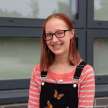

My creative journey has been a unique one, thanks to chronic illness. It managed to get in the way of the thing I loved doing most – art – but that didn’t stop my creativity. No way!
Growing up, I loved doing art. When I was a toddler, I had an art set in my Christmas stocking and spent far more time using that than playing with the toys I’d actually asked for on that Christmas morning. And that didn’t change. I adored drawing and painting and making collages from Argos catalogues.
When I was 8, I got M.E. and I had to stop my other hobbies – I didn’t have enough energy to go swimming and I couldn’t hold the flute up because of muscle pain in my arms. So art was the only outlet I had left. When I didn’t have the energy to go out and play, but managed to get out of bed, I could escape into the world of art.
When I was 10, I started doing art lessons with Kathryn Saunby. I have many memories of being rushed over to the sink because my long blonde hair had gone in the acrylic paint. Again. But I developed into a competent artist, who enjoyed all mediums but particularly enjoyed acrylics – even if it was more messy than drawing.
At the age of 16, my chronic illness, which hadn’t been that bad for a year or two, flared up again. The nerve pain I’d started getting at the age of 12 returned with a vengeance, spreading from a focus in my ankles to attacking my back and my wrists as well. My wrists proved the biggest problem – I couldn’t hold a pen. Or a pencil. Or a paintbrush. Art was gone, and I went out of my mind for the first few weeks. I didn’t know how to cope. Then, I started doing finger-painting – which is what my GCSE Art exam was done in. It provided an outlet, yes, but it simply wasn’t the same. I experimented with digital art and photo editing as well, but that didn’t quite fill the gap either.
It was then that I discovered poetry. Poetry was my lifeline – it let me create art with words.
My poems were often angry. I wasn’t writing about romance or sunsets on picturesque beaches; my poems were on pain. And I don’t mean a poem on heartbreak or emotional upset, this was about physical pain that had turned my life upside down and I was furious about it. I turned the pain and the fatigue and all the frustration that went with it into poems. Real, emotion-filled poems. And do you know what? It filled the gap that the wrist pain had made, and, more than that, it provided me with an outlet for the anger. And that gave me peace.
‘Swing me round!’
she asks, with excitement
and glittering eyes.
‘I can’t,’ I say,
‘My back hurts.’
‘But you did it at the start!’
And you can see the confusion
of a 5 year old –
she doesn’t understand
the barriers that pain holds,
that I may be fine one moment
then later I’m in pain,
and I cannot do
the same thing again.
You might think that this is where the journey ends – me finding peace by writing poems on pain. And if you’d asked me a little over a year ago that was indeed where I was at, doing poetry workshops and refining the craft. I also had the added bonus that I could now use a paintbrush for short amounts of time. I painted rocks to hide, and this new activity gave me great joy.
Then the pandemic happened, which none of us saw coming. But what else I didn’t see coming was that in this lockdown, I would start writing my first novel. I’d never planned on writing a novel, it wasn’t really on my agenda, as I was quite happy with my poetry. But one day in March last year, I had this idea for a novel I just couldn’t suppress. I started writing it in the notes section of my phone, and somehow it became 70,000 words. It’s a futuristic Young Adult novel called 'The Resilient', which highlights the struggles faced by those with disabilities and invisible illnesses in our society by portraying a futuristic society that turns ours on its head. It follows the story of a sixteen-year-old girl who discovers the truth about the inequalities in her society and the secrets their dictator had been keeping. She decides she needs to act.
Writing this story, creating these characters, designing their world, was undeniably satisfying. I could express myself in a new way, showing the things that I wanted to talk about and telling the message I wanted to be heard in a fun and exciting fashion. I now have a whole other world in my head where I can escape to, to be with a cast of characters I love.
Who knows where my creative journey will go from here! But right now? I’m working on book two!
About the Creator
Keep reading
More stories from Miriam H. Culy and writers in Motivation and other communities.
Nobody Abandoned Me — I Just Quietly Left
Nobody abandoned me. I just quietly left. That is the version of the story that sounds simplest, almost harmless, when said out loud. It avoids blame. It avoids drama. It avoids the uncomfortable task of explaining how a person can be surrounded by others and still feel completely unseen. But simplicity does not mean the truth is small. Sometimes it just means the truth learned how to stay quiet.
By Komsan Goodstories10 minutes ago in Motivation


Comments
There are no comments for this story
Be the first to respond and start the conversation.