
From Ancient Agora to Modern Angst: Why Everyone's Talking About Stoicism (Again!)
Feeling Overwhelmed? There's an Ancient Philosophy for That!

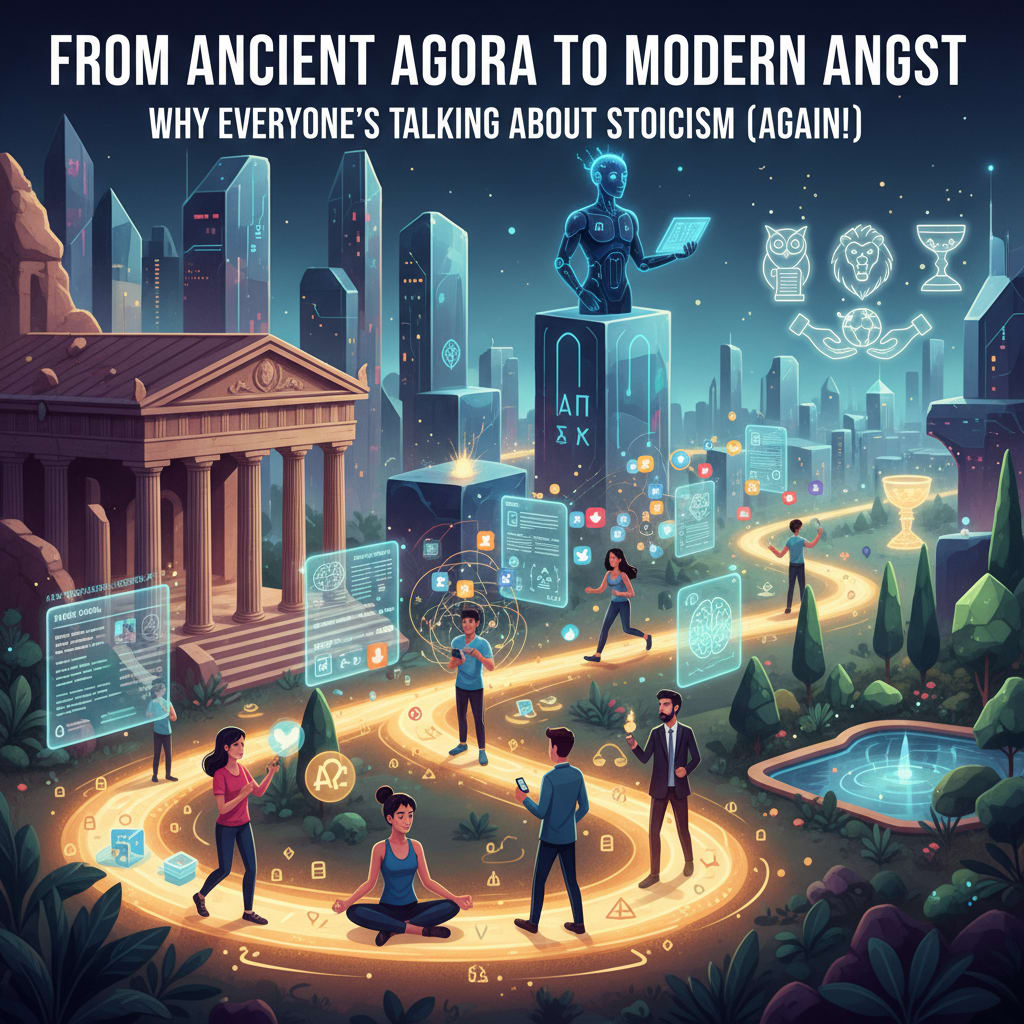
Introduction: Feeling Overwhelmed? There's an Ancient Philosophy for That!
Life in the 21st century often feels like navigating a minefield blindfolded. A relentless barrage of notifications, global crises flashing across our screens, and to-do lists that seem to multiply overnight—it’s a recipe for feeling utterly, hopelessly out of control. We chase fleeting moments of satisfaction, only to be confronted by a gnawing sense that something is profoundly amiss. Is there a refuge? A way to find solid ground amidst this swirling chaos?
Enter Stoicism. Now, dismiss any preconceived notions of emotionless automatons. This isn't about suppressing feelings or adopting a stiff upper lip. Instead, Stoicism presents itself as a surprisingly practical, time-tested toolkit for navigating the complexities of modern life with calm, clarity, and an unwavering sense of purpose. It’s a philosophy that doesn't shy away from the harsh realities of existence but instead offers a framework for meeting them with equanimity and even, dare I say, a touch of grace.
We're about to embark on a journey – a meander, if you will – from the sun-drenched agora of ancient Athens to the anxiety-ridden landscape of the 21st century. We’ll explore Stoicism’s ancient roots, examine its surprising modern comeback, and delve into both the fervent hype and the potential hang-ups that accompany its newfound popularity. Fasten your seatbelts; it's going to be a philosophical rollercoaster.
The Original Life Hackers: A Stroll Through History
Back to Athens, Circa 300 BC:
Our tale begins not in a hushed library or an ivory tower, but rather on a bustling, painted porch in Athens. Here, around 300 BC, Zeno of Citium, a merchant-turned-philosopher, began sharing his radical ideas. This "painted porch," the Stoa Poikile, lent its name to the burgeoning philosophy: Stoicism. Imagine the scene: citizens milling about, the scent of olives and the murmur of debate filling the air, as Zeno laid the foundation for a way of life that would echo through the ages.
The Big Three:
Stoicism wasn't a mere flash in the pan; it wasn't some philosophical TikTok trend destined to fade into obscurity. Instead, it flourished, evolving through the centuries and finding fertile ground in the Roman Empire. Here, the philosophy was championed by a triumvirate of intellectual heavyweights: Seneca, the witty essayist and advisor to Nero, whose writings crackle with insight and a sardonic understanding of human nature; Epictetus, the former slave who, despite his physical constraints, taught the world about the true freedom of the mind; and Marcus Aurelius, the philosopher-king, whose Meditations offer a remarkably intimate glimpse into the mind of a ruler grappling with the burdens of leadership and the search for inner peace. These weren't just academics; they were individuals wrestling with the complexities of power, freedom, and the human condition.
The Whole System:
Stoicism wasn't just a collection of pithy sayings or self-help slogans. It was a comprehensive worldview, a holistic system for understanding and navigating the world. At its core lay three interconnected domains:
Logic: The Stoics believed in the power of reason, emphasizing the importance of clear thinking and sound judgment as essential tools for navigating the complexities of life.
Physics: This wasn't just about understanding the laws of nature; it was about recognizing our place within the grand cosmic order and accepting the inherent interconnectedness of all things. Understanding the universe, they believed, was key to understanding ourselves.
Ethics: The ultimate goal of Stoicism was to live a truly good life, a life of virtue. For the Stoics, virtue wasn't just a lofty ideal; it was the only true good. External factors like wealth, health, or reputation were ultimately indifferent, mere externalities that could neither guarantee nor diminish our inner well-being.
From Decline to Renaissance:
Like many philosophical movements, Stoicism experienced periods of both prominence and decline. With the rise of Christianity, its influence waned, only to be rekindled during the Renaissance as "Neostoicism," reminding us that ideas, like embers, can lie dormant, waiting for the right moment to ignite once more.
Your Inner Compass: The Core Ideas That Still Resonate
The "Dichotomy of Control":
Herein lies what I consider to be the absolute game-changer, the cornerstone of Stoic philosophy. The "dichotomy of control" is a simple yet profoundly liberating concept: distinguish between what is within your power (your thoughts, actions, and judgments) and what is beyond your control (everything else). Stop stressing about the vagaries of the stock market, the political climate, or the unpredictable behavior of others. Focus instead on cultivating inner virtue, on acting with wisdom, justice, courage, and temperance. This isn't about resignation; it's about strategic engagement, about directing your energy where it can have the greatest impact. As Epictetus observed, "The chief task in life is simply this: to identify and separate matters so that I can say clearly to myself which are externals not under my control, and which have to do with the choices I actually control."
The Four Cardinal Virtues:
Consider these your ethical GPS, the guiding principles that will steer you toward a life of flourishing:
Wisdom: This isn't just about accumulating knowledge; it's about seeing things clearly, making sound judgments, and understanding the consequences of your actions.
Courage: This isn't about reckless bravado; it's about facing challenges, both big and small, with unwavering resolve. It's about standing up for what is right, even when it's difficult or unpopular.
Justice: This is about treating others with fairness, kindness, and respect. It's about recognizing the inherent dignity of all human beings and striving to create a more just and equitable world.
Temperance: This is about self-control, moderation, and balance. It's about resisting the siren call of instant gratification and cultivating a sense of inner harmony.
Apatheia (Not Apathy!):
This is perhaps the most misunderstood concept in Stoic philosophy. Apatheia isn't about becoming an emotionless robot; it's about achieving freedom from destructive emotions like rage, anxiety, and envy. It's about cultivating emotional resilience, about learning to respond to life's challenges with equanimity and composure. It's about mastering your emotions, rather than being enslaved by them.
Amor Fati:
Love your fate. Embrace everything that happens, both good and bad, as an opportunity for growth. This isn't about blind acceptance; it's about recognizing that even in the face of adversity, we can find meaning and purpose. It's about turning lemons into lemonade and then thanking the universe for the lemons.
Cosmopolis:
We are all citizens of the world, interconnected and interdependent. Be a good neighbor, a good global citizen. Recognize your responsibility to contribute to the well-being of humanity as a whole.
The Hype is Real: Why Stoicism is Everywhere Today
Modern Day Gurus & Books:
From Ryan Holiday's The Daily Stoic to William B. Irvine's A Guide to the Good Life, Stoicism is experiencing a remarkable resurgence in popularity. YouTube channels, podcasts, online communities – it's everywhere!
Mental Health's Ancient Ally:
It turns out that Stoicism is essentially an ancient version of Cognitive Behavioral Therapy (CBT)! It helps manage stress and anxiety and boosts emotional intelligence by changing how we interpret events.
Practical Life Hacks:
Daily journaling, "negative visualization" (imagining things going wrong so you appreciate the good and prepare for the bad), and mindfulness are all part of the modern Stoic toolkit.
For Everyone, Everywhere:
From Silicon Valley CEOs to athletes and military leaders, people are finding actionable wisdom in these old texts.
Not So Fast: The Controversies & Common Misunderstandings
The "Emotionless Robot" Myth:
This is the biggest and most persistent misconception. Stoics don't advocate for suppressing emotions; they advocate for understanding and mastering them. It's about cultivating healthy emotional responses, not eliminating emotions altogether.
Passive vs. Active:
Are Stoics just chill and accept everything? Absolutely not! The virtue of Justice and the concept of Cosmopolis compel us to actively engage and improve the world within our sphere of influence.
"Tough It Out" vs. Self-Care:
While resilience is key, it's not about gritting your teeth through suffering. It's about building inner strength with self-compassion and wisdom.
Academic Gripes:
Some philosophers debate whether Stoicism is too simplistic for the average person or whether its metaphysics are underdeveloped.
Social Media Shenanigans:
The rise of "hustle culture" Stoicism can sometimes miss the point, focusing on personal gain rather than virtue and contribution to the common good.
Beyond Tomorrow: The Future of Stoicism
Academic Deep Dives:
Rigorous studies are underway, validating Stoic practices for mental health, cognitive flexibility, and lifestyle choices.
AI Ethics:
Get ready for Stoic robots! Researchers are exploring how Stoic virtues like justice and wisdom can guide the development of ethical AI.
Futurism & "Pre-Mortem Thinking":
Stoic techniques can be used to anticipate future challenges and build resilience in an unpredictable world.
Community & Accessibility:
Online movements like "Stoic Week" and "Stoic Mindfulness and Resilience Training" continue to grow, bringing the philosophy to a wider audience.
The Challenge of Nuance:
As Stoicism gains popularity, the challenge is to maintain its depth and avoid oversimplification into mere "life hacks."
Conclusion: Your Ancient Guide to a Better You
Stoicism is far more than a historical curiosity; it's a living, breathing philosophy profoundly relevant to our modern lives. It offers a powerful framework for cultivating inner peace, resilience, and wisdom, helping us navigate the uncontrollable with grace and focus on what truly matters. So, next time you're feeling overwhelmed, perhaps it's time to channel your inner Marcus Aurelius and remember that true freedom lies not in controlling the world around you, but in mastering yourself.
About the Creator
khalilhoti
Motivational Entrepreneur Digital Marketing and Social Media Expert.
Keep reading
More stories from khalilhoti and writers in Motivation and other communities.
10 Lessons From Stoicism To Keep Calm
In a world filled with chaos—traffic jams, workplace tensions, and personal crises—Stoicism offers a roadmap to tranquility. This ancient philosophy, practiced by thinkers like Marcus Aurelius, Seneca, and Epictetus, teaches that true power lies not in controlling external events but in mastering our reactions to them. Below are 10 distilled lessons from Stoicism to help you cultivate calm and resilience.
By khalilhoti8 months ago in Motivation
From Daydreaming to Doing: How to Turn Desire Into Action
Daydreaming is easy. Action is not. You can sit for hours imagining a better life, the work you want to do, the habits you wish you had, the confidence you hope to feel, the version of yourself you’d love to become. You can picture it in detail, feel the excitement of it, even get a rush of inspiration.
By Stacy Faulka day ago in Motivation




Comments
There are no comments for this story
Be the first to respond and start the conversation.