
Fear of the future. How does it arise, how to remove
Today we are talking with you about the fear of the future

how it arises, and how to get rid of it. I'm sure this will be the best article of all time, because 70% of the time, fear arises for the future. Out of 10 times, every 7th you are afraid of the future.
Fear is an emotion that only occurs in real-time. You can only experience fear here and now. And you can be afraid of just two directions:
Your plans for the future
What happened in the past
Fear doesn't arise for anything else, so you only need to focus on these two areas.
If we are talking about the fact that you are worried about your plans, then you are worried not about the future as such, but about the outcome of your plans. For example, now I can think of that death with a scythe will come to me today and kill me while I sleep. It doesn't give me fear. The point is, I'm not going to implement any of this. Fear for the future arises when you plan that something will happen in your life. You plan either that you will do something, or how you will feel, or where you will be, or what you will be told.
Thought - this is a plan that you form in your head. The plans themselves are neutral, they do not carry any assessment. And the outcome that you see in this plan is your perception. If you think that in the future, as part of your plan, a negative outcome will occur, then you have fear.
To help you understand better, I will give you a couple of examples. The plan begins with the word "thought." For example, I thought to do something, go somewhere. I thought how the day would pass - what if there would be anxiety all day. I thought about how I would feel during the day, suddenly there would be anxiety all day.
I thought about how I would feel - this is your plan, it is neutral. And the outcome that you see - suddenly there will be anxiety all day - this is the perception of this plan.
Or thought to go to bed - that's a plan. Here fear will arise if you perceive it as follows - suddenly I cannot fall asleep, there will be insomnia.
That is, I plan to go to sleep, like all people on earth. But I see a negative outcome that I will face insomnia. Thought to stay alone at home is a plan. When you are about to do this, you might think, "What if I feel bad?" It turns out that you are already seeing a negative outcome. I thought to call my client - what if he tells me something negative. Or I thought to call the girl and go to the cinema with her, what if she would send me. That is, any plan of yours is neutral in itself and you are afraid for the outcome of this plan.
Let's define why you are afraid of the outcome of the plan. After all, not all people have fear. The fact is that, unfortunately, you see only two outcomes in your plan. Take the situation - I thought to go to sleep. You think whether you will fall asleep or not, whether there will be insomnia or not. If you stay alone at home, you think about whether it will become bad or not. In the case of a girl, she will agree or refuse. If you go outside, a panic attack will happen or not. As the day passes, there will be anxiety, there will be no.
That is, you are using black and white thinking. You see only two options - good and bad. Imagine you have a powerful stream of confidence in something, 100% certainty. If you have to evaluate what will happen in the future, and at the same time there are only two options, then your reserve of 100% of energy is distributed between these two options.
Often, if there is a negative experience, then you are 70% sure of a negative outcome, and only 30% of a positive one. It turns out that you are already 70% convinced that there will be a bad outcome. Commensurate with how convinced you are and fear arises. Relatively speaking, a person is going to go to sleep, sees the outcome - what if I cannot sleep. He believes in this outcome by 90% and immediately has the strongest fear because he is convinced that he will have insomnia. This conviction gives him fear.
Why does fear arise? Because you see only two outcomes: good and bad. Believe already half or more than half in bad. What to do? Take a piece of paper or open notes on your phone or something else where you can write down because it's useless to do it in your head. You need to write numbers from 1 to 10 in a column. First, it is advisable to write a plan that you intend to carry out. For instance:
A- thought to go to sleep
B- what if I don't sleep
S-alarm
If you write not according to the ABC scheme, it's not a big deal. The main thing is that you understand what you are examining.
Our task is to understand that in life there are so many options between good and bad. There are so-called intermediate options, which are neither good nor bad. In each situation in which you see only two options, you need to describe the rest that are in between. Because you don't have these options, fear arises. There will be other options, fear will not arise.
Write down the worst option - insomnia: "I won't be able to sleep all night" in the first place. 10th option, write out the most positive: "I fell asleep immediately, I will sleep right until the morning." Your task is to fill in the remaining options between 1 and 10. And each next option should be slightly better than the previous one. For instance:
1. "I can't sleep all night"
2. "I'll fall asleep for an hour in the morning" - it is a little better.
3. "I'll sleep three hours all night."
4. "Sleep at midnight"
5. "I'll sleep more than half the night"
6. "I will hardly fall asleep, wake up several times and hardly sleep again"
7. "I will fall asleep for a long time, I will wake up once and hardly sleep again"
8. "I'll fall asleep quickly, wake up once, quickly fall asleep again"
9. "I will fall asleep for a long time, but I will fall asleep until morning"
10. "I'll fall asleep quickly and sleep until morning"
Thus, you kind of create a bridge from the worst option to the best one. You have built such a log bridge from one bank to the other. When you see other options, your consciousness expands. Before that you had black and white thinking, now you see all the options.
It's like a color blind person sees all colors in black and white. That is, any green sees as black, any beige sees as white, any yellow sees as white, any blue sees as black, any red sees as black. If the light is light, he sees it as white; if the color is dark, he sees it as black. It turns out that a person has a black and white world. And then he takes it and starts painting each color. His world becomes colorful. He sees many colors and now understands that black is not enough.
Thus, you reduce confidence in the worst option. It is the worst option that causes you to experience intense fear. Once you have outlined the options, your anxiety is reduced by reducing your confidence in a bad outcome. Because your 100% confidence is now split not 50% by 50% between the two options, but 10% between each option.
But there are nuances here. You need to write options that are convincing enough for yourself so that each option is believable. You need to write options that you believe in so that a piece of your confidence will be passed on to him. It is necessary that they do not differ from each other, you cannot write bad versions first, then good ones, you need to make a smooth transition. Write at least 10 options, sometimes more is required. It is necessary to make smooth and logical transitions, and not only try to reduce the number of hours: "I will sleep for an hour, two, three, four …". We say that there is an option that is objectively worse and objectively better, you need to use not only a mathematical approach but try to make the options look better than the previous ones.
You can sleep for 6 hours, but it can be good enough for you. But you can sleep for 6 hours in total, wake up 15 times a night - it will be worse than if you fell asleep for 6 hours and woke up in the morning. You need to specifically formulate your options.
Thus, by working through your plans, you can easily remove 70% of your anxiety.
About the Creator
Keep reading
More stories from Japjit Singh and writers in Motivation and other communities.
The Grapes of Wrath. The loudest falls in the US stock market
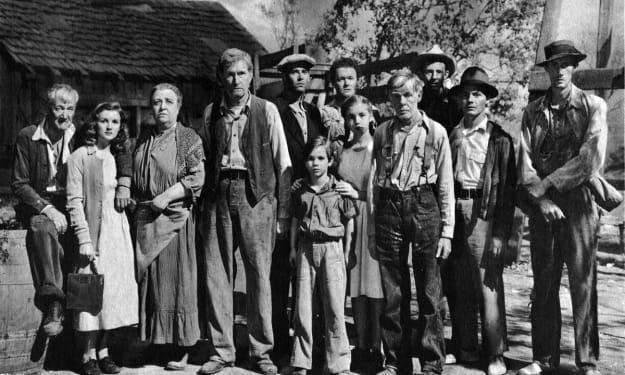
Many remember John Steinbeck's cult novel "The Grapes of Wrath" about a family of farmers who went bankrupt during the Great Depression, forced to travel from Oklahoma to California to survive. Today, October 29, marks 91 years since the day of perhaps the most famous stock market crash in history, "Black Tuesday", which marked the beginning of the Great Depression (1929-1932) - October 29, 1929.
By Japjit Singh5 years ago in Trader
Dream Big. Work Bigger
Dreaming big has always been celebrated. From childhood, we are encouraged to imagine limitless futures, to picture ourselves succeeding beyond ordinary boundaries. Dreams give us direction, hope, and a sense of purpose. But dreams alone are fragile. Without action, they remain ideas—beautiful, inspiring, and incomplete. That is where the second half of the phrase matters most: Work Bigger. “Dream Big. Work Bigger.” is not just a motivational slogan. It is a mindset that acknowledges a hard truth many people avoid: extraordinary dreams demand extraordinary effort. The size of your dream sets the destination, but the size of your work determines whether you ever arrive. The Power of Dreaming Big Dreaming big is an act of courage. It requires you to think beyond your current circumstances, resources, or limitations. Big dreams often feel uncomfortable because they challenge the identity you currently hold. When you dream big, you are admitting that you want more—more growth, more impact, more meaning. Big dreams also create clarity. They help you define what truly matters to you rather than what is merely convenient or expected. A bold vision acts like a compass, guiding decisions both large and small. When your goals are clear, distractions lose some of their power. You begin to ask better questions: Does this move me closer to my dream, or further away from it? However, dreaming big has its risks. Big dreams can intimidate, not only others but also yourself. They can invite doubt, fear of failure, and the temptation to stay comfortable. This is why many people quietly shrink their dreams over time. They convince themselves to aim lower, not because they lack potential, but because they underestimate the effort required to aim higher. Why Working Bigger Matters More Hard work is often misunderstood. It is not simply about working longer hours or exhausting yourself. Working bigger means working with intention, discipline, and consistency over a long period of time. It is about aligning your daily actions with your long-term vision, even when motivation fades. Working bigger requires patience. Results rarely appear quickly, especially when the goal is meaningful. The effort you put in today may not show visible rewards tomorrow, or even next month. This delayed gratification is where many people give up. They mistake slow progress for failure and stop just before momentum builds. It also requires humility. Working bigger means accepting that you do not know everything and that growth often involves learning through mistakes. Feedback, setbacks, and moments of doubt are not signs that you are on the wrong path. Often, they are evidence that you are stretching beyond what is familiar. Most importantly, working bigger requires consistency. Talent may open doors, but consistency keeps them open. Small actions, repeated daily, accumulate into powerful results. Writing one page every day eventually becomes a book. Practicing a skill regularly transforms ability into mastery. Working bigger is less about dramatic bursts of effort and more about showing up, again and again. The Gap Between Vision and Reality Many people live in the gap between what they want and what they are willing to do. They admire success stories without acknowledging the years of unseen effort behind them. Social media often amplifies this misunderstanding by highlighting outcomes rather than processes. The truth is less glamorous but far more empowering. Success is usually built quietly. It is created in early mornings, late nights, and moments when no one is watching. It is shaped by choices that feel ordinary at the time but prove extraordinary in hindsight. Bridging the gap between vision and reality means being honest with yourself. Are your daily habits aligned with your dreams? Do your actions reflect the future you say you want? This honesty can be uncomfortable, but it is also freeing. It gives you control. Once you recognize the gap, you can start closing it, step by step. Redefining Failure and Progress Working bigger also means redefining how you view failure. Failure is not the opposite of success; it is part of the process. Every attempt teaches you something—about your strategy, your mindset, or your limits. When you work bigger, failure becomes data, not a verdict. Progress is rarely linear. There will be periods of rapid growth and long stretches where nothing seems to change. During those quiet phases, the temptation to quit is strongest. But often, those are the moments when the foundation is being built. Growth happens beneath the surface before it becomes visible. Learning to appreciate progress, even when it is subtle, helps sustain momentum. Progress might look like improved discipline, clearer thinking, or greater resilience. These internal shifts often come before external success, and they are just as important. Living the Mindset Daily “Dream Big. Work Bigger.” becomes powerful when it is lived daily, not just repeated. It shows up in how you manage your time, how you respond to setbacks, and how seriously you take your own goals. It means choosing long-term growth over short-term comfort and commitment over convenience. This mindset does not demand perfection. It asks for effort, honesty, and persistence. There will be days when you fall short, when energy is low, and when doubt is loud. Working bigger does not mean never struggling; it means continuing despite the struggle. In the end, big dreams are not fulfilled by chance. They are earned through consistent action, thoughtful effort, and the willingness to keep going when the outcome is uncertain. When your work grows to match your dreams, something powerful happens. The future you once imagined slowly becomes the life you are building. Dream big, because your potential deserves space. But work bigger, because dreams only come alive through action.
By Saboor Brohi 6 days ago in Motivation



Comments
There are no comments for this story
Be the first to respond and start the conversation.