
Everest Base Camp Trek
A Legendary Journey to the Roof of the World

Introduction: Why Everest Base Camp is More Than a Trek
Few adventures in the world carry the same legendary status as the Everest Base Camp Trek. Nestled in the heart of the Everest region of Nepal, this journey combines raw natural beauty, cultural immersion, and a sense of human triumph. For decades, adventurers, mountaineers, and dreamers have set their sights on this trail — not just to see Mount Everest, but to experience the life-changing journey that leads to its base.
In this article, I’ll take you through the entire experience of the Everest Base Camp Trek: the highlights, the challenges, the culture, and everything you need to know before you set out.

The Allure of the Everest Region
The Everest Region, also known as the Khumbu, is more than just mountains. It’s a living tapestry of Sherpa villages, ancient monasteries, and high-altitude landscapes that shift from lush forests to glaciers. The region is protected under Sagarmatha National Park, a UNESCO World Heritage site, where biodiversity thrives in the shadow of towering peaks like Lhotse, Ama Dablam, and, of course, Everest itself.
This is not just a place to walk — it’s a place to connect with history, spirituality, and the resilience of people who have lived in these harsh, yet magnificent, conditions for centuries.
The Journey Begins: Lukla to Namche Bazaar
Your trek begins with an unforgettable flight from Kathmandu to Lukla, often described as one of the most thrilling airstrips in the world. From there, the trail unfolds gradually, leading through suspension bridges, rhododendron forests, and villages where prayer flags dance in the wind.
The climb to Namche Bazaar, the bustling Sherpa capital, is a rite of passage for trekkers. Nestled in an amphitheater-like valley, Namche offers stunning views of Everest on clear mornings, along with cozy lodges, bakeries, and a vibrant marketplace where culture meets adventure.
Cultural Encounters: The Heartbeat of the Trek
One of the most enriching aspects of the Everest Base Camp Trek is the chance to immerse yourself in Sherpa culture. Known worldwide for their mountaineering expertise, the Sherpa people also have deep spiritual traditions rooted in Tibetan Buddhism.
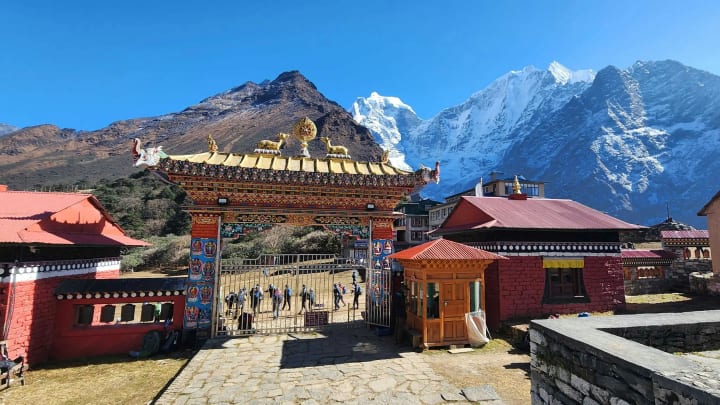
The Tengboche Monastery, perched at 3,867 meters, is a highlight of the journey. Surrounded by Himalayan giants, it offers trekkers a glimpse into spiritual practices that have guided Sherpa life for centuries. Listening to the chants of monks while gazing at Ama Dablam is an experience that words barely capture.
The Challenge of High Altitude
As the trail ascends beyond 4,000 meters, the landscape changes dramatically. Trees give way to alpine scrub, then to rocky moraine and ice. This is where altitude becomes the greatest challenge. Trekkers must acclimatize slowly to avoid altitude sickness, with rest days in Namche Bazaar and Dingboche built into most itineraries.
The walk may feel tougher, but every step brings you closer to your goal. And when you finally approach Everest Base Camp, with the Khumbu Icefall stretching ahead like a frozen river of giants, the struggle feels more than worth it.
The Crown Jewel: Everest Base Camp
Reaching Everest Base Camp at 5,364 meters is a moment that stays with you forever. While you can’t see the summit of Everest itself from here, the sense of accomplishment is unparalleled. You stand where legends like Tenzing Norgay and Sir Edmund Hillary once began their climb to history.
Many trekkers also hike to Kala Patthar, a nearby viewpoint at 5,545 meters, for the best panoramic view of Everest. Watching the sunrise cast golden light on the tallest mountain in the world is often described as the most breathtaking moment of the entire trek.
Practical Information for Trekkers
Best Time to Go: Spring (March–May) and Autumn (September–November).
Duration: Standard itineraries last 12–14 days.
Difficulty Level: Moderate to challenging, mainly due to altitude.
Cost: Around $1,500–$2,000, depending on whether you trek independently or with a guide.
Permits Required: Sagarmatha National Park Entry Permit and a Khumbu Pasang Lhamu Rural Municipality Permit.
Why the Everest Base Camp Trek Stands Out
There are countless treks in Nepal — Annapurna Circuit, Manaslu, Langtang — but none carry the weight of the Everest Base Camp Trek. It’s not just about the destination; it’s about walking in the footsteps of explorers, meeting people whose lives are intertwined with the mountains, and confronting your own limits in one of the most awe-inspiring places on Earth.
Final Thoughts: A Journey of a Lifetime
The Everest Base Camp Trek is more than an adventure — it’s a pilgrimage. It calls to those who seek challenge, beauty, and meaning in their travels. Whether you’re an experienced trekker or someone taking on their first big Himalayan challenge, the Everest region has a way of leaving its mark on your heart.
Standing at Base Camp, with prayer flags fluttering and the wind carrying whispers from the highest peaks, you realize this journey isn’t just about reaching a place. It’s about discovering strength within yourself, forging connections with people and landscapes, and carrying home a story that lasts forever.
So if the Himalayas are calling, maybe it’s time to answer. The Everest Base Camp Trek awaits — and it’s ready to change your life.
About the Creator
Keep reading
More stories from Sundar Nepal Treks and writers in Motivation and other communities.
Trekking in Nepal: A Journey Through the Himalayas
There are very few places on earth that can compare to Nepal when it comes to trekking. Home to the Himalayas, the country offers trails that are as diverse as they are breathtaking. From towering peaks that scrape the sky to lush valleys dotted with charming villages, Nepal presents an experience unlike anywhere else in the world. Every trek here is an invitation to immerse yourself in a landscape that is at once wild, serene, and profoundly inspiring.
By Sundar Nepal Treks5 months ago in Motivation
The CEO of Everything
They say "jack of all trades, master of none," but they forgot to mention the part where the jack of all trades is also the camera woman, the makeup artist, and the person currently yelling at a tangled Wii microphone cable in a her own bathroom while recording herself singing and trying to make it look realistic and professional. (As professional as you can make it with nothing but a cell phone camera and a mic that doesn't work)
By Sara Wilson4 days ago in Humans


Comments
There are no comments for this story
Be the first to respond and start the conversation.