
Currency Collapse
When money died, something else began to live.

It began on a Tuesday.
At first, it seemed like a glitch. People opened their banking apps only to find zeros. ATMs refused to dispense cash. Credit cards were declined worldwide. Within hours, it was confirmed: the global financial system had crashed.
No one saw it coming.
Central banks scrambled. Economists screamed on live television. Governments issued statements full of hope but void of solutions. The world had entered an era no one had prepared for — The Great Currency Collapse.
Paper money became paper weight. Crypto vanished into the void. Even gold lost meaning when there were no systems left to define its value.
In New York and Paris, people lined up outside supermarkets, hoarding whatever they could. In Tokyo, vending machines were smashed open for bottled water. In cities everywhere, desperation unfolded like a slow earthquake — quiet at first, then catastrophic.
But somewhere far from the chaos, in the rural hills of Peru, things were different.
Alba, a local farmer, had never trusted banks. She grew potatoes, raised chickens, and bartered with neighbors. When the news broke, she didn’t panic. She walked to the nearby village and traded eggs for rice, just like her grandparents had done. No money needed. No system broken — because they had never relied on one.
In contrast, Zara sat alone in her Berlin apartment, watching news updates scroll endlessly across the screen. As an economist, her entire world had been built on numbers, graphs, and currencies. She had advised investors, lectured on monetary theory, and believed in the strength of structured economies. Now, all of it was meaningless.
The silence in her apartment was loud.
Days turned into weeks.
The initial panic gave way to strange stillness. In cities, some hoarded what little they had, while others sought connection. People knocked on neighbors’ doors, not to ask for help, but to offer it. An old woman in Rome cooked meals for families on her street using shared groceries. A retired mechanic in Chicago fixed bikes in exchange for fresh bread.
Bit by bit, people remembered each other.
Zara’s turning point came when her elderly neighbor, Frau Eberhardt, fell ill. She hadn’t seen anyone visit her for days. Instinct took over. Zara used the last of her canned food and medicine to care for her. She stayed for hours, reading to her and making tea over candlelight.
Three days later, Frau Eberhardt’s family returned from the countryside with baskets of potatoes, carrots, and warm clothes. They cried as they thanked Zara — not with money, but with care. That was the first time Zara truly understood: value hadn’t vanished — it had simply changed form.
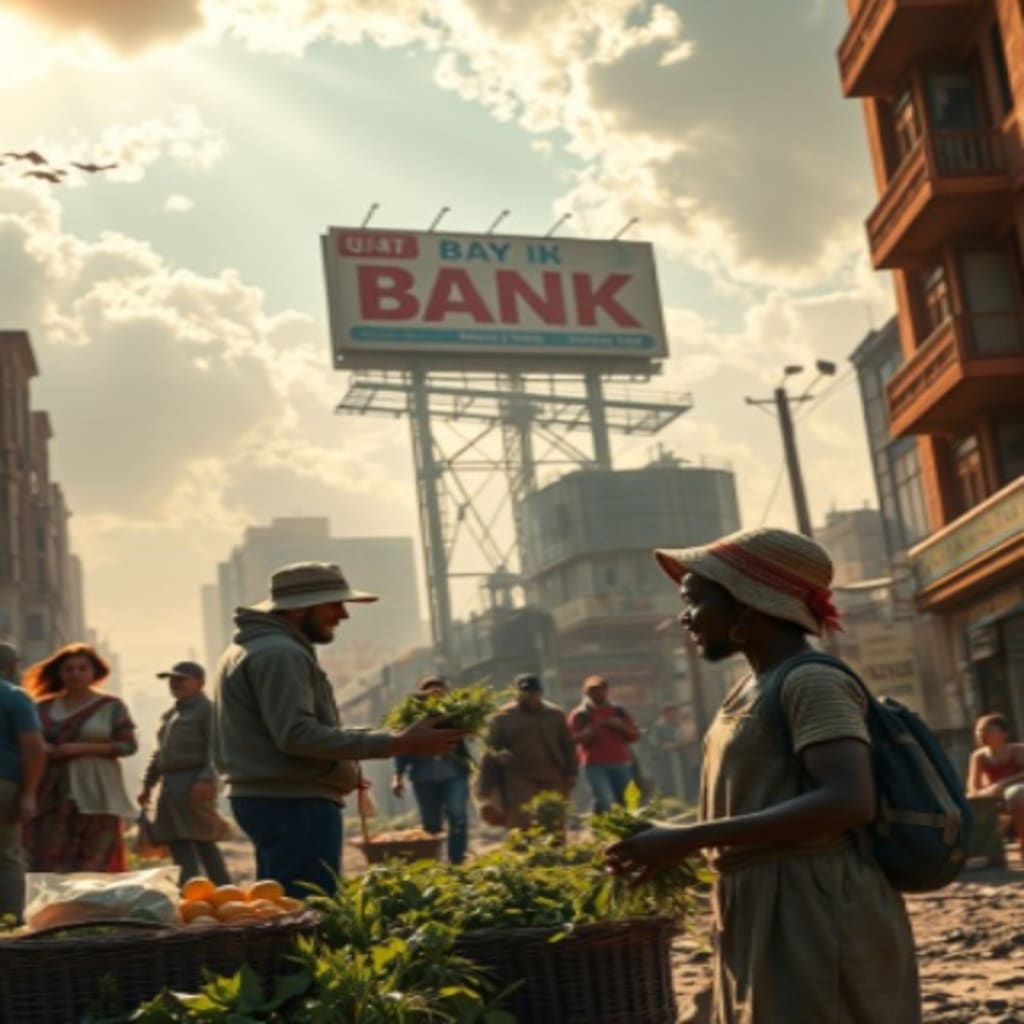
Soon, local community centers transformed into trade hubs. People offered whatever they had — skills, tools, food, or time. A nurse offered checkups in exchange for eggs. A musician played in exchange for shelter. A carpenter fixed roofs and asked only for seeds in return.
In Nigeria, children delivered letters between neighborhoods, becoming lifelines for those with no phones or internet. In India, teachers held open-air classes and were paid in fresh milk and vegetables. In Brazil, people painted murals and repaired old homes together — not for pay, but for pride and solidarity.
They called them Trust Circles — informal systems where reputation became currency. If you helped, you received. If you took, you gave back.
Some corporations and wealthy elites tried to resurrect the old ways. They proposed new digital currencies backed by artificial scarcity. But the public had tasted freedom. Many refused to return to a system that had failed them so completely.
Governments tried to issue emergency money. But by then, people were already rich in something far more powerful: interdependence.
Zara, who once measured success in stock markets and GDP charts, now grew herbs on her balcony and led a neighborhood barter group. She wrote essays — not for journals, but for the bulletin board in the town square, where people gathered daily to trade, talk, and listen.
Six months after the collapse, the world hadn’t returned to “normal.” It had reinvented itself.
Not everywhere was perfect. Greed still existed. Some tried to dominate local systems. But the difference was stark: no one person or government controlled everything. Wealth was no longer locked behind passwords or printed with permission. It lived in hands that gave, feet that walked to help, and hearts that stayed open.
In this new world, people used a different kind of language — not of profits and prices, but of purpose.
Zara walked through the streets one afternoon, passing murals filled with color and community announcements written in dozens of languages. She smiled as she saw a young boy trading a song for a piece of fruit. No lawyers. No taxes. Just trust.
The world had lost its money, yes. But in that loss, it found something richer:
Each other.
About the Creator
Keep reading
More stories from Sana Ullah and writers in Motivation and other communities.
The Flag on Maple Street
Every morning, without fail, Mr. Thompson raised the American flag in front of his small white house on Maple Street. He was tall, lean, and always dressed in pressed slacks, a tucked-in shirt, and his old Korean War cap. His movements were slow but deliberate. The ritual never changed: unlock the flag box, unfold the stars and stripes with reverence, attach it to the pole, and hoist it up as the sun peeked over the trees.
By Sana Ullah8 months ago in Families


Comments
There are no comments for this story
Be the first to respond and start the conversation.