

The sirens started just after midnight. Naomi pressed her baby closer to her chest as blue and red lights flashed through the thin curtains of her tiny flat on the edge of the city.
The government’s new Security Order said any male child born to families from “high‑risk communities” had to be registered within 48 hours. Unregistered boys could be taken into “protective custody” at any time.
Everyone knew what that meant. Children disappeared into “centres” that no one could visit. No photos. No calls. Just silence. Naomi had not registered her son. He was three months old now, heavy and warm against her, wrapped in the only soft blanket she owned. She tried to keep him quiet when patrol cars passed, stuffing towels into the gaps in the windows to muffle his cries. She only left the flat at night, when her neighbour, Amina, watched for drones while Naomi ran to the corner shop. Her phone buzzed with a citywide alert: “Immediate compliance checks will be carried out in all high‑risk zones between 00:00 and 04:00. All infants must be produced upon request. Failure to comply is a criminal offence.”
Her hands trembled. She had heard the stories. Some mothers obeyed, hoping the rumours were wrong. Some tried to run and were arrested. One woman in the next block had jumped from the third floor rather than open the door. Naomi looked down at her son. His eyelashes fluttered in sleep, unaware that an entire law had been written about his right to exist.
“I can’t let them take you,” she whispered.
She called Amina. “They’re coming,” Naomi said. “I can hear the vans.”
“Bring him here,” Amina replied. “We’ll hide him.”
“They searched your block last week,” Naomi said. “They’ll come back. They’re using heat scanners now.”
On the muted TV, a news panel argued about “population management” and “national security.” Three men in suits discussed Naomi’s community as if it were a problem on a chart. A ticker scrolling along the bottom read: “Government insists no abuses in Child Protection Centres.”
A message popped up in a local group chat: “If you are desperate and cannot keep your baby safe, you can leave them anonymously at a Safe Haven Box. No questions asked. The baby will be taken to a hospital and placed with emergency carers.”
A location pin blinked: a church‑run shelter on the other side of the river. Naomi stared at the screen. The river.
When she was a girl, it had meant summer and ice cream. Now it was a line between those like her and those who were safe. She looked at her son.
“I can’t let them take you,” she said again. “But how do I let you go?”
By 1 a.m., the vans were two streets away. Naomi wrapped her son more tightly and opened the cupboard above the sink. Behind a stack of chipped plates, taped to the wall, was an envelope – her most dangerous possession. Inside were documents for a child who “did not exist”: a different surname, a different district, a safer postcode.
It had cost more than she had. She had sold her wedding ring and half her furniture. Even the forger had warned her, “This only works if you get him out of this zone.”
She shoved the papers into the baby bag with nappies, a bottle, and the little knitted hat Amina had made. There was no more time for panic.
Outside, the streets were nearly empty, lit by the slow sweep of headlights and the metallic buzz of a police drone. She pulled up her hood, strapped her son to her chest, and walked.
Every camera felt like an eye. Every parked car seemed ready to burst into blue light. She took side streets, ducking behind closed shops. Somewhere ahead, beyond the dark curve of water, a Safe Haven Box waited—a metal door in a wall, warmed, monitored, connected straight to a hospital.
When she reached the bridge, a checkpoint blocked the centre. Two soldiers stood under a streetlamp, rifles hanging by their sides.
“No crossing after curfew,” one called. Naomi froze.
Her baby stirred and whimpered. “Please,” she said, stepping closer.
“I need to get to the hospital. He has a fever.”
“ID,” the soldier said. She handed over her card, praying he would not notice how carefully it had been kept, the unnaturally crisp edges.
He studied it, then glanced at the child.
“He doesn’t look sick,” he said. Desperation rose inside her, sharp as glass.
“He will be,” she replied quietly, “if you send him where you send the others.”
The wind lifted the edges of posters on the lamppost—faces of missing children, smiling from another time. The soldier looked at them, then at her.
“Cross quickly,” he said, returning the card. “If anyone asks, you didn’t come through here.”
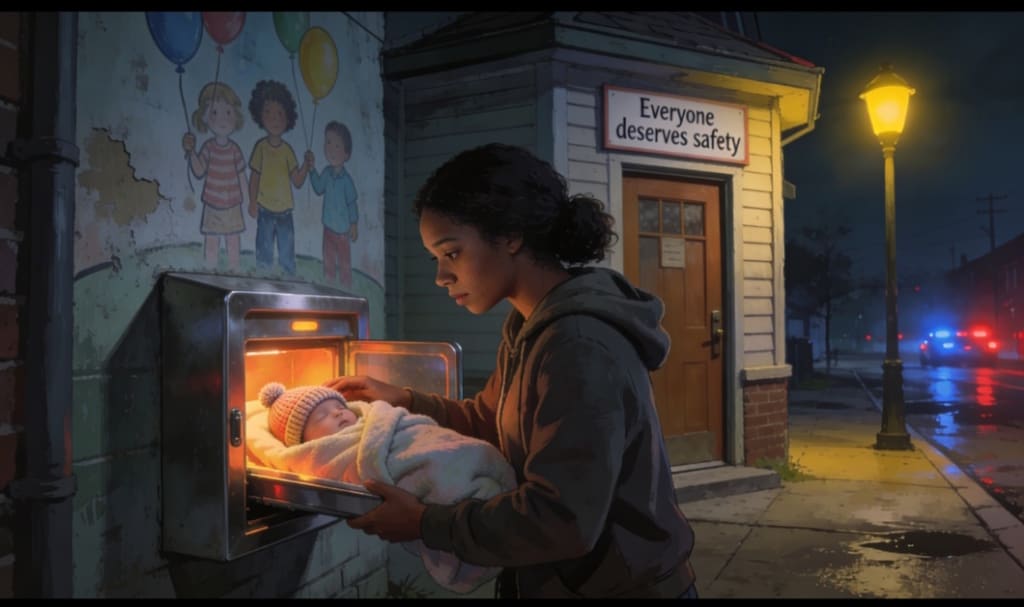
Naomi nodded, too choked to speak, and walked. The shelter was a squat, square building with a fading mural of children holding balloons. A small sign above the door read: “Everyone deserves safety.”
Around the side, in a shadowed alley, stood the Safe Haven Box—just big enough for a new-born, with a soft mattress, a heat sensor, and an alarm that rang inside the shelter.
By law, once a child was placed there, no one was allowed to trace the parent. Naomi had read that law carefully. It was the only one she trusted. She stood in front of the box a long time, fingers on the handle.“I love you,” she whispered. “This is not rejection. This is resistance. I’m pushing you toward a future they can’t control.”
She opened the door. Warm air flowed out. She laid him inside, tucking the blanket around him, and slid the envelope with the documents under the mattress. He stirred, tiny fist opening and closing. Naomi kissed his forehead, then forced herself to close the door. A soft chime sounded inside the shelter. She walked away before her courage broke.
Inside, the alarm buzzed at the desk where Dr. Lila Farouk, the shelter’s director, was finishing paperwork. Lila had grown up on the safe side of the river, only later understanding how different life was where the sirens never stopped. When the Security Order passed, she could not change the law. But she expanded the Safe Haven programme, built links with lawyers and social workers, and pushed for independent oversight of the “centres.”The Safe Haven alarm always made her heart race.
She hurried down the corridor and opened the inner door. The baby blinked at the sudden light.“Hey there,” she murmured, lifting him. “We’ve got you.”She noticed the envelope, opened it, and studied the papers. They mixed truth and fiction—real birth date and weight woven into a false address. She understood at once: a mother trying to slip her child past a system that marked him as a threat.“You are not a case number,” she said softly. “You are a person. And you are not going to any centre.”
She called Miriam, an older woman who had raised three children and fostered seven.“I have a little one,” Lila said. “No name yet.”
“Bring him,” Miriam replied. Within hours, the baby lay in a quiet room filled with plants and mismatched furniture. Miriam held him with practised ease.“What shall we call you?” she asked. Lila thought of an old story her grandmother told her, about another child once hidden from another cruel law.“Moses,” Lila said. “Because he was drawn out of danger.”
“Moses it is,” Miriam smiled. The story did not end there.
A journalist wrote about the Safe Haven programme and the rise in anonymous relinquishments, protecting mothers’ identities while exposing the cruelty of the Security Order.
A civil servant leaked reports showing neglect and harm in the “centres.” A judge used that evidence in a landmark ruling, striking down parts of the law and demanding independent monitoring.
Protests followed. Faith leaders, youth groups, teachers, social workers, and parents marched together with signs: “No child is illegal” and “Protect families, not fear.”
Change came slowly, with setbacks. But over time, registration was replaced with support. Families once treated as “threats” were recognised as citizens with rights. Whistle-blowers were protected.
Safe Haven Boxes became not last resorts, but partners in a system meant to help, not punish.
Moses grew up knowing he had been left, but not discarded. When he was old enough, Lila and Miriam told him everything—not as a shame, but as a story of courage in the face of an unjust law. He learned about the soldier on the bridge, and the mother who walked through a city of cameras to place him gently in a metal “basket” that said, “Your life matters.”
“I was not abandoned,” he told a room of law students years later. “I was protected in the only way my mother knew. The real question isn’t why she left me. It’s why she had to.”
He looked at them.“Your job is to help build a world where no parent is ever cornered into that choice again.”
About the Creator
Oluremi Adeoye
Accomplished writer & former journalist. I craft engaging articles for Vocal media, exploring diverse topics with passion and depth, creating compelling narratives that resonate with readers.
Keep reading
More stories from Oluremi Adeoye and writers in Motivation and other communities.
Echoes of Absence.
In a TikTok video I recently watched, an amputee was visibly distressed as her leg trembled uncontrollably. The comments section provided insight into her experience which was described as Phantom pain. Her brain and nerves were seemingly “remembering” the lost limb. This concept resonated with me deeply, as it drew parallels to emotional pain and grief—particularly the kind we feel when mourning the loss of loved ones.
By Oluremi Adeoye about a year ago in Motivation
Delivering Service That Customers Remember Long After the Purchase
Customer service plays a critical role in shaping how people view a brand. Products and prices may attract customers at first, but the quality of service often determines whether they return. In a competitive market where customers have endless options, businesses must go further than simply solving problems. They must create experiences that customers remember and appreciate.
By Apex Service Partners3 days ago in Motivation
Suraj Shivbaran Singh: Driving Business Success Through Marketing Strategy and Client Engagement
Suraj Shivbaran Singh is an Indian sales and marketing professional recognized for his expertise in business development, marketing strategy, and customer relationship management. His career highlights a strong commitment to helping organizations expand their reach, strengthen brand identity, and connect effectively with clients through strategic marketing initiatives.
By Thetribunemedia5 days ago in Motivation



Comments
There are no comments for this story
Be the first to respond and start the conversation.