
Bruce Lee: The Dragon Who Refused to Die
Inspirational Story

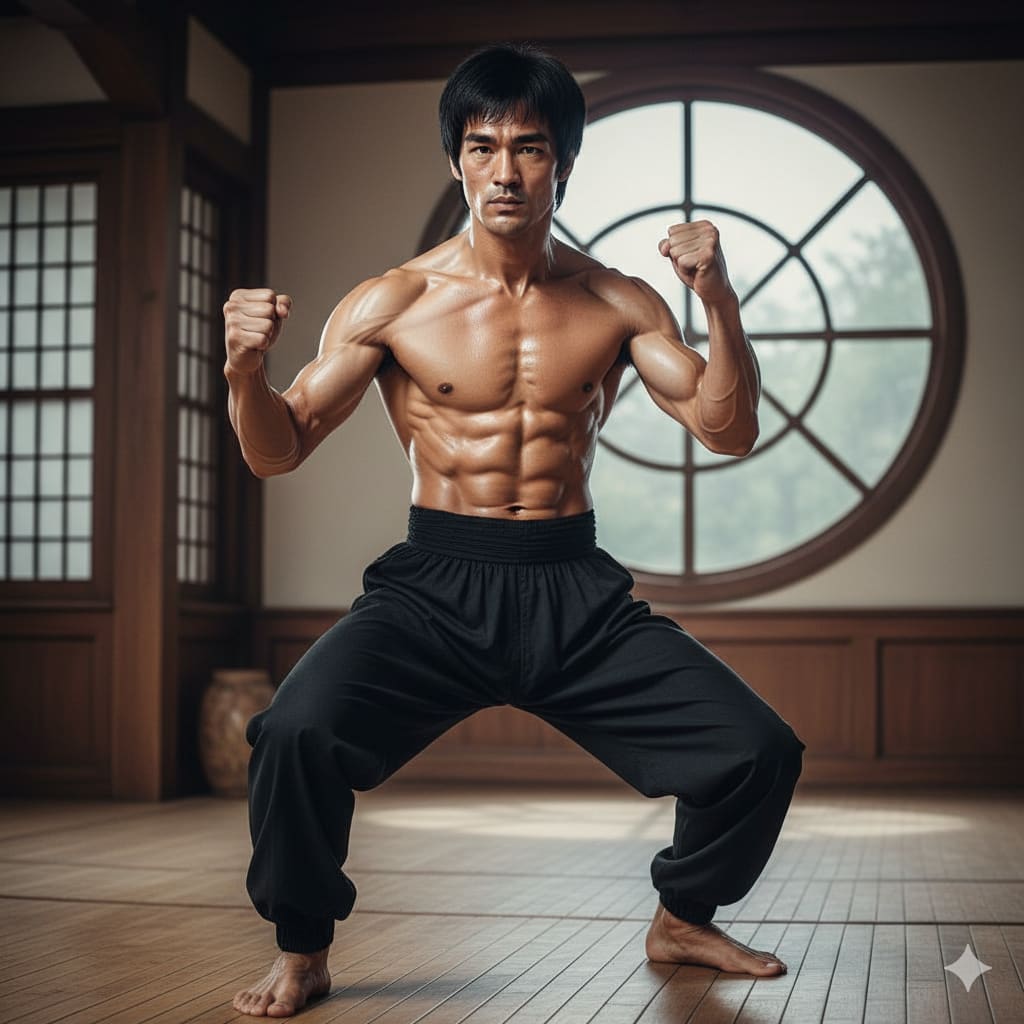
The Beginning of the Dragon
In the winter of 1940, in San Francisco’s Chinatown, a baby boy was born during the Year of the Dragon. His parents named him Lee Jun-fan, but the world would one day know him as Bruce Lee — the man who would bridge East and West, redefine cinema, and become a symbol of human potential.
His mother, Grace Ho, was from one of Hong Kong’s most respected families, and his father, Lee Hoi-chuen, was a famous Cantonese opera actor. The stage was Bruce’s earliest playground. Yet, even as a child, he was restless — full of energy, confidence, and rebellion.
When Bruce was just a few months old, his parents returned to Hong Kong. The city was under Japanese occupation, and life was difficult. Bruce grew up surrounded by war, fear, and poverty — a harsh contrast to his later fame.
By age nine, he was already appearing in films with his father. He loved performing, but school was another story. He was quick-tempered, often in fights, and earned a reputation as a street brawler. One of his teachers once said, “Bruce Lee will either be a gangster or a superstar.”
He would prove them both wrong — he became a philosopher warrior.
The Street Fighter Turned Philosopher
Hong Kong’s streets were rough after the war. Gangs ruled neighborhoods, and teenage Bruce was often involved in fights. His mother feared for his safety and sought a way to channel his aggression.
That’s when Bruce met Yip Man, the legendary Wing Chun master. Yip Man saw potential in the boy and began to train him in martial arts, discipline, and inner balance. For Bruce, it was more than learning how to fight — it was learning how to control the fight within himself.
Bruce’s training transformed him. He became obsessed with movement, speed, and the mind-body connection. “The successful warrior is the average man, with laser-like focus,” he would later say — a philosophy rooted in those early lessons.
But trouble still followed him. By the time he was 18, Bruce got into a fight that ended with serious injury to another boy. The police warned his parents that if he stayed in Hong Kong, he’d likely end up in jail. So his parents made a hard decision: send him to America to start anew.
The American Dream — With Bare Hands
In 1959, with just $100 in his pocket and a steamer ticket, Bruce Lee arrived in Seattle. He was alone, unknown, and determined to make something of himself.
He worked odd jobs washing dishes and delivering newspapers. To earn money, he taught martial arts informally to friends and co-workers. His charisma and unique style quickly caught attention.
Bruce enrolled at the University of Washington, majoring in philosophy — because for him, martial arts was never just about fighting. It was about expressing the self fully, without fear or limitation. “All types of knowledge, ultimately, mean self-knowledge.”
Soon, Bruce began teaching Wing Chun publicly. But what he taught was evolving into something new. He was taking principles from boxing, fencing, and wrestling — blending them into a fluid, practical form he would later call Jeet Kune Do, or The Way of the Intercepting Fist.
---
Breaking Barriers — The Birth of Jeet Kune Do
In 1964, Bruce Lee gave a legendary demonstration at the Long Beach International Karate Championships. His speed was shocking — he could punch before most people could even blink. The crowd gasped when he performed his now-famous “one-inch punch.”
That day, Hollywood discovered him.
Producers were fascinated by this confident, lightning-fast Chinese man who spoke like a poet and moved like a storm. Soon after, Bruce landed a role in the TV series The Green Hornet (1966), playing Kato, the masked sidekick.
It was a small role, but Bruce stole every scene he was in. Viewers loved him — but Hollywood didn’t know what to do with him. At the time, leading Asian characters were rare, and studios often preferred stereotypes to substance.
When Bruce pushed for bigger roles, he was told bluntly that America wasn’t ready for an Asian star.
The Rejection That Built a Legend
Disappointed but not defeated, Bruce turned back to teaching. He opened martial arts schools in Los Angeles, Oakland, and Seattle. His students weren’t ordinary people — they included Steve McQueen, James Coburn, and Kareem Abdul-Jabbar.
Through teaching, Bruce developed his life philosophy. He wrote essays about adaptability, freedom, and authenticity — ideas far ahead of his time. “Be water, my friend,” he famously said. “Empty your mind. Be formless, shapeless, like water.”
But Hollywood rejection cut deep. In 1971, after another failed pilot called The Warrior (which studios later adapted into Kung Fu without crediting him), Bruce decided to go back to Hong Kong. There, he was surprised to find he was already famous — thanks to The Green Hornet, which had aired there as The Kato Show.
Hong Kong welcomed him as a hero.
The Dragon Awakens
Bruce signed with Golden Harvest Studio and began working on his first major Hong Kong film, The Big Boss (1971). It was a low-budget movie — but when it hit theaters, it broke every box-office record in Asia.
Audiences had never seen anything like him. His speed, intensity, and raw power were magnetic. He wasn’t just an actor; he was truth in motion.
Next came Fist of Fury (1972), and it exploded even bigger. The film’s story — about a Chinese martial artist standing up against foreign oppression — mirrored Bruce’s own life. He was fighting not just villains on screen, but racism, stereotypes, and limitations.
By the time Way of the Dragon (1972) came out, Bruce had full creative control. He wrote, directed, and starred — and even choreographed the legendary fight with Chuck Norris in the Colosseum. It remains one of the most iconic fight scenes in cinema history.
Bruce Lee was now a global phenomenon.
Enter the Dragon — and Exit the Legend
In 1973, Warner Bros. collaborated with Bruce to make Enter the Dragon, the first major Hollywood-Hong Kong co-production. This was his dream — a film that united East and West on equal terms.
The movie was set to release in August 1973. But Bruce would never see that day.
On July 20, 1973, at just 32 years old, Bruce Lee collapsed and died suddenly in Hong Kong. The official cause was cerebral edema — swelling of the brain. His death stunned the world. Millions mourned, unable to believe that such an energetic force of life could vanish overnight.
Enter the Dragon released a month later. It became one of the most successful martial arts films in history, turning Bruce into a legend.
The Legacy That Never Died
Bruce Lee was gone, but his influence only grew stronger.
He wasn’t just a fighter or actor — he was a thinker, a philosopher, a bridge between worlds. His writings on personal growth, discipline, and adaptability are still quoted across industries, from business to sports to education.
His philosophy of self-expression, adaptability, and authenticity changed how people viewed martial arts — and themselves.
“Knowing is not enough; we must apply. Willing is not enough; we must do.”
From MMA fighters to motivational speakers, his impact runs deep. Without Bruce Lee, there would be no modern martial arts cinema, no global fascination with kung fu, and perhaps no recognition of the strength and artistry of Asian culture in Western media.
The Man Behind the Myth
Behind all the fame, Bruce Lee was a husband and father. His wife, Linda, supported his every dream, and his children, Brandon and Shannon, inherited his passion.
His son Brandon’s tragic death during the filming of The Crow decades later only deepened the legend — as if destiny was determined to write their lives in flames.
But Bruce’s essence remains immortal.
His story is not just about fame or fighting — it’s about self-belief. About having the courage to redefine yourself when the world tries to define you.
He once said:
> “If you love life, don’t waste time, for time is what life is made of.”
Bruce didn’t waste a second.
In 32 short years, he changed film, philosophy, and global culture forever. His spirit still moves through every punch thrown, every barrier broken, every dream pursued fearlessly.
Final Reflection: Be Water, My Friend
When you think of Bruce Lee today, don’t just think of the fighter or the superstar. Think of the man who faced rejection, racism, injury, and tragedy — yet turned them all into fuel.
He taught us that to be truly strong, you must be flexible. To be unstoppable, you must adapt.
Be water — not because water is soft, but because nothing can resist it.
And that’s the story of Bruce Lee — the man who turned pain into purpose, motion into art, and a short life into eternal impact.
About the Creator
Frank Massey
Tech, AI, and social media writer with a passion for storytelling. I turn complex trends into engaging, relatable content. Exploring the future, one story at a time
Keep reading
More stories from Frank Massey and writers in Motivation and other communities.
The Night I Finally Heard My Own Voice
There are moments in life that don’t announce themselves. They don’t arrive with fireworks or dramatic music or some cinematic revelation. They slip in quietly, almost unnoticed, like a soft knock on a door you didn’t realize was closed.
By Nyra Orrin7 days ago in Motivation
Silken Chains
Silhouettes of the female form were given flesh and bone. Silken skin glistened under the spotlight. Dry ice rose around our Icons as they danced atop their podiums in the Square. Heralded for their beauty, their movements were slight, powerful, and sensual.
By Paul Stewart6 days ago in Fiction


Comments
There are no comments for this story
Be the first to respond and start the conversation.