
Breaking the Rules: The Untold Story of Dua Lipa
(A True Inspirational Story — Full Version

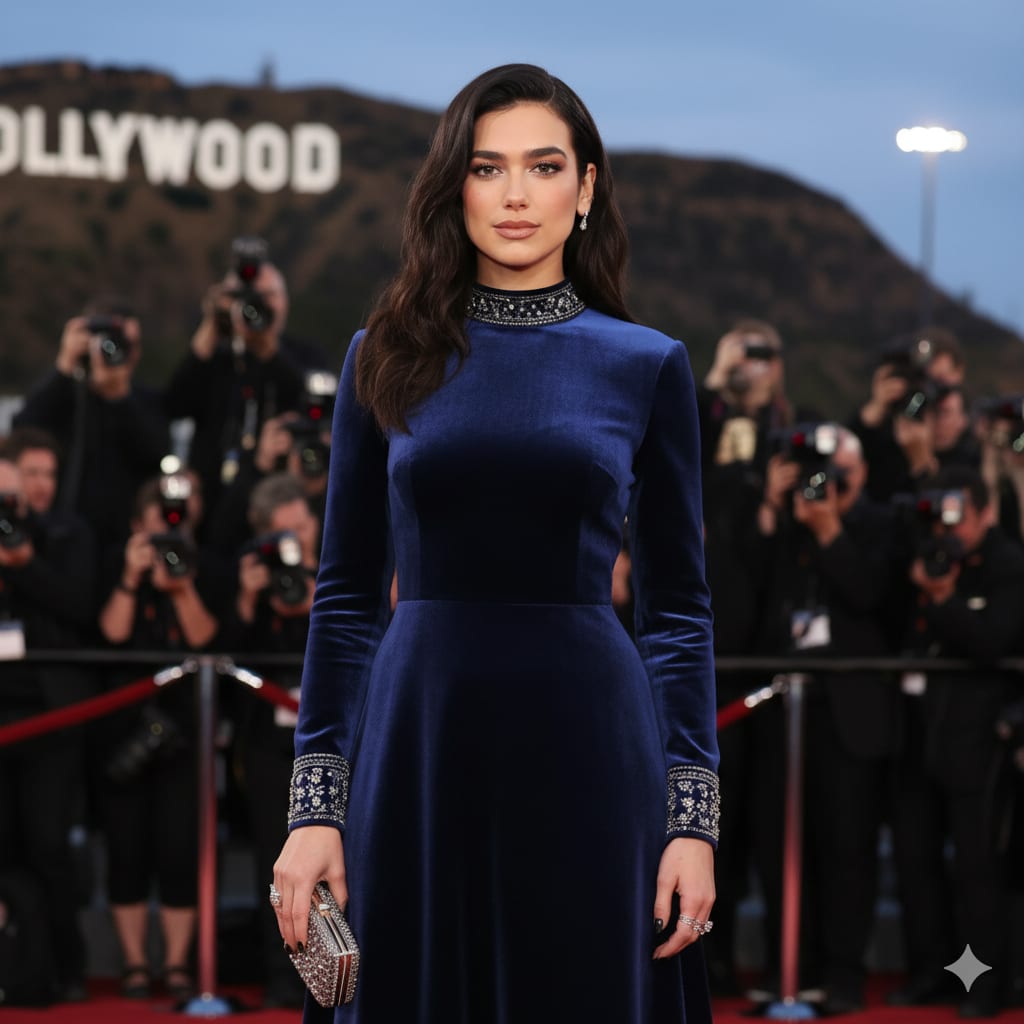
1. Born Between Worlds
The first sound that ever filled Dua Lipa’s childhood home wasn’t her own voice—it was her father’s guitar.
Music drifted through every corner of their small London apartment, a comforting constant in a world that kept shifting beneath their feet.
Born on August 22, 1995, in London, Dua was the eldest child of Albanian parents from Kosovo, who had fled the political unrest that tore apart their homeland. Her father, Dukagjin Lipa, was a marketing executive and a former rock musician in Kosovo’s band Oda. Her mother, Anesa, worked in tourism before they settled in London to rebuild their lives.
Her name, “Dua,” means love in Albanian—a prophetic symbol of the passion that would one day move millions.
Yet, the early years were not golden. Her parents worked long hours. English was foreign. The family lived simply but with purpose. And in the evenings, when her father picked up his guitar, Dua listened—eyes wide, voice small, but heart enormous.
Her earliest memories were of her father humming along to Oasis, Bowie, and Radiohead. She didn’t know it then, but those melodies were planting seeds of destiny.
---
2. The Move That Changed Everything
When Dua was 11, her family made a life-changing decision: to move back to Kosovo.
Her father had been offered a job there, and her parents wanted to reconnect their children with their roots.
But for Dua, it felt like being uprooted.
She had fallen in love with London—the chaos, the music, the sense of opportunity. Kosovo, though home in heritage, felt distant. Still, she adapted. She learned Albanian properly, made friends, and carried on.
But something inside her kept whispering: London is where your dream is.
While other kids her age were focused on school dances, Dua was scribbling lyrics in notebooks, practicing her vocals in her bedroom, and uploading her covers of Nelly Furtado and Christina Aguilera on YouTube.
She didn’t have a big studio or fancy gear—just a webcam, a laptop mic, and pure will.
Every upload felt like a prayer whispered into the void:
Please let someone out there hear me.
---
3. The Leap of Faith
At just 15 years old, Dua did something that would define her life.
She told her parents, “I’m going back to London. Alone.”
They were stunned. She was barely a teenager. But Dua was unwavering. She argued, negotiated, and promised to stay safe. Finally, her parents relented, and she moved back—living with a family friend in Camden, North London.
It was terrifying, lonely, and uncertain.
But it was freedom.
She enrolled at Parliament Hill School, then studied at the Sylvia Young Theatre School part-time, juggling education with part-time jobs as a hostess and model to pay rent.
She had no industry contacts, no backing. Only her determination.
Every night, she would stare at her tiny bedroom wall where she had taped three words:
“London. Music. Stage.”
That was her universe.
4. Rejection After Rejection
Dua began recording demos and sending them to anyone who would listen.
But no one cared.
Her emails went unanswered. Her DMs ignored.
When producers did respond, they’d say things like:
“Your voice isn’t radio enough.”
“You don’t have a market image.”
She smiled politely—but inside, she burned.
So she decided to build her own audience. She began uploading her own written songs online. Her voice was smoky, soulful, confident—old beyond her years. Slowly, it caught attention.
A modeling agency signed her briefly, not for the runway, but for exposure. It wasn’t her dream, but it paid bills—and gave her an inside look at fame’s illusion.
She once said,
> “Modeling made me realize I didn’t want to be a model. I wanted to be the reason someone else feels something.”
5. The First Break
In 2015, after years of small gigs, open mics, and unpaid studio sessions, Dua finally signed with Warner Music Group.
Her first single, “New Love,” didn’t explode—but it introduced her to the world.
Then came “Be the One.”
It wasn’t just a song. It was a heartbeat.
“I could be the one,” she sang—and the world listened.
The track went viral in Europe, topping charts in over 10 countries. Suddenly, Dua Lipa, the girl from a bedroom in London, was being played in nightclubs, cafes, and radio stations across continents.
6. New Rules, New Power
But it was 2017 that changed everything.
Her self-titled debut album, “Dua Lipa,” gave birth to an anthem that would define a generation:
“New Rules.”
It wasn’t just a breakup song—it was a manifesto for self-respect.
With its bold hook—
> “I got new rules, I count ’em” —
it became the soundtrack for every girl (and guy) who had ever needed the courage to walk away.
The song’s video went viral, racking up billions of views. Overnight, Dua Lipa became a global symbol of confidence and independence.
But behind the camera, the pressure was real.
The fame that came was sharp-edged.
Critics called her robotic, cold, overrated. She was scrutinized for her dance moves, her facial expressions, even her posture.
Instead of collapsing, she evolved.
She took dance lessons, vocal training, stage coaching—day after day.
Later, she’d say,
> “I had two choices—get crushed by judgment or grow from it. I chose growth.”
7. The Inner Struggles
Fame looks glamorous from the outside, but it’s often lonely inside.
Dua battled anxiety, imposter syndrome, and the fear of losing herself.
In interviews, she confessed:
> “I used to feel like an imposter in my own success. Like any moment, someone would realize I didn’t deserve it.”
She kept herself grounded by focusing on gratitude—calling her family daily, spending time with her friends, and writing music as therapy.
She once said,
> “Every time I doubt myself, I think of the 15-year-old me who left home with nothing. I can’t let her down.”
8. Future Nostalgia — A Revolution
In 2020, when the world shut down due to the pandemic, Dua released her second album, “Future Nostalgia.”
It wasn’t just another pop record.
It was light in a dark time.
While the world was in lockdown, her songs “Don’t Start Now” and “Levitating” became global anthems of hope, joy, and resilience.
Critics called it one of the best albums of the decade. It won Grammy Awards, topped Billboard charts, and cemented Dua as one of the most influential pop artists alive.
But what made it special was the timing.
While the world hid in fear, Dua danced. She recorded, promoted, and streamed from her apartment. Her virtual concert, Studio 2054, attracted over 5 million viewers—proof that passion can’t be quarantined.
9. Love, Loss, and Lessons
While Dua’s professional life soared, her personal life faced heartbreaks.
Her relationship with model Anwar Hadid ended after years together.
Fans speculated. The media wrote endlessly. But Dua stayed silent, dignified.
In an interview later, she said:
> “Heartbreak is human. It’s part of growth. I pour it into my songs because music heals what words can’t.”
From heartbreak came strength. From tears, transformation.
Her later works—songs like “We’re Good” and “Dance the Night”—showed a mature Dua: more reflective, self-assured, glowing not from fame but from peace.
10. From Pop Star to Global Icon
As her fame exploded, Dua didn’t just dominate charts—she began to reshape culture.
She started her own newsletter, Service95, amplifying young voices, journalists, and global stories. She also hosted a podcast, Dua Lipa: At Your Service, where she interviewed change-makers, activists, and artists.
Her goal?
> “To give people what I needed when I was growing up—stories that make you think, believe, and act.”
She collaborated with top designers, became a Versace ambassador, and even stepped into acting, starring in the 2023 Barbie movie and Argylle (2024).
But despite her superstardom, Dua never forgot her roots.
She co-founded the Sunny Hill Foundation with her father, supporting youth and education in Kosovo.
When asked what success meant to her now, she smiled and said,
> “Success is when your story helps someone else believe in theirs.”
11. The Quiet Strength
What most people don’t see about Dua Lipa is her quiet resilience.
Behind her smile is discipline—ruthless, relentless discipline.
She’s known for her strict work ethic, rehearsing for hours even when exhausted. Her team calls her “bulletproof focus.”
In one documentary clip, after a 14-hour rehearsal, someone asked her, “Don’t you ever get tired?”
She replied softly:
> “Of course. But I remember when I prayed for this life. That’s what keeps me going.”
That line—so simple, yet so profound—captures the essence of Dua Lipa.
12. Becoming the Light She Once Needed
Today, Dua stands not just as a pop star, but as a symbol of self-made strength.
A woman who left home at 15.
Who faced rejection, ridicule, and doubt.
Who fell, learned, evolved—and then conquered.
Her music isn’t just catchy—it’s courage set to rhythm.
She once said,
> “I’m not here to fit in. I’m here to make space for people like me.”
And she has.
Millions of girls now chase dreams because Dua proved it’s possible.
Millions of immigrants believe in themselves because Dua showed that roots don’t limit you—they anchor you.
From her humble London bedroom to the Grammys stage, Dua Lipa’s journey is proof that faith in oneself can rewrite destiny.
13. Legacy in Motion
Dua Lipa isn’t done.
In fact, she’s just begun.
Her third album (upcoming in 2025) promises to explore even deeper truths—about identity, love, and rebirth. She’s entering her next era not as a pop princess, but as an artist—confident, grounded, unstoppable.
Her story is a reminder that greatness doesn’t come from talent alone. It comes from grit, courage, and persistence.
Because in the end, Dua Lipa didn’t just sing about breaking rules—
She lived it.
🌟 Message from Dua’s Journey
Believe in yourself when no one else does.
Don’t wait for validation; create your own path.
Turn pain into power and criticism into fire.
And above all—never stop dancing, even when the world stands still.
---
“I was told no so many times,” Dua once said.
“But every no made my yes mean something.”
And that—
is how a girl named Love became the heartbeat of a generation. 💫
About the Creator
Frank Massey
Tech, AI, and social media writer with a passion for storytelling. I turn complex trends into engaging, relatable content. Exploring the future, one story at a time
Keep reading
More stories from Frank Massey and writers in Motivation and other communities.
From South Side to the White House: The Real Love Story of Barack and Michelle Obama
From South Side to the White House: The Real Love Story of Barack and Michelle Obama There are love stories that capture our imagination, and then there are those that redefine what partnership truly means. The story of Barack and Michelle Obama belongs to the latter — a tale of two determined souls who found each other on the South Side of Chicago and built a life that would one day inspire the world.
By Frank Massey 5 months ago in Motivation
Entrepreneur Terry Croteau -Begins New Chapter in Landscaping and Outdoor Living
Ontario, Canada — Entrepreneur Terry Croteau is beginning a new phase in his professional life, focusing on landscaping, outdoor living spaces, and a lifestyle that values both nature and personal well-being. The shift reflects a practical step forward for Croteau, combining hands-on outdoor work with a growing interest in wellness and community connection.
By Variety Press5 days ago in Motivation
The Forsyth House Fire
Since 1851, Forsyth House has stood on the corner of Union Street and Gordon Street in the heart of Glasgow. Its iconic, or was... because on Sunday 8th of March, 2026, a fire broke out in a small, seemingly un-named shop in the building and tore all that history down. As I write, the rubble is still unsettled and the street is still blocked off. Central Station is quiet on the upper level, and around 30 small businesses have quite literally gone up in smoke.
By S. A. Crawford3 days ago in The Swamp


Comments
There are no comments for this story
Be the first to respond and start the conversation.