


Nina, portrayed by Giulia Be, firmly believes in the existence of soulmates, convinced that everyone has a perfect partner awaiting them in the world. However, with the vastness and high population of Earth, finding that ideal match becomes a daunting task for most individuals. This is particularly true for Nina, who faces a time constraint due to her battle with lupus, an autoimmune disease that necessitates a kidney transplant. Her failing organs and the extensive waiting list of around 14,000 people make it difficult for her to prioritize searching for a soulmate. Moreover, Nina aspires to become a pianist in the Symphony Orchestra, requiring dedicated practice to achieve her dream.
Fortunately, fate intervenes and spares Nina from an arduous search for her soulmate. While playing the piano at a railway station, she unexpectedly encounters Gabriel, played by Henry Zaga. Although the presence of a piano at a railway station raises logical questions, it is in this serendipitous moment that Nina's inamorato appears. Gabriel, a doctor by profession, may give the impression of recklessness with his cycling habits, but he happens to work at the same hospital Nina frequents. The film's focus lies in maintaining a smooth and visually appealing narrative, avoiding complex and intense scenes that could disrupt its light-hearted ambiance.
Consequently, Beyond the Universe avoids dwelling on the challenging aspects of Nina's life, such as the distress caused by her lupus. Instead, it emphasizes the cute and fun elements of her relationship with Gabriel. The movie downplays the gravity of her situation, and as a result, the audience does not fully grasp the extent of Nina's distress.
One could argue that the film prioritizes charm and enjoyment over delving into the serious themes. Beyond the Universe devotes significant energy to portraying Nina and Gabriel as an endearing couple but hesitates to explore the more profound aspects of their circumstances. It creates a world where there are no stringent security guards, and people do not react harshly to traffic violations. The vibrant colors and the director's use of lens flares contribute to the glossy aesthetic of the film. Furthermore, the director, Diego Freitas, aims to infuse a sense of fantasy into the narrative, perceiving the love story through a cosmic lens. While the movie occasionally becomes too literal in conveying its intentions (depicting Nina and Gabriel floating in space and sharing a kiss), there are cosmic undertones to be found for those who delve deeper.
The union of Gabriel as a doctor and Nina as his patient embodies a juxtaposition of "life" and "death," evoking an otherworldly and celestial ambiance. Rain showers upon them as they make love on the terrace, as if the angels themselves weep tears of joy at their intimate experience.
Gabriel's portrayal as a doctor may not be entirely convincing, as he more closely resembles a model donning a doctor's uniform. Perhaps if the film had depicted him engaging in more medical activities like surgery or prescribing medication, his credibility as a physician would have been enhanced. Nevertheless, the movie does not explore his professional life in depth, either due to a stronger emphasis on Nina's character or a fear of exposing Gabriel's incompetence. On the other hand, Nina's portrayal as a musician feels believable, which comes as no surprise considering the actress herself is a professional singer and songwriter.
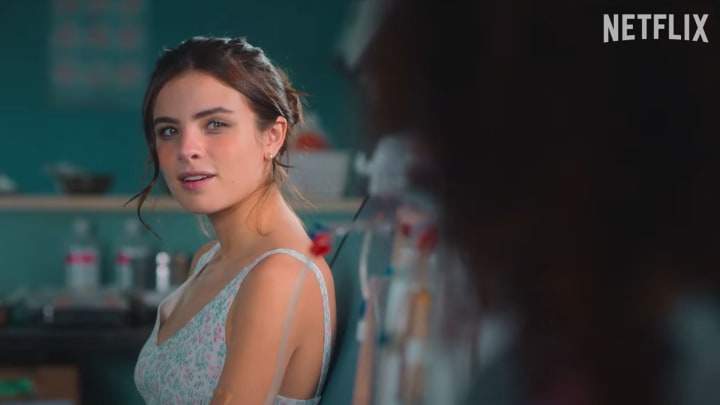
While Beyond the Universe leans towards being a cheesy and manipulative film (as evident in scenes like Gabriel's trekking sequence), its buoyancy is sustained by the chemistry between the lead actors. There were instances where their interactions stirred something within me, suggesting that their romance possesses a genuine and enchanting quality.
Despite its flaws, Beyond the Universe manages to maintain its appeal and captivate audiences due to the undeniable chemistry between the lead characters, Nina and Gabriel. Their interactions on screen evoke a sense of something profound and magical, allowing viewers to become invested in their love story.
The film, admittedly, falls into the realm of cheesiness and employs manipulative tactics to pull at the audience's heartstrings. One particular scene stands out, where Gabriel embarks on a trek, undoubtedly designed to manipulate emotions. Additionally, the movie's weightlessness and tendency to undermine emotional intensity are evident in its choice of songs during pivotal moments, further punctuating the need for improvement in its storytelling techniques.
Nevertheless, the genuine connection shared by Nina and Gabriel keeps Beyond the Universe afloat. Amidst its shortcomings, there are instances when the undeniable chemistry between the actors sparks a stirring sensation within the viewer. Perhaps, despite the film's shortcomings, their romance manages to transcend the limitations of the script.
In conclusion, Beyond the Universe may have its share of weaknesses, from its manipulation of emotions to its shallow treatment of certain themes. However, the film manages to create a captivating experience through the enchanting relationship between Nina and Gabriel. It serves as a reminder that even amidst the cheesiness and flaws, love can still hold a powerful and transformative magic that resonates with audiences.

About the Creator
M. K. Anandan
Thank you for joining me on this creative expedition. The power of storytelling, we can embark on incredible adventures, explore uncharted territories, and create a world where words hold the power to shape hearts and minds.
Keep reading
More stories from M. K. Anandan and writers in Motivation and other communities.
Viking Wolf
Viking Wolf, Norway's inaugural werewolf film, lives up to its promises. This recent addition to Netflix's collection delivers on its premise, offering a thrilling tale of a savage lycanthrope prowling a quaint Norwegian town. However, director Stig Svendsen takes a departure from the conventional origins found in such stories, opting to adapt the werewolf myth to better suit the Scandinavian backdrop. The result is a distinctive yet imperfect addition to the genre.
By M. K. Anandan3 years ago in Horror
Plugging Along
Hello friends, hope this finds you well and in good health. I remember seeing this comic strip where an older man with a gut and grey hair saw a “hiring” sign at a fast food restaurant and thought it was a good opportunity. The theme of the strip was that he was a plugger — plugging along.
By Robbie Newport3 days ago in Motivation
"Hear Me Out"
"Hear me out, what if we ran away together?" "Where do you want to go?" "Anywhere but here. We could move to a new city or to Canada, or we could disappear from society to live in the middle of the woods. Maybe a combination of two of those things would be good. What do you say?"
By Kay Husnick6 days ago in Fiction


Comments
There are no comments for this story
Be the first to respond and start the conversation.