
Barn Storming
A Boy Scout in the 1940's defends the homefront

Despite what folks tend to think, the dancer that rattles around in a pea whistle ain’t a pea. It is a pea-sized ball of synthetic cork. It’s my job to know these things. I’m an Eagle Scout now. Too much spit when you blow, and the cork gets stuck. If it’s jammed in the wrong spot you can hardly make any sound at all.
In Sacket’s Harbor, barn owls were rare, but the poor thing that lived here had its cork stuck most of the time, giving it this otherworldly rasp that folks found wholly unwelcome in the dark. The rest of the time it didn’t sound much better, but at least it squawked almost like a bird should.
The first time I heard the faulty whistle, I was eleven, a new Boy Scout who loved to explore any of the works of man or nature. I loved it so much I often felt the urge to skip school on any excuse. Even the couple of years before I met the age limit I used to dress up in my brother’s uniform so that I could look important anywhere I went. Olin was off at war fighting the Jerrys. Well, he was officially done by then, but demobilization was slow. What with the loss of manpower and all, the little jobs that needed doing for the Office of War Information and the tasks that everyone else in town hired me to do, I was welcome anywhere. I always had my sack of posters to prove it. My job was to put them up: Our Homes are in Danger; Man the Guns; We Can Do It; Save Waste Fats for Explosives; Buy War Bonds; Join a Car-sharing Club (When you ride alone, you ride with Hitler)… The government churned out more notices than the world had store windows to hold them. But you couldn’t be too careful. Given the messages, residents were nervous and still thought the Nazis would come here. There was always talk of them planting spies, even kids. It made some people quick with a gun. If I wandered off to the wrong place and anyone questioned me, I’d walk briskly, hold up a poster, and say, real serious-like, “Can’t talk. I’m on official business.”
I had plenty of business. The end of so much industry and war left us lots of abandoned buildings in town to explore. Something about the wreckage drew me in and stirred my imagination about all the things that came before me from the rusty ruins to the fallen plaster showing the old brick beneath. The poet Hopkins in a book I found in dad’s study said something that lodged in my mind, “beauty is past change.” Maybe he meant something else by it, but I knew what it meant to me.
One day after school when summer was coming, and I’d finished my chores and hired jobs, I was out on my bike investigating old storage buildings on the edge of town headed east. The road to Watertown had a fair amount of traffic but after a long gap I’d come to the last building, a barn a few hundred yards off to the side, which was busy being reclaimed by forest. I was so preoccupied I hardly noticed it was dusk and the road had emptied out. That’s when I heard the screech coming from a smashed window in the hay loft. It was so strange that the first time I thought it was a stuck whistle like you might hear in the schoolyard or maybe nails raking a blackboard. Then of course since it wasn’t a schoolyard, I heard the second screech and thought someone was moving heavy furniture, scraping it along in the barn’s upper level.
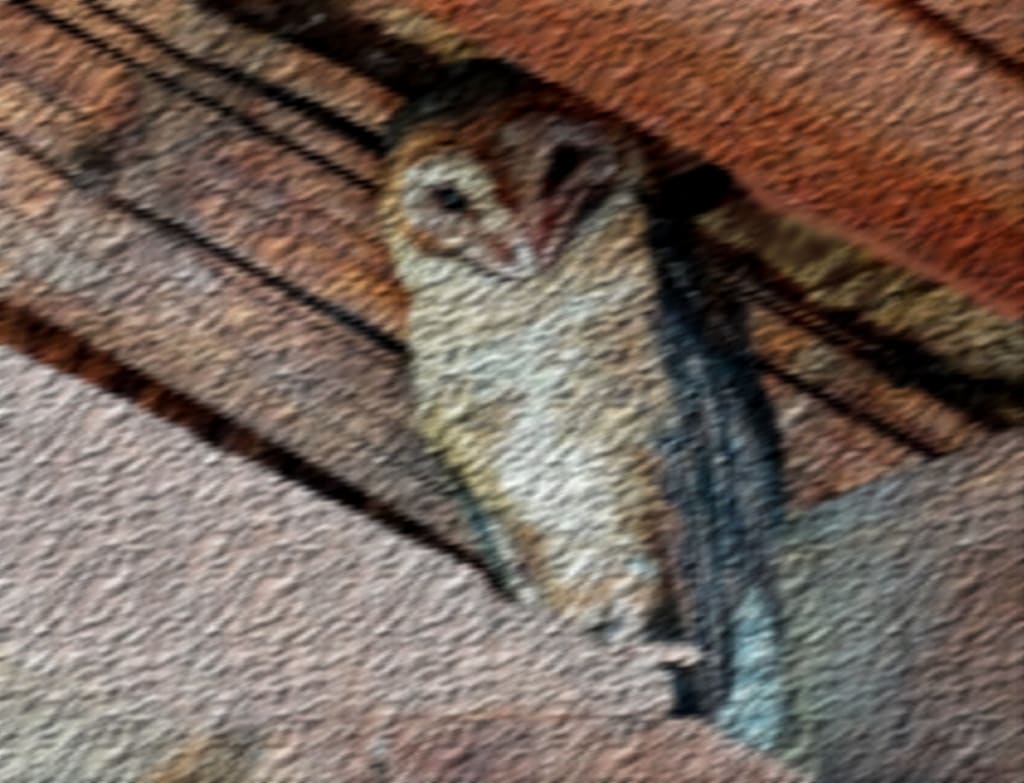
The Boy Scout’s motto, “be prepared,” was deeply infused in me. Switching on my angle head flashlight and holding it up like a torch, I trod cautiously inside the structure, shining the beam to look for rodents, and finding none in sight. By now I suspected a barn owl. When I was sure of my footing, I raised the beam to the loft platform and played it over to the window. There was not one, but two barn owls nesting there, showing their golden backs.
It’s easy to miss that there’s a pair of them because it’s the male you usually hear. In Western New York, the barn owl’s northernmost limit, most people don’t expect even one. These creatures like warmer weather than we tend to have, which makes them a rare and wonderful thing.
A burly man stepped abruptly into the barn wielding a flashlight of his own. He regarded me suspiciously and aimed his light up to see what I was looking at. My blood chilled. It was Horace Denton Flax, who everyone called “Dodge” behind his back. At least they did lately. Dodge was somewhere in his late 20s. It wasn’t until 1944 that he got called up. He must have gotten used to the idea that the whole war was going to go by while he sat pretty. The sort who feels more protective of his life than his country. Instead of answering the call, he went missing for a while and just reappeared in 1946 when induction was suspended. No one knew if he had gone to Canada or just hid in the cold woods for the duration. He was too big and ornery for most people to ask and demobilization hadn’t brought a lot of soldiers home to Sacket’s Harbor yet to challenge him.
Now he was looking hard in the high corners. Maybe he didn’t have the courage to put his own life on the line, but I’d heard he loved to shoot animals. Could he see the owl from his angle or was a beam in the way?
“That you, Gordon Petry?” he asked, turning the light my way. His tone was sharp and full of accusation. People always think that boys my age are up to something bad, but I had a strong suspicion that he had other things on his mind. Also he was staring more at my uniform than me, as though it reminded him of a failing in himself.
“Yeah, it’s me, Horace. So what? Official Boy Scout business,” I warned in the stern voice I had developed for this purpose. This rankled him.
“What business, you little liar? There are no stores here for your signs.”
I opened my sack, pulled out the poster I had sitting on top and held it up so he could see. It read it out to him as if I were giving a command, “Abandoned building. Do not trespass.” Who knew if Dodge could even read?
“You wouldn’t be putting that up this late,” he accused.
“Do you see a sign on this building? No? Then I’m putting one up.”
“Whatever you do, stay out of my way. I’m gonna shoot that ghost bird.”
“You have no reason to shoot it!”
“That damned thing has a face like a monkey and that screech makes me sick. I’m gonna come back here tomorrow with a shotgun and you’re gonna go home and mind your own business.”
“Don’t forget,” I warned, “my brother Olin will be back. So will a lot of people.” In letters home, Olin said Horace wasn’t always like this and couldn’t figure the angle. He didn’t think anyone should shirk or desert. But my grandpa Emory once said, “There’s two ways a man goes bad. There’s either the something that happens to him on the road of life, or a born weakness that doesn’t show ‘til he has reason to be scared.” Since no one could figure out the first for Horace, I figured it had to be the second.
Curious why he only talked about one of the matching birds, I poked my flashlight up again. Sure enough, one of the owls had flown. Dodge thought there was only a single nuisance, other than, of course, me.
“Naturally,” he continued stiffly, as if he just thought of something embarrassing, “I have my service revolver on me. I’d shoot it right now, but there’s no way to hit a bird with that. It will definitely have to wait.”
Service revolver? In my anger, I almost blurted out that he never joined the service. Never went to war. I almost called him Dodge. But that would have been provocation.
He turned as if to go. I did the same, but instead of leaving, I hid and watched him.
Dodge walked out the door and kept going. Good. This would give me a chance to fetch help. At least fetch the scout master.
As I pondered my resources and started to doubt anyone would care about the owl the way he did, the night grew chill and the barn owl rasped. The full moon was up, giving off a strong light. Sitting there stretching out the worry caused me much heartburn. I was about to get up when Dodge came stalking back with a twelve-gauge double barreled shotgun in his lying hand. He must have had it stashed somewhere outside waiting for me to get far away, but not far enough to bring aid.
As he broke open the breach to chamber the shells, I ran into the open and past him to a tin barrel. I banged on the tin with the metal butt of my scout knife, stirring up a racket. The birds took wing, and I hoped, fled to safety.
Angrier than ever, Dodge ran outside, found my bike, and through the wide doors I saw him shoot down at my tire with a pistol.
Then Dodge closed the shotgun and turned it on me. I dove for cover and my poster sack spilled. The one on top said, “Wanted for Murder (Careless talk costs lives). Underneath that: Our Homes are in Danger. When the blast shook the night, I didn’t know if he used both barrels or he saved one. Whatever it was, he missed me.
Before he could get another shot off, a barn owl swooped down and scratched at his face. The gun went off and bloodied his ear. Then both birds started flapping hard around him. He dropped everything and ran like he thought the Jerrys had loosed a machine gun. I was sure he’d lost his appetite for bird hunting in barns, though I kept watch a while just in case.
Did Dodge really mean to shoot me? I don’t know. It was a good day, though. I checked my tire to find that it was only nicked. The inner tube was sound. Be prepared. I pulled the repair kit out of my pack, patched the wheel, waited for it to set, and climbed back on my bike. The sun would soon rise. The scout master would want a full report and I planned to put a thing or two about owls in there.
Despite what folks tend to think, barn owls don’t like to migrate. Like me, maybe they have no choice. They memorize every hunting ground in their home range, and when there’s more food in summer, stay close to the nest. And sometimes they know they have to—just have to—defend it.
About the Creator
Ben Parris
Author of seven books including the Wade of Aqutiaine series and Mars Armor Forged as well as numerous short stories in anthology collections. He lives in New York.
Keep reading
More stories from writers in Motivation and other communities.
“This Story Will Change the Way You Think”
Ethan had always felt like life was moving forward without him. Every morning, he woke up with plans and went to bed with disappointment. He worked hard, stayed honest, and tried to do the right things, yet nothing seemed to work. Promotions went to others. Opportunities appeared for people who seemed less deserving. Over time, Ethan began to believe that effort didn’t matter—that success was reserved for a lucky few. He often told himself, “Maybe I’m just not meant for more.” One evening, after another long and tiring day, Ethan missed the last bus home. With no other choice, he started walking. The city was unusually quiet, and the streets felt longer than usual. As he passed a small tea stall near a closed bookstore, he noticed an elderly man sitting alone, slowly turning the pages of an old notebook. The notebook caught Ethan’s attention. Its pages were yellow, but every line was written carefully, as if each word mattered. “Are you writing a story?” Ethan asked. The old man looked up and smiled. “No,” he said gently. “I’m rewriting my life.” That answer confused Ethan, but he sat down anyway. “What does that mean?” Ethan asked. The old man closed the notebook. “For years, I blamed the world for everything I didn’t become. Then one day, I realized the story I kept telling myself was the real problem.” Ethan felt uncomfortable. The words felt personal. The old man continued, “Tell me, young man—what story do you tell yourself every day?” Ethan hesitated. Then he spoke honestly. “That no matter how hard I try, it won’t be enough.” The old man nodded slowly. “And so life agrees with you.” That sentence hit Ethan harder than he expected. “What do you mean?” he asked. “Life listens,” the old man replied. “Not to your words—but to your beliefs. If you believe effort is useless, you will unconsciously prove yourself right.” Ethan laughed nervously. “So you’re saying my thoughts control my life?” “No,” the old man said. “Your thoughts control your actions. And your actions shape your life.” The rain started falling lightly. People rushed past, but Ethan stayed. For the first time in a long while, he felt like someone was speaking the truth he had been avoiding. The old man opened his notebook and showed Ethan a page. It had two columns. On the left side, it said: What I Fear On the right side, it said: What I Can Control “Most people,” the old man explained, “live on the left side. They fear failure, rejection, and judgment. Few people live on the right side—where effort, learning, and patience exist.” That night, Ethan walked home thinking deeply. He realized how often he replayed his mistakes, how often he compared his life to others, and how rarely he focused on what he could improve today. The next morning, Ethan made a small decision. He stopped saying, “Why does this always happen to me?” Instead, he asked, “What is this teaching me?” At work, he stopped waiting for motivation and started building discipline. He arrived earlier, learned skills outside his job, and asked questions instead of pretending to know everything. Some days were painful. Old habits tried to pull him back. There were moments when quitting felt easier than continuing. But Ethan remembered the notebook. What can I control? He couldn’t control promotions. He couldn’t control opinions. But he could control his effort. Months passed. Slowly, things began to shift—not dramatically, but meaningfully. Ethan gained confidence. His work improved. People started noticing his consistency. One afternoon, his manager called him into the office. Ethan expected criticism, but instead, he received an opportunity to lead a small project. It wasn’t a reward—it was a test. Ethan accepted. The project was difficult. Mistakes were made. Pressure was constant. But for the first time, Ethan didn’t run from responsibility. He faced it. The project succeeded. That success didn’t make him rich. It didn’t make him famous. But it changed something far more important. Ethan no longer saw himself as a victim of circumstances. Years later, Ethan walked past the same tea stall. The bookstore was still closed. The city still rushed. But the old man was gone. Ethan smiled, understanding the lesson at last. Life had never been against him. Life had been responding to the story he believed. When he changed the story, life changed the direction. Final Lesson Change the story you tell yourself—and your life will follow.
By Inayat khan6 days ago in Motivation



Comments
There are no comments for this story
Be the first to respond and start the conversation.