
“This Story Will Change the Way You Think”
“Sometimes one small story carries a lesson that can change your entire mindset.”
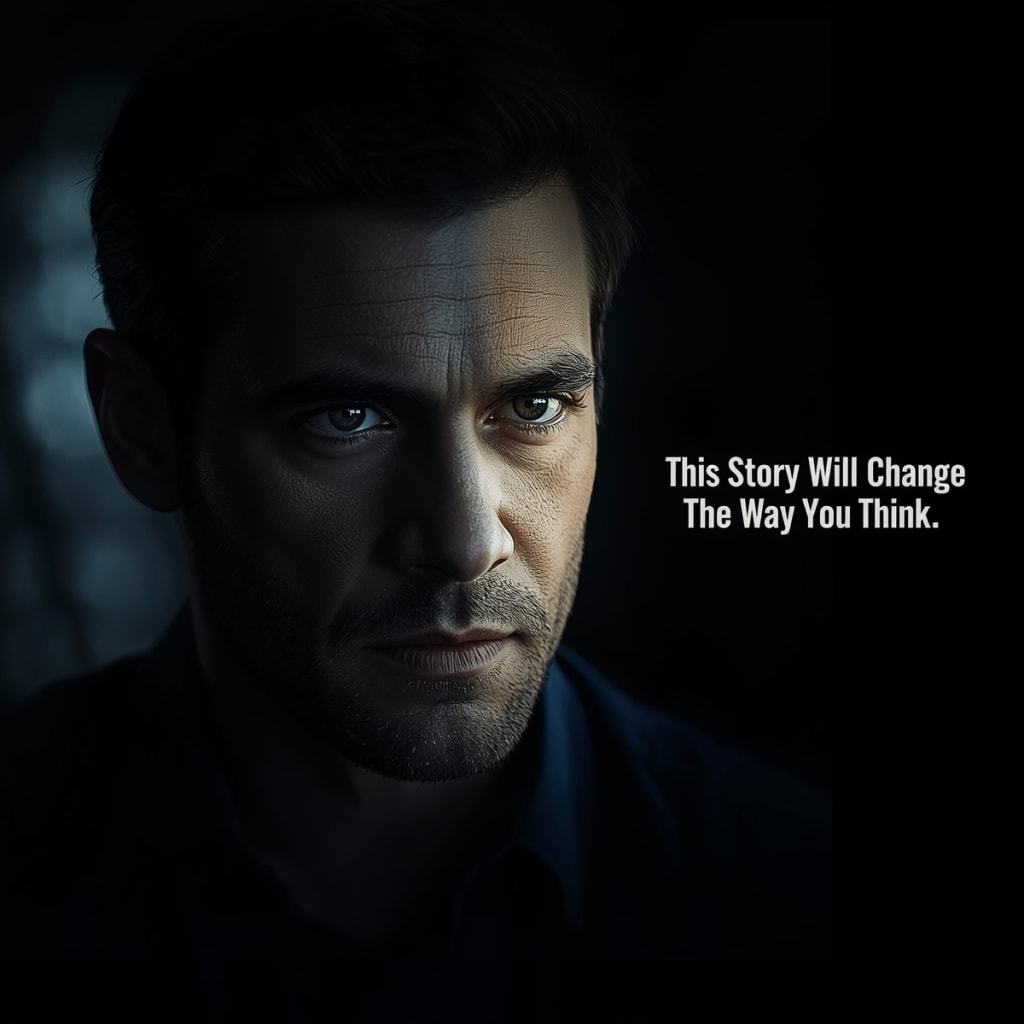
Ethan had always felt like life was moving forward without him.
Every morning, he woke up with plans and went to bed with disappointment. He worked hard, stayed honest, and tried to do the right things, yet nothing seemed to work. Promotions went to others. Opportunities appeared for people who seemed less deserving. Over time, Ethan began to believe that effort didn’t matter—that success was reserved for a lucky few.
He often told himself, “Maybe I’m just not meant for more.”
One evening, after another long and tiring day, Ethan missed the last bus home. With no other choice, he started walking. The city was unusually quiet, and the streets felt longer than usual. As he passed a small tea stall near a closed bookstore, he noticed an elderly man sitting alone, slowly turning the pages of an old notebook.
The notebook caught Ethan’s attention. Its pages were yellow, but every line was written carefully, as if each word mattered.
“Are you writing a story?” Ethan asked.
The old man looked up and smiled.
“No,” he said gently. “I’m rewriting my life.”
That answer confused Ethan, but he sat down anyway.
“What does that mean?” Ethan asked.
The old man closed the notebook.
“For years, I blamed the world for everything I didn’t become. Then one day, I realized the story I kept telling myself was the real problem.”
Ethan felt uncomfortable. The words felt personal.
The old man continued,
“Tell me, young man—what story do you tell yourself every day?”
Ethan hesitated. Then he spoke honestly.
“That no matter how hard I try, it won’t be enough.”
The old man nodded slowly.
“And so life agrees with you.”
That sentence hit Ethan harder than he expected.
“What do you mean?” he asked.
“Life listens,” the old man replied. “Not to your words—but to your beliefs. If you believe effort is useless, you will unconsciously prove yourself right.”
Ethan laughed nervously.
“So you’re saying my thoughts control my life?”
“No,” the old man said. “Your thoughts control your actions. And your actions shape your life.”
The rain started falling lightly. People rushed past, but Ethan stayed. For the first time in a long while, he felt like someone was speaking the truth he had been avoiding.
The old man opened his notebook and showed Ethan a page. It had two columns.
On the left side, it said:
What I Fear
On the right side, it said:
What I Can Control
“Most people,” the old man explained, “live on the left side. They fear failure, rejection, and judgment. Few people live on the right side—where effort, learning, and patience exist.”
That night, Ethan walked home thinking deeply. He realized how often he replayed his mistakes, how often he compared his life to others, and how rarely he focused on what he could improve today.
The next morning, Ethan made a small decision.
He stopped saying, “Why does this always happen to me?”
Instead, he asked, “What is this teaching me?”
At work, he stopped waiting for motivation and started building discipline. He arrived earlier, learned skills outside his job, and asked questions instead of pretending to know everything.
Some days were painful. Old habits tried to pull him back. There were moments when quitting felt easier than continuing. But Ethan remembered the notebook.
What can I control?
He couldn’t control promotions.
He couldn’t control opinions.
But he could control his effort.
Months passed. Slowly, things began to shift—not dramatically, but meaningfully. Ethan gained confidence. His work improved. People started noticing his consistency.
One afternoon, his manager called him into the office. Ethan expected criticism, but instead, he received an opportunity to lead a small project. It wasn’t a reward—it was a test.
Ethan accepted.
The project was difficult. Mistakes were made. Pressure was constant. But for the first time, Ethan didn’t run from responsibility. He faced it.
The project succeeded.
That success didn’t make him rich. It didn’t make him famous. But it changed something far more important.
Ethan no longer saw himself as a victim of circumstances.
Years later, Ethan walked past the same tea stall. The bookstore was still closed. The city still rushed. But the old man was gone.
Ethan smiled, understanding the lesson at last.
Life had never been against him.
Life had been responding to the story he believed.
When he changed the story,
life changed the direction.
Final Lesson
Change the story you tell yourself—and your life will follow.
About the Creator
Keep reading
More stories from Inayat khan and writers in Motivation and other communities.
“Alone in the Cold, Walking Toward a Dream No One Believed In”
The Long Walk No One Applauded The penguin did not know why he started walking. There was no dramatic goodbye, no sudden disaster that forced him away. One morning, he simply stood at the edge of the colony and felt something unfamiliar pressing against his chest—an unease that could not be named. Around him, the others huddled close, sharing warmth, sharing noise, sharing certainty. Everything was as it had always been. And yet, something was missing. The ice stretched endlessly ahead, pale and unforgiving. No one walked that way unless they were lost, reckless, or foolish. The elders said nothing good waited beyond the familiar paths. The young laughed at the idea of leaving safety behind. Even the wind seemed to whisper warnings. Still, the penguin took one step forward. Then another. At first, he expected someone to call out to him. A voice telling him to come back. A wing pulling him gently home. But no one noticed. Or maybe they noticed and chose not to care. Either way, silence followed him as faithfully as his shadow. The cold deepened with every step. Snow crept into his feathers, biting at his skin. The ground was uneven, cracked in places, deceptively smooth in others. Each footstep left a mark behind—small, temporary, easily erased by the wind. He wondered if his journey would be just as temporary. By the second day, doubt arrived. It did not come loudly. It never does. It slipped into his thoughts quietly, asking reasonable questions. Why are you doing this? What are you trying to prove? Who do you think you are? Doubt walked beside him like an old friend, matching his pace, never pushing, never pulling—just talking. He stopped once, turning back to look at the horizon behind him. The colony was no longer visible. Only endless white in every direction. For the first time, fear outweighed curiosity. He sat down on the ice, tucking his head into his chest. The wind howled above him, indifferent to his smallness. Tears froze before they could fall. He thought of warmth. Of belonging. Of how easy it would be to turn around and pretend this walk had never happened. But when he stood again, he surprised himself by facing forward. He did not feel brave. He felt stubborn. And sometimes, that was enough. Days blurred together. The sky shifted from gray to darker gray. Hunger gnawed at him, sharp and constant. His steps slowed. His body ached. There were moments when he whispered apologies—to himself, to the life he had abandoned, to the life he had not yet earned. No one watched him struggle. No one recorded his persistence. There were no medals for continuing when quitting made sense. At night, he dreamed of voices calling his name, but he could never see their faces. He woke each morning with the same question: Is this worth it? The answer did not come. Instead, something else did. On the seventh day, the storm arrived. It came without warning, swallowing the sky and the ground until there was no difference between up and down. Snow struck him sideways, fierce and blinding. The wind roared like a living thing, furious at his existence. He fell more than once, struggling to rise, his legs trembling beneath him. This was where journeys ended. Curled against a jagged ridge of ice, he waited for the storm to decide his fate. He was too tired to fight it, too tired to think. All he could do was breathe and hope the cold did not steal that too. In the quiet space between exhaustion and sleep, he understood something important. No one was coming to save him. And strangely, that realization did not break him. It steadied him. When the storm finally passed, it left behind a transformed world. The ice glimmered under a pale, fragile sun. The air was sharp but still. The silence felt different now—not empty, but respectful. The penguin stood slowly, testing his weight, expecting pain that never came. He was thinner. Weaker. But still standing. Ahead, far in the distance, something rose from the ice. A mountain. Its peak pierced the clouds, dark and resolute, a red flag fluttering at its summit. He did not know what the flag meant or who had placed it there. He only knew that seeing it made his heart beat faster. For the first time since he began walking, he smiled. The path toward the mountain was not easier. If anything, it was harder. The slope was steep, the air thinner. Each step demanded effort. But now, every step had direction. The doubts returned, quieter now, less convincing. Fear still existed, but it no longer controlled him. Pain became familiar, almost comforting—a reminder that he was alive and moving. As he climbed, memories surfaced. Moments of being overlooked. Of being told he was too slow, too quiet, too different. Of being laughed at for wanting more than survival. Those memories no longer hurt. They fueled him. By the time he reached the summit, the sky had begun to soften into evening. The red flag snapped gently in the wind. The world below stretched endlessly, beautiful and brutal and real. He stood there alone. No crowd cheered. No one documented the moment. And yet, something inside him settled into place. He had not walked to be seen. He had walked to become. The penguin planted his feet firmly on the ice and looked outward, knowing one truth with absolute clarity: The journey that changes you most is the one no one notices. And sometimes, the quietest victories are the ones that matter the most.
By Inayat khanabout a month ago in Motivation
When Insight Does Not Translate Into Change
There is a common experience where something finally makes sense, yet life remains unchanged afterward. The connection is clear. The reasoning holds. The conclusion feels settled. And still, nothing moves. This gap between understanding and embodiment is not rare, and it is not primarily a failure of intelligence or sincerity. It is a structural gap between knowing what is true and living in alignment with it.
By Peter Thwing - Host of the FST Podcast2 days ago in Motivation
The Piggy Project
I’ve had so many names in this life I lose track of which ones were ever really mine and which ones I wore because someone needed me to. Some were handed to me before I had words to refuse them, before I knew what they meant, before I knew I could say no. Most weren’t meant to hurt. That doesn’t mean they didn’t leave marks. Marks that told me who I belong to, who I am by way of who claims me, recognizes me in the good and bad, who walks beside me.
By Fatal Serendipity5 days ago in Confessions


Comments
There are no comments for this story
Be the first to respond and start the conversation.