

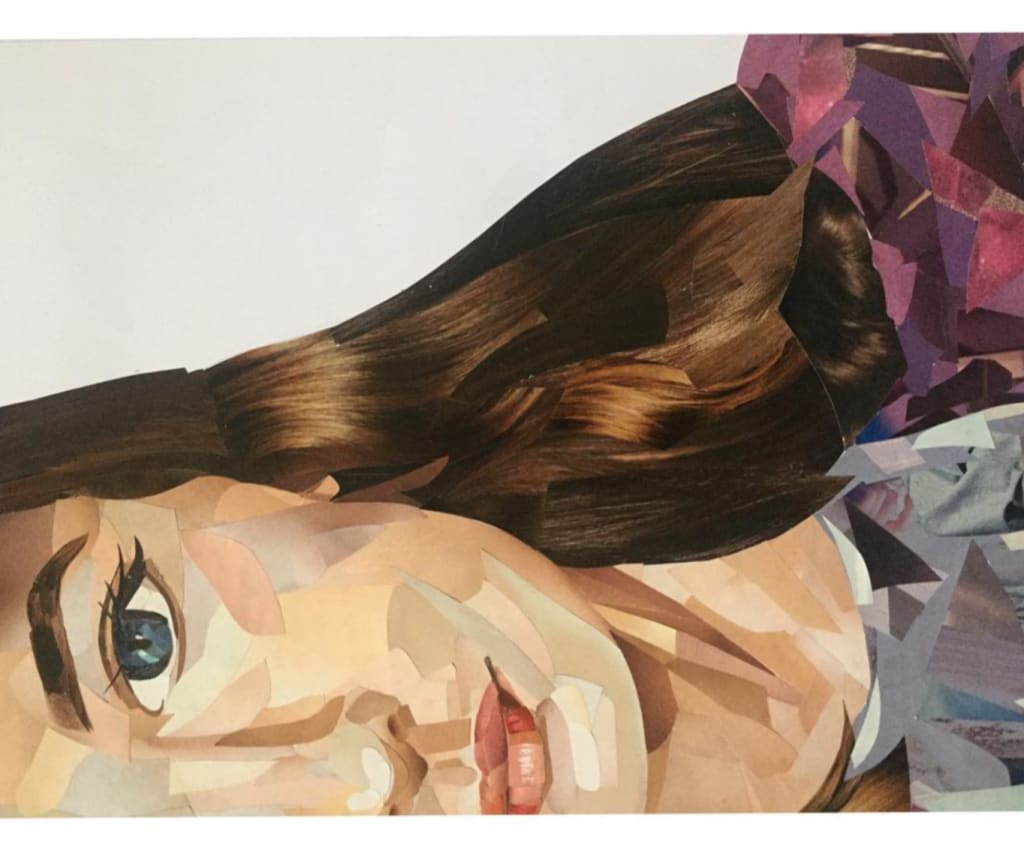
As with many creative hobbies, collage began, ultimately, as a way of making sense of the world. What can we control except what is right in front of us?
While the materials may vary from time to time (health leaflets from the GP here, fabric taken from old cushions there), there is a constant, a refrain of the collective works: magazine pages.
But magazine culture, we are now told, presents one version of reality with its edits, its censorship, its narrow, colourless focus. Too afraid, by all accounts, to stretch beyond the edges of its pages. What if we don’t fit neatly inside them? Where do we belong when we cannot see ourselves?
And so collage began. There’s a particular version of reality that exists inside every individual’s person’s mind: it would be impossible, no doubt, to see them all on the popular page. Like horoscopes, grasping onto the token detail and hoping we yearn just enough to situate our own feet in the very centre of that story. Like we’re the only Aries to feel fed up at work that particular week (and why does mercury always seem to be in retrograde? A question for another time).
Inspiration is found in the every day, the mundane, the very object that becomes the art (before the catalyst, before the butterfly). How can something so ordinary, so mass-produced, become something unique?
Well, of course, you have to cut it to shreds.
Not only is there a cathartic release in the destruction of the object, there is also a thrill in doing it in such a way that you know it has a purpose. In its destruction it's given meaning. The blade glides around a particular line, divides two disparate colours, all in the knowledge that it will be reunited again as a whole.
Then there is that pride that comes with the assembly of these pieces, blended seamlessly (or not, as the choice may be) into a deliberate story, a specific moment in time. That feeling is better than the sound of the scissors tearing down the grain in the first place.
And then one day it’s your own reflection in the mirror, distorted by all those pages you never quite found yourself inside, itching to be retold. A blank, new page stares back at you.
And you scramble together every page of that glossy subscription you’d ever torn out and saved: folded down the corner, important articles starred with that same glossy gold pen you’ve had since you were twelve (some things we can never throw away). You cut and paste, the scissors and glue kind — there are no computers here — and begin to draw yourself on the page, growing in life as in colour, in texture. I must mean something. The last half of that article you only ever glanced at (‘12 lessons for loving yourself’) but saved anyway, covered in glue, pasted to a surface no one will see, a title no one will read. But you know that it’s there, sacrificed only for the iridescent blue you need to construct those eyes. Captured in the moment to look for eternity.
And maybe you shape the brows, lighten those trenches beneath your eyes. The darkest mauve (once a printed lid of a moisturiser in double-page advert) lifts your cheek bone — but who will know the difference? This is, you’re sure, how you’re supposed to look. Those brown locks are far more luscious on paper, it would seem, but there are no dull browns to tear up or choose from. So this is how you look in that world — recognisable, perhaps. But different. Better, by all accounts.
Collage seems to be, ultimately, a metaphor for this very life — you try, desperately, to piece together the scraps and hope that, in the end, they create something beautiful.
Even if you no longer recognise the face staring back at you.
About the Creator
Keep reading
More stories from Alex Roden and writers in Motivation and other communities.
Why Influential Women Magazine Is Redefining Modern Influence
In today’s digital-first world, influence is often reduced to numbers - followers, views, and visibility. But modern leadership is quietly shifting away from performative presence toward something far more meaningful. Influential Women Magazine is at the forefront of this shift, redefining influence as impact, intention, and integrity rather than attention alone.
By influentialwomenmagazine4 days ago in Motivation




Comments
There are no comments for this story
Be the first to respond and start the conversation.