
United States Cannabis Market Size & Forecast 2026–2034
From Regulation to Revenue: How Cannabis Is Becoming One of America’s Fastest-Growing Industries

Introduction
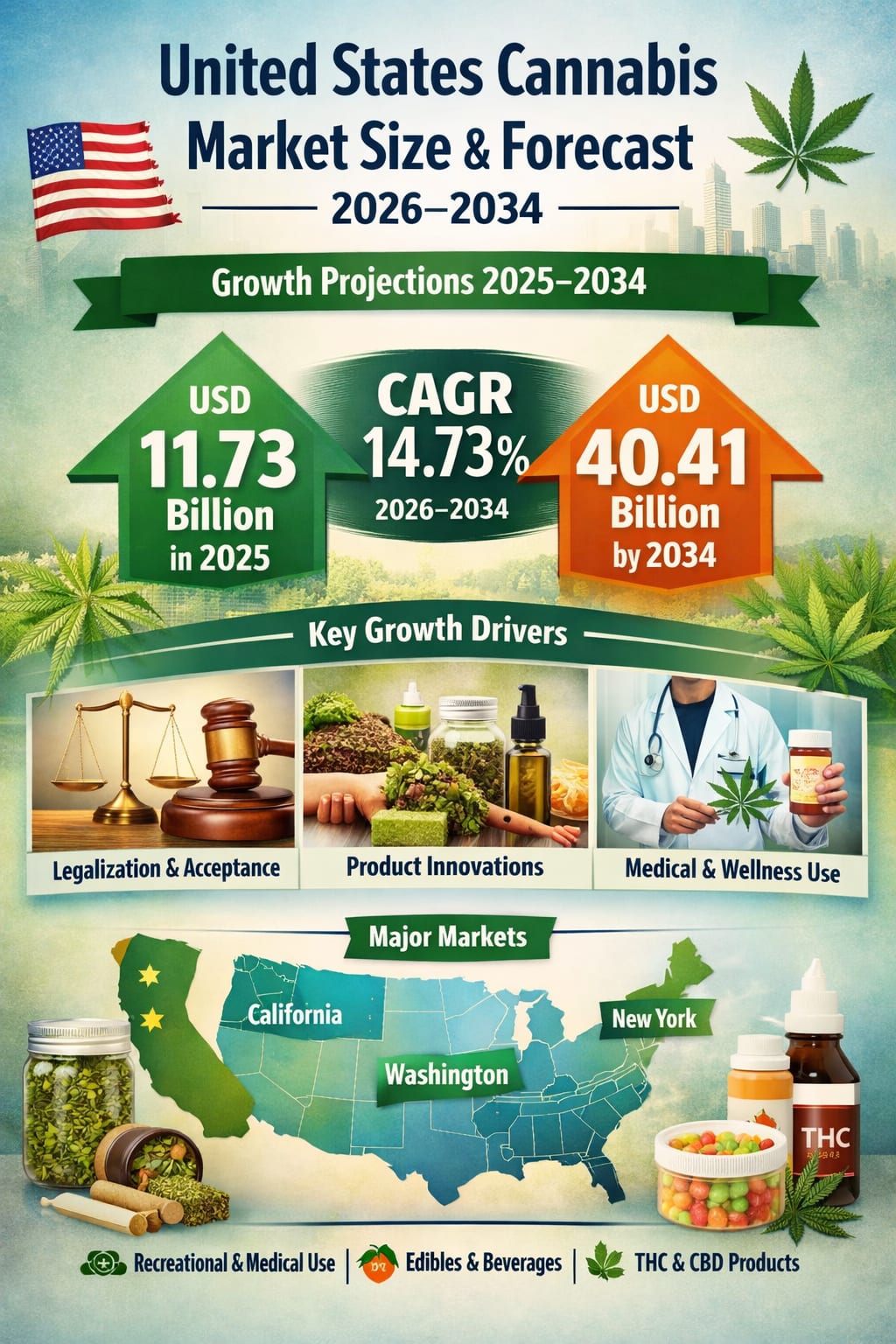
The United States cannabis market is entering a decisive growth phase, transforming from a once-restricted industry into one of the country’s most dynamic and commercially promising sectors. According to Renub Research–based projections, the U.S. cannabis market is expected to expand from USD 11.73 billion in 2025 to USD 40.41 billion by 2034, registering a strong compound annual growth rate (CAGR) of 14.73% between 2026 and 2034.
This expansion is being driven by continued state-level legalization, rising acceptance of marijuana for both medicinal and recreational use, and sustained investments across cultivation, retail infrastructure, and product innovation. As consumer spending patterns diversify, cannabis is steadily positioning itself as one of the most structured and regulated growth industries in the U.S. economy.
United States Cannabis Market Outlook
Cannabis contains active compounds known as cannabinoids, most notably THC and CBD, which interact with the body’s endocannabinoid system. These compounds are responsible for cannabis’ therapeutic and psychoactive effects. Today, cannabis is consumed in a wide variety of forms, including dried flowers, edibles, oils, tinctures, concentrates, beverages, and wellness products.
Once stigmatized and heavily restricted, cannabis has experienced a resurgence due to its growing role in pain management, anxiety relief, sleep improvement, and chronic disease care. Scientific research and changing public attitudes have played a major role in redefining cannabis from a taboo substance into a mainstream consumer and medical product.
In the United States, legalization at the state level has significantly expanded access. Millions of Americans now use cannabis for recreational enjoyment, wellness routines, or medical treatment. Continuous product innovation—such as micro-dosed edibles, fast-acting beverages, and CBD-based wellness solutions—has broadened consumer appeal while improving safety, consistency, and predictability.
Key Growth Drivers of the U.S. Cannabis Industry
Expanding Legalization and Cultural Acceptance
State-level legalization remains the most influential driver of cannabis market growth in the United States. As more states permit medical and adult-use cannabis, consumer access expands and participation rises sharply. This legal momentum is reinforced by growing public approval, scientific validation, and recognition of cannabis’ therapeutic potential.
Beyond consumer demand, states are motivated by tax revenues, job creation, and economic diversification. Regulated dispensaries provide consumers with safe, tested products, reducing reliance on illegal markets and improving overall industry credibility. Surveys consistently show overwhelming public support for legalization, highlighting the permanence of cannabis’ role in American society.
Product Innovation and Consumer Diversification
Innovation is reshaping the cannabis marketplace. While traditional flower products remain popular, rapid growth is occurring in edibles, beverages, concentrates, topicals, pre-rolls, and vapor products. These formats attract consumers who prefer alternatives to smoking and enable precise dosing for wellness-oriented users.
Micro-dosed and fast-acting products appeal to first-time users and health-conscious consumers, while premium offerings such as terpene-rich strains, solventless extracts, and infused pre-rolls target experienced buyers. Additionally, the development of minor cannabinoids like CBG, CBN, and THCV is opening new use cases related to sleep, inflammation, focus, and appetite management.
Branding, packaging design, and flavor innovation are also elevating cannabis into a consumer packaged goods category that increasingly mirrors mainstream food, beverage, and wellness markets.
Medical Adoption and Healthcare Integration
Medical marijuana continues to play a foundational role in the U.S. cannabis ecosystem. Patients increasingly rely on cannabis for chronic pain, anxiety, epilepsy, cancer-related symptoms, PTSD, and sleep disorders—often as an alternative to pharmaceuticals with heavier side effects.
The opioid crisis has further accelerated interest in cannabis as a harm-reduction tool. Many states have developed structured medical programs with physician oversight, standardized dosing, and patient education initiatives. Ongoing research and discussions around insurance coverage are strengthening cannabis’ legitimacy within healthcare conversations.
Challenges Facing the U.S. Cannabis Market
Federal Illegality and Regulatory Fragmentation
Despite widespread state legalization, cannabis remains illegal at the federal level, creating regulatory complexity and operational inefficiencies. Each state maintains unique licensing, taxation, packaging, and compliance requirements, making nationwide expansion costly and complicated.
Interstate commerce restrictions force companies to duplicate cultivation and manufacturing facilities across states. Additionally, limited access to traditional banking services results in cash-heavy operations, increasing security risks and administrative burdens. These structural challenges continue to restrict the industry’s full economic potential.
High Taxes and Illicit Market Competition
Excessive state and local taxes inflate retail prices, making legal cannabis less competitive against illicit alternatives. In regions with delayed licensing or weak enforcement, illegal markets continue to thrive, eroding legal sales and tax revenues.
At the same time, oversupply in mature markets has driven wholesale prices downward, pressuring margins for growers and manufacturers. Balancing tax policy, enforcement, and supply management remains a critical challenge for regulators and businesses alike.
Key Market Segments
United States Cannabis Flower Market
Cannabis flower remains the largest and most established segment of the U.S. market. Consumers value flower for its affordability, strain diversity, terpene profiles, and immediate effects. Its versatility for smoking, vaporizing, or infusing ensures continued relevance.
High-quality indoor flower commands premium pricing among experienced consumers, while constant genetic innovation keeps the category competitive despite growth in alternative formats.
Pre-Rolls and Convenience Products
Pre-rolls represent one of the fastest-growing segments due to their convenience, portability, and predictable dosing. Infused pre-rolls, multi-packs, and flavored options are expanding appeal, particularly among new and social users. Increasingly, pre-rolls are evolving into lifestyle products similar to specialty cigarettes.
Medical Marijuana Market
Medical cannabis remains essential to the national market structure. Patients often prefer capsules, tinctures, topicals, and balanced THC-CBD formulations tailored to specific conditions. With physician guidance and controlled potency, medical marijuana continues to gain trust as a therapeutic alternative to traditional pharmaceuticals.
Adult-Use (Recreational) Cannabis Market
Adult-use cannabis generates the majority of revenue in legalized states. Consumers purchase products for relaxation, creativity, socialization, and enjoyment across multiple formats. Retail experience, brand identity, and product availability play a major role in customer loyalty. As more states transition from medical-only to recreational frameworks, this segment is expected to dominate national growth.
THC-Dominant and Minor Cannabinoid Segments
THC-dominant products remain the most popular due to their psychoactive effects and therapeutic applications for pain, nausea, and insomnia. Meanwhile, interest in minor cannabinoids such as CBG, CBN, CBC, and THCV is accelerating, driven by wellness-focused consumers seeking targeted benefits beyond traditional THC experiences.
State-Level Market Highlights
California remains the largest cannabis market, driven by scale, innovation, and cultural influence despite high taxes.
New York is emerging rapidly due to population size, equity-focused licensing, and strong consumer demand.
Washington represents a mature, price-competitive market with advanced cultivation and product standards.
Competitive Landscape
The U.S. cannabis market features a mix of vertically integrated operators, multi-state brands, and product innovators. Companies compete on scale, product diversity, branding, retail reach, and regulatory expertise. Competitive analysis typically includes company overviews, leadership insights, recent developments, SWOT assessments, and revenue performance.
Final Thoughts
The United States cannabis market is no longer an emerging experiment—it is a rapidly maturing industry with long-term economic significance. With projected growth from USD 11.73 billion in 2025 to USD 40.41 billion by 2034, cannabis is positioned to become one of America’s most influential regulated markets.
While challenges related to federal legality, taxation, and illicit competition remain, sustained legalization, innovation, and consumer acceptance continue to drive momentum. As regulation stabilizes and market structures evolve, cannabis is set to play an increasingly central role in healthcare, wellness, and consumer lifestyles across the nation.
About the Creator
Keep reading
More stories from shibansh kumar and writers in Trader and other communities.
United States Artificial Intelligence in Pharmaceutical Market Size and Forecast 2026–2034
United States Artificial Intelligence (AI) in Pharmaceutical Market Overview The United States Artificial Intelligence in Pharmaceutical Industry is entering a decisive growth phase, driven by the convergence of advanced computing, biological data expansion, and urgent demand for faster, cost-effective drug development. According to Renub Research, the market is projected to expand from USD 0.97 million in 2025 to USD 16.78 million by 2034, reflecting an impressive compound annual growth rate (CAGR) of 37.23% during 2026–2034.
By shibansh kumarabout 8 hours ago in Trader
Ceramics Market: Trends, Innovations, and Industry Growth
Overview The ceramics market is a dynamic and expansive sector that spans a wide range of applications, from traditional pottery and tiles to cutting-edge industrial ceramics used in electronics, aerospace, and medical devices. Ceramics are prized for their durability, heat resistance, and insulating properties, making them essential in various high-tech and manufacturing applications. The market is being influenced by technological advancements, growing demand for eco-friendly products, and innovations in smart ceramics. This industry is experiencing significant growth, particularly in emerging markets, driven by infrastructure development and rising consumer interest in ceramic products for both functional and aesthetic purposes.
By James Smith3 days ago in Trader
Australia Payments Market: USD 1.34 Trillion by 2033—A Cashless Future in Motion
The Australia payments market is undergoing a profound shift as digital transaction technologies replace traditional cash and reshape how businesses and consumers exchange value. According to IMARC Group’s latest analysis, the market reached USD 806.4 billion in 2024 and is projected to grow to USD 1,341.7 billion by 2033, exhibiting a CAGR of 5.3% over 2025–2033.
By Rashi Sharmaabout 13 hours ago in Trader


Comments
There are no comments for this story
Be the first to respond and start the conversation.