
Two faces of solitude
What no one ever told you about solitude

“Solitude.”
It’s one of those words that, the moment it’s spoken, leaves a cold trail, a sense of unease. In everyday language, “being alone” is often associated with sadness, lack, and isolation. It’s a condition we fear, avoid, and hide behind polite smiles and constant notifications.
And yet, millions of people live with solitude every day. According to a global survey conducted by Gallup in 2023, one in four people feels lonely on a regular basis. Despite—or perhaps because of—constant connectivity, solitude has become a widespread, silent reality.
Who suffers the most? Young people between the ages of 18 and 24.
Yes, them. The ones who spend hours chatting, scrolling, commenting. The most recent data shows that younger generations feel lonelier than older ones. But why?
Perhaps because they don’t know what to do with solitude. They’ve never truly known it.
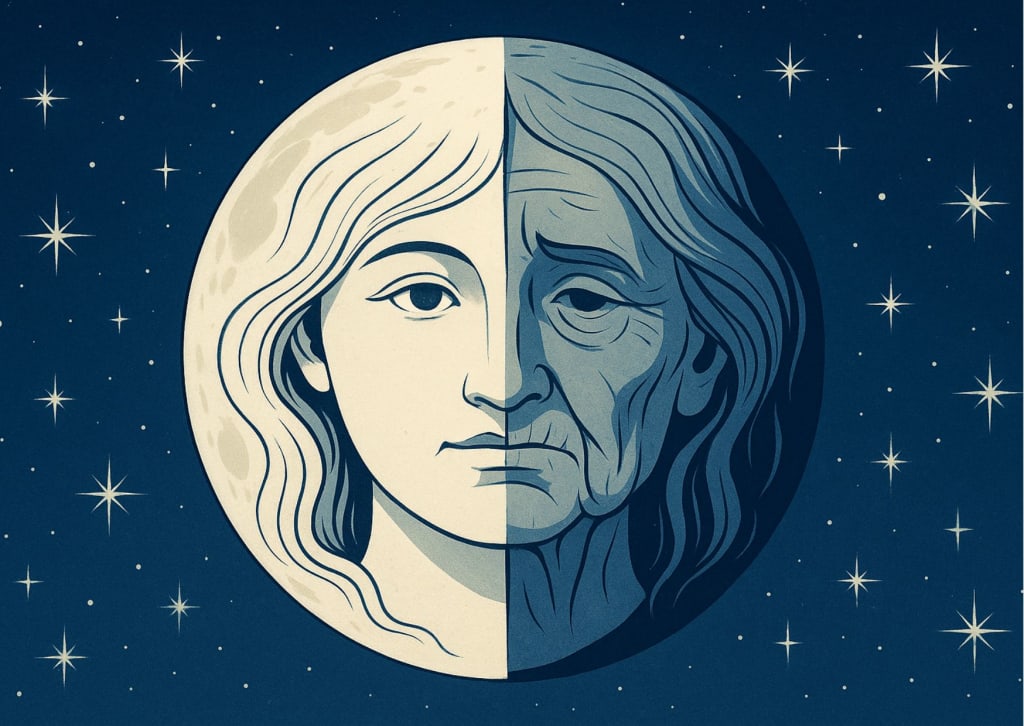
For them, it’s only lack. Only emptiness—painful and sad. Only the visible side of the Moon.
But there’s another side, one less often told…
We live in a world made of opposites. Day and night. Light and shadow. Motion and stillness. Duality is a law of existence. And solitude is no exception: it, too, has two faces. To truly understand who we are, we must learn to recognize both.
On one hand, there are social relationships. Fundamental. Nourishing. Essential. No one doubts that. Human beings are social creatures, and genuine connections bring meaning and warmth to life.
But on the other hand, there is the ability to be alone without falling apart. A rare skill—yet a vital one.
Only those who are at peace in their solitude can truly appreciate the company of others.
Only those who have made peace with their own silence can truly listen without expecting.
Only those who don’t fear the void can fill it with what’s real.
In a society that teaches us to run, to talk, to share everything, almost no one teaches us how to inhabit solitude. And yet, it is precisely there that our strength is measured. Not the kind that shouts, but the kind that is quiet. Not the kind that conquers others, but the kind that reclaims the self.
Young people often don’t know this other side of solitude. They experience it as punishment, not as opportunity. They’ve never been taught that silence can be fertile, that emptiness can be creative, that boredom can be a passage to something deeper.
It’s like seeing only one side of the Moon. Always the same. Lit, visible, obvious. But there’s another side. Hidden. Truer.
There is a side of solitude no one taught us to see.
That’s exactly what I explored in a recent article, where I dive into solitude as a tool for personal growth—a silent power that can become a creative refuge, an ally in the construction of the self.
Because it’s not about choosing between the crowd or the void.
It’s about knowing how to move in both spaces.
It’s about recognizing that every authentic relationship is born from a solid identity—and that solidity, more often than not, is built precisely in moments of solitude.
If you’ve ever felt alone, if solitude scares you or feels like an enemy to fight, maybe it’s time to look at it from another angle.
✦ I invite you to read:
Solitude as a superpower: the creative refuge of independent minds
Because maybe it’s not solitude that makes you feel lonely.
Maybe it’s just the way you were taught to see it.
#solitude #selfgrowth #introvertlife #personaldevelopment #mentalclarity #selfreflection #deepthoughts #modernlife #emotionalintelligence #lifeinbalance #youngandlonely #dualityoflife #consciousliving #quietpower #solitudestrength
About the Creator
Halina Piekarska (UltraBeauty Blog)
Blogger, writer, and illustrator, I share stories, reflections, and practical tips on psychology, well-being, and natural beauty. I believe that learning never stops, and I strive to enrich readers’ lives with knowledge and inspiration.
Keep reading
More stories from Halina Piekarska (UltraBeauty Blog) and writers in Longevity and other communities.
Coco Chanel and the invention of the sun
In the 1920s, Gabrielle “Coco” Chanel didn’t just revolutionize fashion with the little black dress and pearls. Unwittingly, she also transformed the very concept of feminine beauty when she returned from a vacation on the French Riviera with an unusually tanned complexion. At a time when pale skin was a symbol of class, protection, and aristocratic purity, her golden skin caused a stir. Yet her clients immediately began to imitate her. As always, Chanel wasn’t following fashion — she was creating it.
By Halina Piekarska (UltraBeauty Blog)10 months ago in Longevity
Are You Actually Burned Out or Just Nutrient Deficient?
Exhaustion has become the unofficial personality trait of university students. You wake up tired, drag yourself through lectures, lose focus halfway through studying, and end the day wondering why everything feels so heavy. Most students immediately assume one thing: I’m burned out.
By Being Inquisitive2 days ago in Longevity




Comments (1)
Wonderful