
The Three-Body Problem: Science's Most Beautiful Headache
What Happens When the Universe Throws You a Curveball (or Three)?

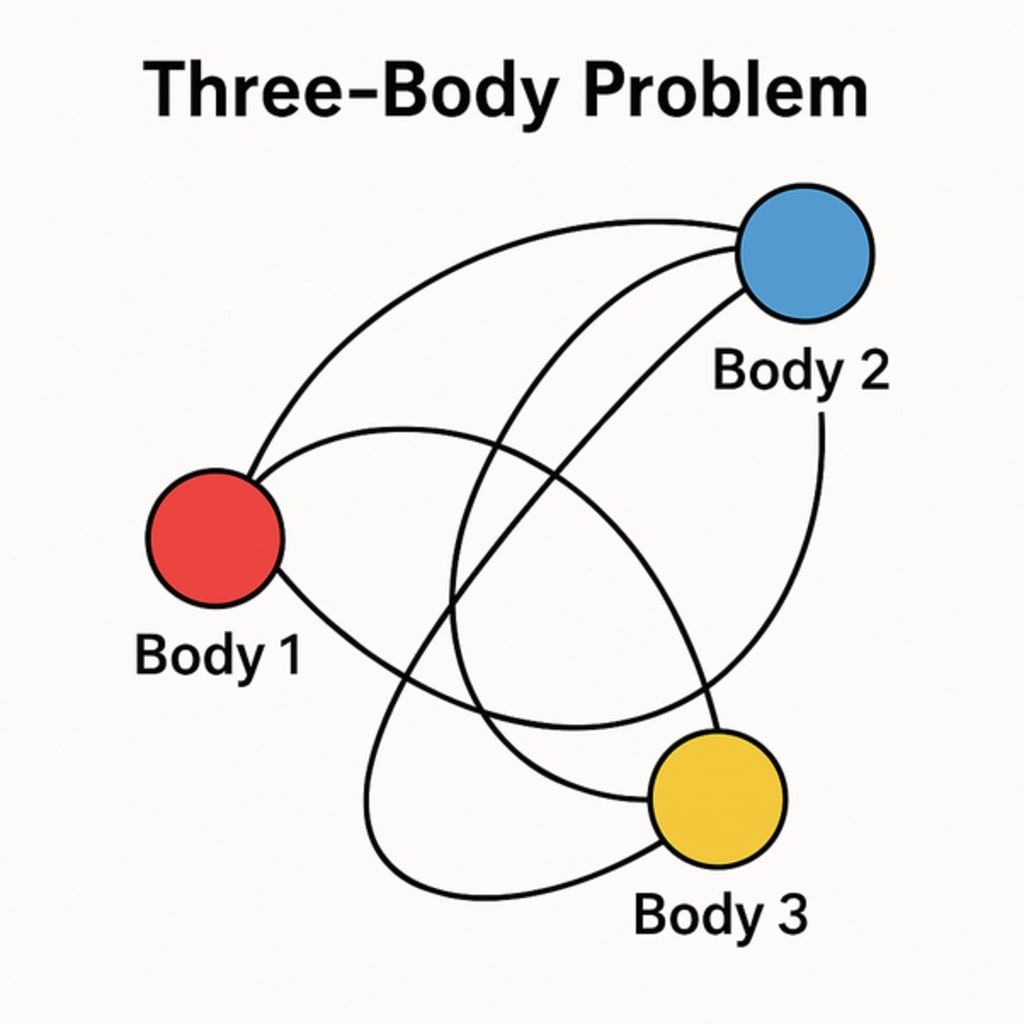
What Is the Three-Body Problem?
The three-body problem is a puzzle in celestial mechanics — the branch of science that studies how objects in space move under gravity.
In simple terms:
"What happens when three celestial bodies interact with each other gravitationally? Can we predict their motion?"
With two bodies — say, Earth and the Moon — it’s easy (well, relatively). Sir Isaac Newton’s laws give us clean equations to map out their future positions with pinpoint accuracy.
But throw in a third object — another moon, a rogue star, or a planet — and all bets are off.
Now you’re in chaos territory.
Suddenly, those neat equations collapse into a swirling mess of possibilities. You’re no longer solving a problem — you’re watching a cosmic soap opera where every episode rewrites the plot.
Who First Noticed This Problem?
Of course, it all starts with Isaac Newton. Back in the 1600s, he was working on how gravity keeps planets in orbit and realized something odd:
While two-body systems were solvable, three-body ones weren’t — at least, not in any general, neat way.
That’s right — Newton himself shrugged at this one. And when the guy who invented gravity says “this might be too hard,” you listen.
Enter Lagrange: The Man with a Mathematical Wig and a Plan
Jump ahead to the 18th century. Enter Joseph-Louis Lagrange, a French mathematical genius.
Lagrange found some workarounds, not full solutions. He discovered that in certain special setups, a third object (like a spacecraft or asteroid) can sit at very specific points and stay stable between two larger bodies. These spots are now called Lagrange points, and yes — NASA uses them today to place satellites in space.
Useful? Absolutely. A full solution to the problem? Not even close.
Poincaré: The Man Who Introduced Us to Chaos
Now fast forward to the late 1800s. Henri Poincaré, another Frenchman (what is it with the French and cosmic puzzles?), took a crack at the problem.
He didn’t solve it either. But what he did do was revolutionary: he realized that the three-body system isn’t just complicated — it’s chaotic.
Tiny differences in initial conditions — like a planet starting one inch closer or a second earlier — could lead to completely different outcomes. In doing so, Poincaré essentially invented chaos theory before it even had a name.
Why Is the Three-Body Problem So Difficult?
Because gravity is messy.
The gravitational pull between two objects is predictable. But when you add a third, you don’t just have three interactions — you have a constantly changing system where every move affects the others. It becomes a loop of feedback and interference, spiraling into unpredictability.
Think of it like trying to balance three spinning plates on one stick — while riding a roller coaster. Blindfolded.
Has Anyone Ever Solved It?
Let’s get this straight: No one has solved the general three-body problem. There’s no single formula that tells you where all three objects will be at any time in the future.
What we do have are:
- Special-case solutions (like the Lagrange points)
- Numerical simulations (powered by supercomputers)
- And a lot of very smart people saying, “Well... it depends.”
Modern computers can simulate three-body interactions with remarkable precision, but they’re still approximations. Not elegant formulas. Just a whole lot of math crunched very, very fast.
So What’s the Point, Then?
Why care about an unsolvable problem? Because the three-body problem teaches us something profound:
The universe isn’t always tidy.
It reminds scientists, astronomers, and engineers that reality can be complex, unpredictable, and — yes — a little bit wild. And in that complexity lies beauty. It fuels innovation, from orbital mechanics to AI models trained on chaotic systems.
Pop Culture Bonus: Yes, There’s a Sci-Fi Series About This
You might’ve heard of The Three-Body Problem by Liu Cixin, the award-winning sci-fi novel (and now Netflix adaptation). It’s based on this very scientific dilemma — and uses the unpredictability of three-body motion as a central metaphor for alien civilizations, strategy, and survival.
When Science Meets Humility
The three-body problem isn’t just about planets and gravity — it’s a story of human curiosity. A story where some of history’s brightest minds stood at the edge of what we can know and admitted:
“This one’s still a mystery.”
And that’s the beauty of science.
It’s not always about solving everything. Sometimes, it’s about staying curious, chasing chaos, and learning how to dance with the unknown.
About the Creator
Faraz
I am psychology writer and researcher.
Last chance for Australians to send message to the universe on Voyager project’s 50th anniversary
Australians have a unique opportunity this week to contribute to a once-in-a-lifetime event marking the 50th anniversary of NASA’s Voyager 1 and Voyager 2 missions — an initiative inspired by the iconic Golden Record project and designed to let ordinary people send messages to the cosmos. The deadline to participate is fast approaching, and organizers are urging citizens to submit their brief messages via a dedicated online platform before the window closes. The commemorative project — backed by international space partners — aims to honor the legacy of the Voyager probes while celebrating humanity’s curiosity, creativity, and desire to connect across the stars. A Milestone Mission Launched in 1977, the twin Voyager spacecraft have become two of the most enduring icons in space exploration. Both probes, equipped with instruments to measure cosmic rays, magnetic fields, and planetary environments, provided groundbreaking data about the outer planets — including Jupiter, Saturn, Uranus, and Neptune. Decades later, Voyager 1 entered interstellar space in 2012, becoming the farthest-flung human-made object in existence. In addition to their scientific payloads, the Voyagers carry the Golden Records — phonograph discs containing sounds and images selected to portray the diversity of life and culture on Earth. The message capsules were intended as a cosmic handshake, aimed at any intelligent life that might one day encounter them. This anniversary initiative taps into that spirit of cosmic communication, inviting people around the world to submit short texts reflecting “our hopes, stories, and reflections for the universe.” Australia’s Role in Space Australia plays a critical role in the continuing operation of the Voyager missions. The **CSIRO’s Deep Space Communication Complex near Canberra has long been part of NASA’s Deep Space Network, providing vital tracking, telemetry and command support for deep-space missions. The Canberra station, alongside sister installations in California and Spain, helps maintain communication with Voyager 1 and 2 across billions of miles. Australian engineers and scientists have tracked the probes’ faint radio signals and relayed commands for decades — a contribution that underscores the nation’s importance in global space efforts. Given this deep connection, space advocates in Australia have embraced the anniversary initiative with enthusiasm, organizing community events, educational talks, and media campaigns encouraging participation in the global message project. What Participants Are Saying The response from Australians has been enthusiastic. Teachers are bringing message workshops into classrooms, families are crafting messages together, and social media campaigns have encouraged submissions ranging from poetic expressions to heartfelt messages of hope. “I wrote something about unity and the beauty of our shared home,” said one participant from Sydney. “It’s amazing to think that in some far-off future, someone — or something — might read it.” Others have used the opportunity to highlight pressing global issues, such as climate change, sustainability, and peace. Organizers have placed no restrictions on the message content aside from a character limit, encouraging creativity while keeping messages concise. The Submission Process Interested Australians must visit the official anniversary platform, create a brief message (a few hundred characters at most), and submit it before the deadline. The message will then be curated as part of an international repository — a symbolic digital archive that celebrates humanity’s collective voice on this milestone. While the messages won’t be physically launched aboard spacecraft, organizers say the archive will be preserved and shared through digital channels, space museums, and public exhibits around the world. “It’s a symbolic tribute to one of humanity’s greatest technological achievements,” said a representative from the organizing committee. “Everyone gets a chance to contribute to this intergenerational conversation.” Looking Ahead As the Voyager probes continue their journey into the depths of interstellar space — powered by diminishing but enduring nuclear energy sources — they carry not only instruments of science but also human imagination. Their longevity continues to defy expectations, and their data provides scientists with unprecedented insights into the space beyond our solar system. For Australians and global citizens alike, the anniversary is both a celebration and a reminder: humanity’s reach extends far beyond our planet, and even the smallest message can be part of something much larger. With just days left to submit contributions, organizers are urging last-minute participation — a final chance to add personal reflections to a global tribute to one of the most remarkable achievements in the history of exploration.
By Fiaz Ahmed 6 days ago in Longevity


Comments
There are no comments for this story
Be the first to respond and start the conversation.