
The Paradox of Sleep: Why 3 Hours Can Feel Better Than 8
Sometimes, we wake up from a short night of sleep, feeling surprisingly refreshed, while longer sleep, leaves us groggy and tired. What's going on inside our brains - and is it healthy?

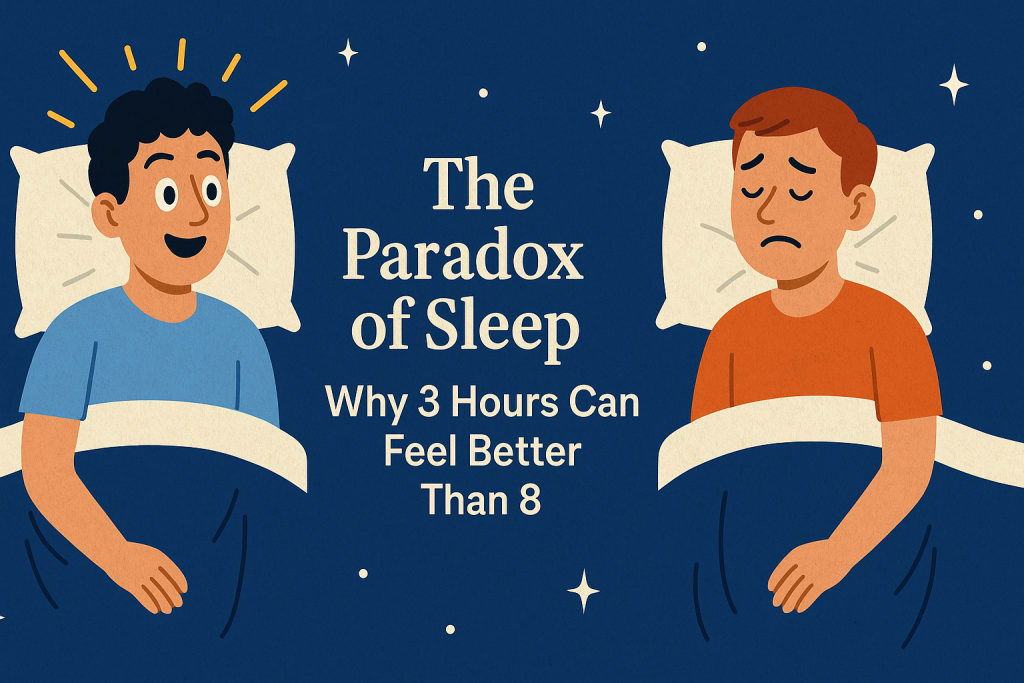
There's something oddly frustrating about sleep: it's supposed to be restorative, yet there are days when a full eight hours leaves you more tired than ever - and others when a mere three hours has you springing out of bed with inexplicable energy. What is the reason behind that paradox of sleep? Are we defying the science, or is there a deeper mechanism at play?
The puzzling phenomenon isn't just anecdotal - it has roots in how our sleep cycles work, how we perceive test, and how external factors like stress, adrenaline, and even mindset influence our waking energy levels.
Let's start with the sleep cycle.
Our sleep isn't uniform throughout the night. We cycle through stages, from light sleep (Stage 1), deeper stages (Stage 3), and REM (Rapid Eye Movement) sleep. Each full cycles lasts about 90 minutes. And ideally, we go through 4-6 cycles at night.
Waking up at the end of a sleep cycle - especially from light sleep or REM - makes it easier to feel alert and refreshed. But, if we wake in the middle of deep sleep, our brains are groggier, and we experience what's known as sleep inertia.
Now, here's where the paradox kicks in: if you only sleep 1.5 to 3 hours, your body might have completed just one or two full cycles, it means that you're more likely to wake up at the end of one - feeling better than if you have interrupted a deeper part of your sleep with a longer rest. Ironically, more sleep can feel worse if the timing is off.
Then, there's also a role of hormones and stress. On nights when you've barely slept, your body may release adrenaline and cortisol - stress hormones that help you function despite exhaustion. This chemical boost, can give a false sense of energy, and alertness - kind of like a natural high. That's why, sometimes pulling an all-nighter makes you feel weirdly "on" - until you crash, of course.
Another interesting factor is expectation. If you know you didn't sleep much, your brain sometimes goes into survival mode, sharpening focus and awareness in response to the perceived threat of sleep deprivation. Meanwhile, when you sleep longer, you expect to feel great - so if you don't, the disappointment amplifies your sense of fatigue.
But, there's a catch. Feeling good after little sleep, doesn't mean it's good for you. Chronic sleep deprivation is linked to everything from weakened immunity - to memory loss and mood disorders. That "refreshed" feeling is often short-lived. Your body is borrowing energy - it doesn't really have - and it'll collect the debt eventually.
Still, the phenomenon tells us something fascinating: the quality, timing, and context of sleep, matter as much - if not more - than the quantity. That's why, sleep trackers and smart alarms are becoming more popular; they aim you to wake you during your light sleep phase, not based solely on duration.
So, what can you do with this knowledge?
If you're ever forced into a short night of rest, try to sleep in 90-minute increments to align with natural cycles. A 3-hour nap might feel better than a 5-hour one, if it helps you avoid waking mid-deep sleep. And on nights when you can get a full night's rest, try to be consistent with your bedtime and wake time to train your internal clock.
Ultimately, sleep isn't just about how long you lie in bed - it's about when and how your body moves through those mysterious, essential cycles. The paradox isn't really a paradox at all - it's just your brain playing tricks in its effort to keep you functioning. Fascinating, isn't it? ☺️
About the Creator
HazelnutLattea
Serving stories as warm as your favorite cup. Romance, self reflection and a hint caffeine-fueled daydreaming. Welcome to my little corner of stories.
Stay tuned.🙌
Keep reading
More stories from HazelnutLattea and writers in Longevity and other communities.
The Silence Between the Pines
The sun was gone. Not just hidden behind clouds or sinking beyond the ridge - but gone, swallowed by a sky so dark and deep, it felt like falling. Lily tightened her grip on the Swiss Army knife. It wasn't much, but it was the only tool she had left.
By HazelnutLattea9 months ago in Fiction
Day 4 of Quitting
If this is how sobriety feels, maybe it’s better to go through life a little buzzed… this, along with other hits like, I want to kill myself, I wish I was dead, and I’m going to throw myself off a bridge have been the only thoughts on rotation these past few days. I promise myself that if, in a month, I still feel like this (‘this’ meaning despondent, full of rage, and simultaneously numb) I can go back to smoking. Until mid-February though? Nicotine is off the table.
By sleepy drafts10 days ago in Longevity
Radiology Information System Market Size & Forecast 2025–2033
The global Radiology Information System (RIS) market is entering a decisive growth phase as healthcare providers worldwide accelerate their digital transformation agendas. According to Renub Research, the market is projected to expand from USD 1.07 billion in 2024 to USD 2.17 billion by 2033, reflecting a strong compound annual growth rate (CAGR) of 8.14% from 2025 to 2033.
By Renub Research3 days ago in Longevity


Comments (1)
😴😴😴