
The Man with No Brain: A True Story That Changed Neuroscience Forever
The True Story of a Man Who Lived with 10% of His Brain


Imagine going through life — going to work, having conversations, raising a family — and never realizing that you’re missing 90% of your brain.
Sounds like science fiction, doesn’t it?
But in 2007, a 44-year-old man from France walked into a hospital complaining of mild leg weakness. What doctors discovered during his brain scan would defy everything we thought we knew about human consciousness.
His skull was filled with fluid — so much so that his brain had been compressed into a sliver of tissue, only a few millimeters thick. That’s right: nearly all of his brain was gone. And yet, this man lived what appeared to be a completely normal life. He had a job in public service. He was married. He had two children. He functioned like any ordinary adult. There were no signs of severe cognitive delay or disability. In fact, his IQ was slightly below average — but nothing that raised red flags.
This bizarre and shocking case made headlines across the globe, leaving scientists puzzled and fascinated. It turns out, the man had lived with chronic hydrocephalus — a condition where fluid builds up in the brain — since birth. Most people with severe cases don’t survive infancy. But somehow, his brain adapted over decades, reshaping itself in ways we never imagined possible.
This case challenged everything neuroscientists believed about brain function. For over a century, scientists mapped out the brain like a machine: each part doing one job, each lobe with its function. But this man’s story flipped that map upside down.
How could memory, personality, speech, motor control — all things we associate with complex regions of the brain — still function when those regions were barely there?
The answer lies in a phenomenon called neuroplasticity — the brain’s ability to rewire itself. While the average person’s brain has specific areas dedicated to certain tasks, the brain is not rigid. It’s surprisingly flexible, especially during childhood. When parts are damaged or missing, other regions can often take over.
But even knowing this, scientists didn’t expect the brain to be this adaptable. This wasn’t just a small injury — this was almost a total absence of brain matter. And yet, the man lived, worked, and loved like any of us. His case opened doors into deeper questions. Do we really need all the brain we’re born with? What is the bare minimum for consciousness? Are we underestimating the brain’s hidden potential?
Even more shockingly, he isn’t the only case. In recent years, similar stories have emerged — people living with radically reduced brain volumes, often discovered by accident during unrelated medical scans. It makes you wonder: how many people out there are walking around with brains that have restructured themselves in silence?
And it brings us to a profound question: what is intelligence, really? Is it the size of your brain, the shape of it, or the connections between cells that matter more? For centuries, humans have looked to science for answers about consciousness and intelligence. But this story reminds us that even with all our technology, there are still mysteries locked inside our skulls that we don’t fully understand.
If one man can live a normal life with just 10% of his brain… what are the rest of us truly capable of?
This story is inspired by a real case reported in The Lancet and covered by outlets like Scientific American and New Scientist. It’s a true testament to the miracle of neuroplasticity and the mystery of the human brain.
If you’re fascinated by true science that feels like science fiction, explore more at Abbi Sci — where facts are often stranger than imagination.
About the Creator
Sai
Life science graduate & author of Echoes of the Gayatri (Notion Press). I write articles & books blending science, spirituality & social impact—aiming to inspire, inform, and uplift through purposeful, transformative writing.
How China Is Challenging the U.S. to Become the Next Great Space Power
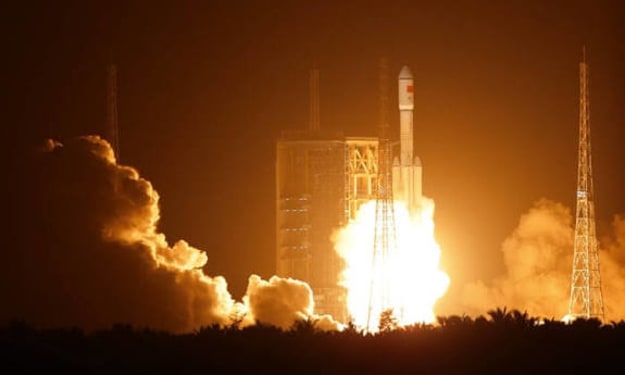
As Beijing’s space ambitions expand, Washington faces an intensifying geopolitical and technological rivalry in orbit and beyond. In the early decades of the 21st century, the United States long stood unchallenged as the dominant space power — a position built on decades of NASA leadership, unmatched launch capability, and a vibrant commercial space economy. But today, a determined China is mounting one of the most consequential strategic challenges in space since the Cold War, pushing to rival — and ultimately surpass — the U.S. in space influence, technology, and strategic advantage. National Strategy and Long‑Term Vision China’s leaders have openly signaled their ambition to become a global space powerhouse. Official space policy documents and state planning envision a broad array of capabilities — from heavy‑lift rockets to lunar exploration — aimed at reshaping the space order that has been U.S.‑dominated for decades. According to analyses of government planning, Beijing intends to establish a full suite of launch vehicles, satellites, and space infrastructure that could surpass current international norms by mid‑century. Underpinning this vision is a belief among Chinese space officials that self‑reliance and indigenous innovation are key to international competitiveness. Recent reports in state media emphasize that China’s aerospace industry is pushing far beyond imitation toward original technological breakthroughs in areas like rocket manufacturing, intelligent space systems, and advanced materials — all with the strategic goal of securing leadership in space. Commercial Space: From Government Giants to Private Innovators China’s rapid ascent isn’t limited to state space agencies. A growing ecosystem of private space companies — much like the commercial boom seen in the U.S. — has taken root, focusing on reusable rockets, satellite networks, and novel space services. A recent South China Morning Post report highlights Beijing’s push to encourage private innovation within its space sector, supporting technologies such as reusable launch vehicles, space debris monitoring, extraterrestrial resource utilization, and even in‑space biomanufacturing — fields long dominated by U.S. firms such as SpaceX or Blue Origin. This commercial expansion broadens China’s capabilities and compresses the technological gap with the U.S., challenging American assumptions that commercial innovation is exclusively an American forte. It also signals a shift in global space economics, where China may soon contend for commercial markets once dominated by Western companies. Military and Strategic Dimensions Alongside civil and commercial ambitions, China’s space strategy has clear military implications. U.S. strategic assessments note Beijing’s efforts to build counterspace capabilities — systems designed to deter, deny, or degrade another nation’s satellite operations — a key advantage in future conflicts. China has already deployed anti‑satellite weapons, jamming technologies, and sophisticated ground‑to‑space radar systems that could threaten U.S. space assets in a crisis. For the United States, which relies heavily on space systems for communication, navigation, and battlefield awareness, these capabilities represent a serious strategic challenge. Beijing’s ability to field space and counterspace technologies could blunt some of Washington’s military advantages in the Asia‑Pacific region and beyond. Lunar and Deep Space Objectives China’s Chang’e lunar exploration program is another marker of its space ambitions. With a series of increasingly complex robotic missions and plans for an International Lunar Research Station by the 2030s, Beijing aims to be a leading voice in lunar science and development — directly challenging the U.S. Artemis program and international partnerships spearheaded by NASA. � Wikipedia Missions like the strategically significant Queqiao‑2 communications relay satellite, which supports lunar missions over long distances, further demonstrate China’s growing sophistication in deep space operations and infrastructure deployment. U.S. Response: Maintaining Leadership Recognizing the challenge, U.S. policymakers are pushing legislative and strategic initiatives designed to preserve American competitiveness in space. A newly passed NASA authorization package includes provisions aimed at reinforcing U.S. lunar presence, strengthening Earth orbit assets, and countering Chinese influence in space science and technology — signaling a bipartisan consensus on the gravity of the space rivalry. A New Era of Cosmic Competition The emerging science and technological competition between China and the United States in space is unlike anything seen since the original Moon race. Today’s contest spans not only national prestige but military advantage, commercial opportunity, and scientific discovery. As each side pursues its vision of space dominance, the outcome will shape global power structures for decades to come — affecting diplomacy, security, and economic leadership both on Earth and beyond. If you’d like alternative versions, transcripts, or a set of headline + subtitle options for this topic, just let me know!
By Fiaz Ahmed 4 days ago in Longevity



Comments
There are no comments for this story
Be the first to respond and start the conversation.