
The Immortal Jellyfish: Nature’s Hidden Time Traveler
Meet Turritopsis dohrnii: The Jellyfish That Rewinds Its Life

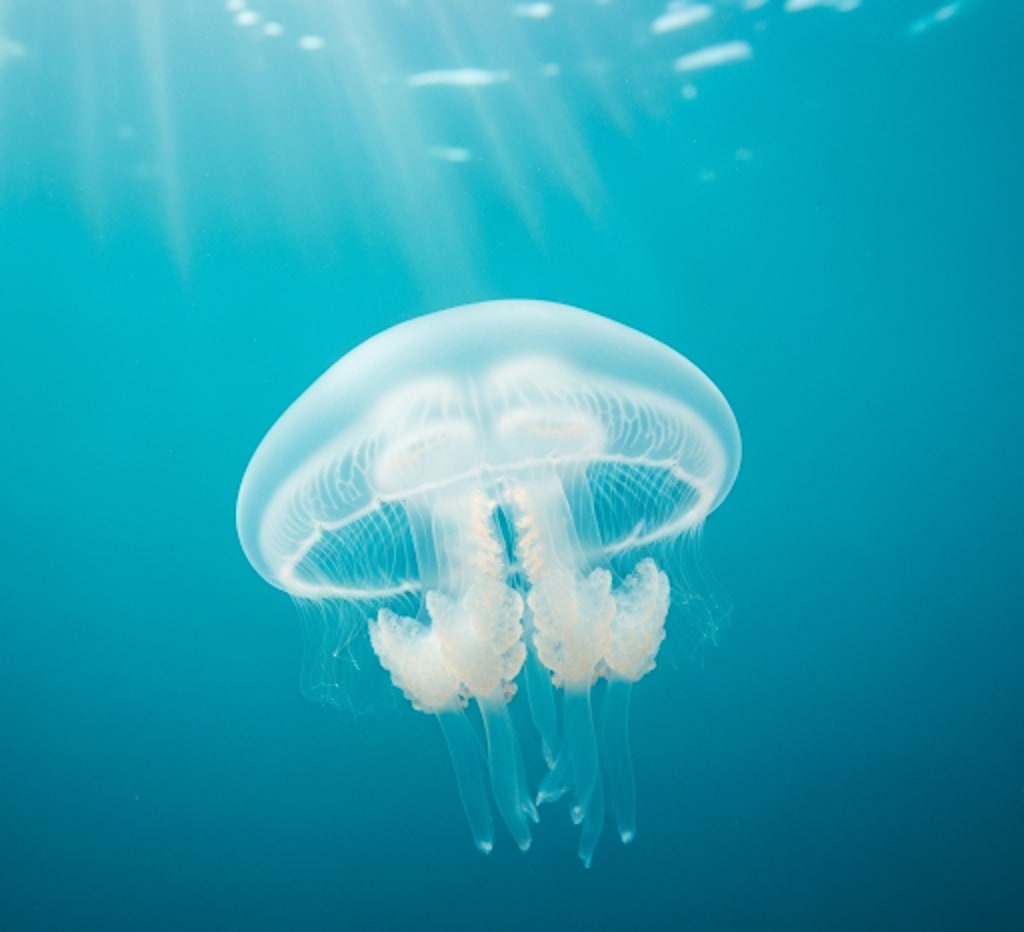
Beneath the surface of the Mediterranean Sea, something extraordinary pulses softly in the shadows. It’s no bigger than your fingernail, nearly transparent, almost forgettable.
Yet this tiny creature may hold the key to unlocking one of the greatest mysteries in biology: how to escape death itself.
Meet Turritopsis dohrnii, better known as the immortal jellyfish.
Discovered in the 1880s, this jellyfish remained little more than a footnote in marine biology textbooks. But in the 1990s, a sharp-eyed scientist in Italy made a startling observation that would change everything.
He noticed that after reproducing—after reaching full maturity—the jellyfish didn’t die. Instead, it did something never seen before in the animal kingdom:
It reversed its life cycle.
The adult jellyfish transformed itself back into a juvenile. It returned to its polyp stage, anchored to a surface, and started its entire life over again. Not once, not twice, but repeatedly.
Imagine if a butterfly could transform back into a caterpillar—and then grow into a butterfly again. That’s exactly what this jellyfish does. It’s not just surviving. It’s restarting.
This isn’t fantasy. It’s not science fiction. It’s real biology.
The Secret Weapon: Transdifferentiation
At the heart of this biological miracle is a process called transdifferentiation. While most animal cells are locked into their identity (a skin cell stays a skin cell, a nerve cell stays a nerve cell), Turritopsis dohrnii breaks the rules.
It can transform one mature cell type into another. Muscle becomes nerve. Stomach becomes egg. Every part of its body reprograms itself, rebuilding the jellyfish from scratch.
It’s like a living organism pressing a biological reset button.
This is not something we’ve ever seen in humans. Our cells degrade over time. Our DNA accumulates damage. Our bodies age. But Turritopsis seems to bypass the ticking clock of biology altogether.
In laboratory settings, scientists have seen it repeat this cycle more than a dozen times. In the wild, it may go on indefinitely—unless killed by disease or predators.
It’s not truly immortal in the sense of invincibility. But it’s biologically immortal, meaning it doesn’t age or die of old age.
And that changes everything.
Why This Isn’t Front Page News
With such profound implications, you might wonder: why isn’t the immortal jellyfish more famous?
The answer lies in complexity.
Turritopsis is extremely fragile and notoriously difficult to keep alive in lab conditions. Its transformation process is unpredictable and hard to replicate.
And while transdifferentiation is fascinating, applying it to human biology is no small task. Human cells are vastly more complex, and we still don’t fully understand how to control them without causing cancer or uncontrolled growth.
But that hasn’t stopped researchers. Today, scientists are sequencing the jellyfish’s genome. They’re hunting for the exact genetic switches that allow it to rewrite its own biology.
They’ve discovered similarities with human stem cells—those rare cells that can become anything in the body. If we learn to harness these pathways, we may one day regenerate damaged organs, reverse age-related diseases, and slow or even halt the aging process.
In fact, some longevity researchers believe Turritopsis dohrnii could hold the key to radical life extension.
Not just living longer—but living younger.
A Glimpse Into Our Future
The implications of this discovery go far beyond marine biology.
What if, one day, a 90-year-old could have their body reset to that of a 25-year-old?What if diseases like Alzheimer’s or Parkinson’s could be reversed by coaxing damaged cells to reprogram themselves? What if death, as we understand it, becomes optional?
Of course, these are distant dreams. But every dream begins with a discovery—and Turritopsis dohrnii is one of the most astonishing clues evolution has ever left us.
For now, the jellyfish continues to drift silently through the oceans, pulsing gently under moonlit waves, rewriting its own timeline. It doesn’t know it may change human history. It only does what it has always done:
Live. Reset. Repeat.
The story of Turritopsis dohrnii is real and based on peer-reviewed studies in regenerative biology. Its abilities challenge the very definitions of aging and death. This is nature’s quiet rebellion against time—and we’re just beginning to listen.
Please subscribe for more fascinating content.
About the Creator
Sai
Life science graduate & author of Echoes of the Gayatri (Notion Press). I write articles & books blending science, spirituality & social impact—aiming to inspire, inform, and uplift through purposeful, transformative writing.
My mother’s best advice: you’re allowed to enjoy nice things
Growing up, my mother always emphasized values like discipline, hard work, and responsibility. But alongside those lessons, she quietly offered me one piece of advice that has shaped the way I view the world: “You’re allowed to enjoy nice things.” At first, I didn’t fully understand what she meant. Life, I thought, was about earning and giving, not indulging. Over time, though, I realized that this simple statement carries profound meaning about self-worth, balance, and the joy of living. The Early Years As a child, I often saw luxury and comfort as something reserved for other people—adults with more money, friends with better opportunities, or strangers on magazine covers. My mother, however, wanted me to understand that pleasure, beauty, and comfort weren’t just frivolous; they were part of life and could be appreciated responsibly. She didn’t mean extravagance for its own sake, but rather a healthy acknowledgment that enjoying life’s little or big pleasures is a form of self-respect. When I was ten, she gave me my first “nice thing”: a leather-bound journal with thick, creamy pages. I didn’t realize it then, but the gift carried a lesson. It wasn’t about owning something expensive; it was about valuing experiences and surroundings that inspire, comfort, or delight. She encouraged me to use it for writing, sketching, and capturing moments, and for the first time, I associated material objects with joy rather than guilt. Learning the Lesson In my teenage years, I began to push myself constantly—academics, extracurriculars, social obligations. Achievements were measured by effort and output, and indulgence felt like a distraction. My mother noticed my tendency to neglect simple pleasures, like a cup of hot chocolate on a rainy day or a quiet afternoon reading. “You’re allowed to enjoy nice things,” she reminded me again. And slowly, I started to understand: enjoying life doesn’t mean being lazy or selfish. It means valuing yourself enough to recognize your needs, your achievements, and your moments of happiness. It’s a form of gratitude, not guilt. Applying It in Adulthood Entering adulthood, the lesson became even more relevant. The workplace can be relentless, financial responsibilities daunting, and the pressures of modern life can make indulgence feel indulgent—or even irresponsible. I found myself hesitating before buying quality shoes, a beautiful coat, or even a small treat like gourmet chocolate. My mother’s advice echoed: enjoyment is not indulgence; it’s a reward for effort and a reinforcement of self-worth. Over the years, I’ve applied this philosophy not just to objects, but to experiences and relationships. Traveling to a new city, attending a concert, or simply savoring a perfectly brewed coffee became acts of self-care rather than guilt-inducing indulgences. Recognizing that I am allowed to enjoy these moments has improved my mental health, strengthened my relationships, and given me a greater sense of purpose. The Deeper Meaning Beyond material comfort, my mother’s advice taught me about boundaries and balance. Life requires hard work, patience, and resilience, but it also requires appreciation. By permitting ourselves to enjoy nice things—whether that’s a well-made handbag, a delicious meal, or a spontaneous weekend getaway—we acknowledge that our happiness matters. It’s a statement of self-worth: we are deserving of care, beauty, and joy. Interestingly, this lesson also translates to generosity. Appreciating what we have allows us to share with others. By enjoying life, we cultivate gratitude and empathy, fostering meaningful connections with those around us. When we respect ourselves, we are more likely to respect and uplift others. Lessons for Others For anyone struggling with guilt over enjoying comfort, my mother’s advice is a reminder that self-care is not selfish. It’s a necessary part of living fully. Recognizing that we are deserving of nice things—whether objects, experiences, or simply moments of peace—creates a foundation for resilience, creativity, and emotional well-being. My mother’s advice may have seemed simple on the surface, but it carries a powerful truth: life is to be lived, savored, and appreciated. We are not merely here to toil endlessly; we are here to experience, enjoy, and grow. Embracing this principle has shaped my approach to work, relationships, and self-care. It’s a lesson I carry every day and hope to pass on to others. In the end, enjoying nice things is not about excess or vanity—it’s about honoring yourself. It’s about saying, I matter. My happiness matters. And that, more than anything, is the best advice my mother ever gave me.
By Fiaz Ahmed about 6 hours ago in Longevity
Thief In The Night
To the thief in the night that took and replicated what once was mine: Honestly, I feel kind of bad for you. It’s funny, because we hardly know each other. I only know of you through the magazines you’ve written and the broadcasts you have televised in the past — as well as through the public mentions of you from your show business connections there.
By Snarky Lisa6 days ago in Humans




Comments
There are no comments for this story
Be the first to respond and start the conversation.