
The Bright Light of Yoga
‘Spirituality’ and Self-Care in The Secular Age?


My earliest memories already carry the imprint of anxiety and depression—right at the beginning of what I can recall. The beginning of memory itself, which, contrary to ancient yogic traditions, is often taken to be what makes me me. Yet I am not my panic, nor am I a perpetual knot of anger. Experience is transient by nature, and if it is to pass cleanly across the moving river of now, we must learn to release it. We must learn to shape, rather than be ruled by, our inner landscape.
When we talk about western philosophies and psychology, I have found that different types of therapies work best for me, and I would be lying if I said I didn’t believe in the necessity of therapy based on studies and scientific methods to get better. However, in 2020, when I was both in my honours year at university and I started practicing yoga online, I found how helpful meditating was for me. Especially a meditation focused on breathing. It changed my life, until I took many steps backwards and found ‘my way’ again a couple of years later.
In 2024, I’ve embarked on a renewed path of yoga and meditation, both physically and mentally. Alongside this journey, I’ve chosen to delve into the research highlighting their benefits in daily life and for individuals struggling with anxiety and depression — nurturing both body and spirit.

Yoga’s history is simple—but complicated.
The yoga most of us practise today is relatively recent. Even its philosophical roots likely stretch back a few thousand years rather than the often-claimed five thousand. Early yoga emerged in Northern India alongside Vedic traditions and focused mainly on meditation and spiritual discipline, not posture. Physical practices existed, but largely as ascetic or devotional extremes.
Between the Vedic period and the time of the Buddha, ideas such as karma, samsara, and liberation from rebirth developed. The Buddha encountered early yogic practices and rejected their harsher extremes in favour of moderation. While yoga was never a religion, it was closely intertwined with traditions we now group under Hinduism, with many texts devoted to deities like Shiva and Krishna.
Over time, the Upanishads and Vedanta introduced ideas of oneness that also appear in Buddhism. Many modern practices still echo these ancient roots: sun salutations, for example, draw on Vedic imagery, even though the physical sequence itself developed much later.
Contemporary yoga draws heavily from texts such as the Yoga Sutra, which defines yoga as “the stilling of the changing states of the mind.” Whether understood spiritually or secularly, yoga offers practical tools—meditation, breath, and movement—to quiet mental noise, loosen unhelpful patterns, and cultivate clarity and connection.
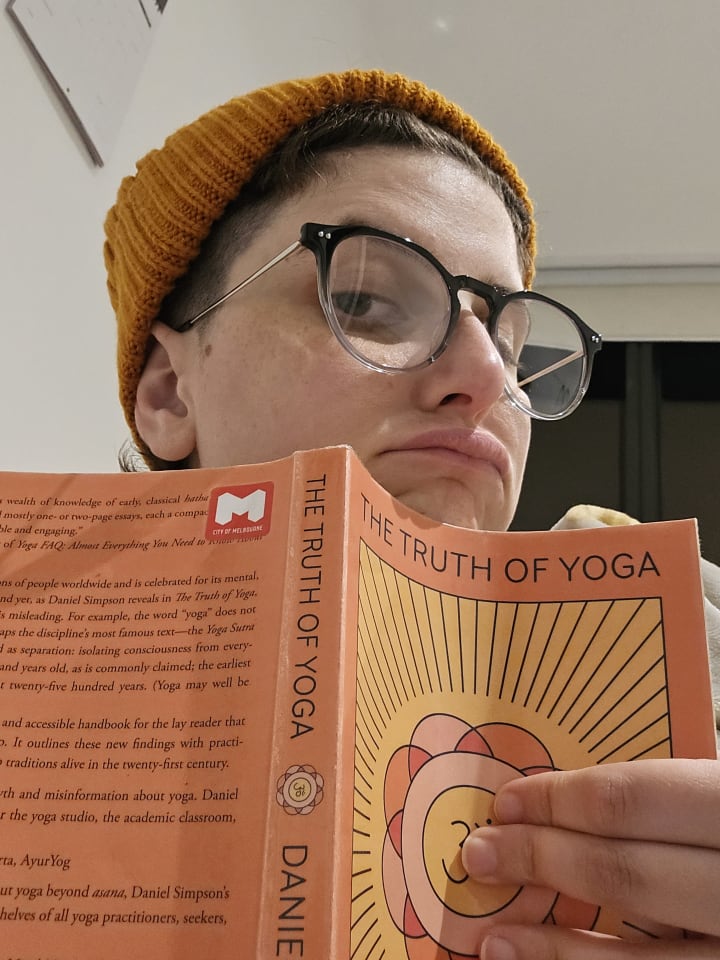
mystical forms. Symbolic tools such as chakras and kundalini are now often treated literally, despite Hatha yoga’s original aim: using practical methods—especially breath—to quiet the mind and transcend thought. Texts like the Hatha Pradipika prioritise technique over philosophy, even as they rely on contradiction and exaggeration.
These traditions were shaped by patriarchal norms, largely excluding women and centring male anatomy.
Over the last few centuries, yoga has become a global, posture-based practice. Many familiar poses date to the 19th century, while Krishnamacharya and his students Iyengar and Jois laid the foundations of modern styles that later spread in the West. Influenced by both Eastern spirituality and Western gymnastics, yoga has always evolved.
The problem lies not in adaptation, but in selling invented antiquity for marketing or political ends (check this article from The Left Berlin).
But enough with history.
To simplify yoga for argument purposes, and perhaps to convince you to give it a try, we can think of it as a practice divided and yolked together by meditation, breathwork, ans asanas (postures, movements).

Meditation is often overlooked in some modern yogic practices, but it's a fundamental part of yoga, and one of the best thing we can do for our brain.
It works in tandem with neuroplasticity and improves brain health all over, and, experience meditators, even see growth and activation in crucial areas of the brain linked to focus and awareness. Meditation may very well slow time (our perception of it, of course, but that's alla that matters).
Meditators show also enlarged areas associated to positive feelings and stronger memory, and a shrinking of those associated with less positive ones.
But at the cost of sounding corny, the best effect of meditation is how you feel during, immediately after, and even for quite some time after that! Although, be advised, deep meditation is not for everyone, and like yoga as a whole, it is not a panacea for every ill.
Meditation can include breathwork, but the practice can be formed by many other exercises (e.g. visualisation, loving kindness, etc).
Breathwork on its own is a powerful life-changing tool. Everyone knows how to breathe, but not many know how to breath well or control our breaths in order to control our emotions or bodily sensations.
As someone with a panic disorder, I can say that routinely training my breathing has been a balm to my anxiety. My slow, tummy driven breath kicks in when anxious or nervous, and I have more tools to manage my emotions. Conversely, when I stop doing breathwork exercises as a routine, I struggle more with anxiety as well, or it takes me longer to consciously regulate my nervous system.
Managing intense emotions like stress, anxiety, or anger through verbal communication (e.g. “calm down”) is difficult due to impaired rational thinking during such moments. Breathing techniques provide a pathway to regain control over one’s mind. Research indicates that different emotions are associated with specific breathing patterns, meaning that by changing our breathing, we can influence our emotional state.
I encourage anyone who would like to try yoga and has the opportunity of having a choice on where to practice, to get informed on breathwork, or pranayama, and making sure that it is on offer at any studio one may be considering. That is, given enough money (I, for example, right now have to practice at home or at my community centre) or environmental opportunities.
Pranayama links the body and the mind, but it also reminds us of our wider connection to the universe (thank you trees!).

Postural yoga is more than stretching. It involves balance, isometric effort, and strength. The physical and mental benefits of these forms of movement are already well documented and widely understood. Stretching and mobility are often treated as accessories to “working out,” yet they offer a distinct and valuable set of benefits in their own right.
I find yoga one of the most complete physical practices (e.g. sports) out there, despite the lack of incremental resistance one may find with weight-training. There is no doubt in my mind that most people practicing yoga regularly will become stronger, more flexible, more mobile, and will improve their quality of life significantly, especially in the presence of chronic pain or old age. That is, if your health profession agrees.
I don’t follow yoga as a belief system, but as a practical framework. I selectively integrate aspects such as kindness, acceptance, meditation, and letting go, while setting aside theology, metaphysics, and devotion. The principle of neti neti—not this, not that—captures this approach: a refusal to fix identity or truth in any single idea.
From yogic and Buddhist thought, I take the insight that actions have consequences and that unhelpful patterns persist until we understand and change them. Practices drawn from yoga can shift perception and help interrupt these cycles without requiring withdrawal from the world.
Ideas like oneness and non-duality are useful not as beliefs, but as tools for loosening rigid self-definitions. We are not only our thoughts, bodies, memories, or actions; a perspective that resonates with my experience of anxiety and depression, and contrasts with approaches that treat mind and body in isolation.
I’m not seeking religion, gurus, or transcendental promises. Yoga is not a panacea, and it should not replace medicine or psychological care. What I value instead is a grounded practice: movement, breath, and attention—ways of working with our anxious, complex nervous systems and learning how to be present.
About the Creator
Avocado Nunzella BSc (Psych) -- M.A.P
Asterion, Jess, Avo, and all the other ghosts.
Keep reading
More stories from Avocado Nunzella BSc (Psych) -- M.A.P and writers in Longevity and other communities.
Echoes
I stepped carefully around the corner, the familiar sights and sounds hitting me like a brick to the face. My eyes watered. I could practically see us, all of us, back then, clustered around the outdoor tables in front of the pizza shop, the bar, the coffee shop. I could smell the various stalls from the events we’d been to on this street. I could taste the churros and nachos.
By Phoenixica247 days ago in Fiction


Comments
There are no comments for this story
Be the first to respond and start the conversation.