fact or fiction
Is it a fact or is it merely fiction? Fact or Fiction explores the lesser known truths in the health and wellness world of Longevity.
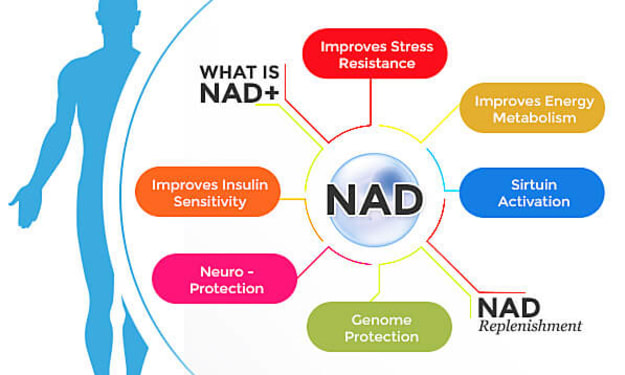
What is NAD+ and Why Does It Matter for Your Health?
Introduction Ever wonder why some people stay energetic and sharp as they age, while others struggle with fatigue and brain fog? The answer may lie in NAD+ (nicotinamide adenine dinucleotide)—a vital coenzyme found in every living cell.
By Mohammed Nageh10 months ago in Longevity
The Truth About Intermittent Fasting: Does It Really Work?
The Truth About Intermittent Fasting: Does It Really Work? What exactly is a intermittent fast? Intermittent fasting (IF) is not a traditional diet plan but rather an eating pattern that alternates between periods of eating and fasting. Unlike conventional weight-loss methods that emphasize calorie restriction or specific food types, IF focuses primarily on timing.
By Afia Sikder10 months ago in Longevity
You'll Regret Not Watching This Video Till The End. AI-Generated.
The Shocking Truth I Discovered About Weight Loss Supplements in 2025 Listen up, because what I'm about to share could save you thousands of dollars and potentially your health. As someone who's been down the challenging road of weight loss, I've learned some eye-opening lessons about the supplement industry that I wish I'd known years ago.
By Edward Smith10 months ago in Longevity
After Cleaning Her House for 2 Hours Straight She Notices Her Fingers Turning Black
After Cleaning Her House for 2 Hours Straight She Notices Her Fingers Turning Black In Hubei province 53 year old Mrs. Jiang began her day like any other unaware that a hidden danger was lurking within her routine household chores. She spent nearly two hours cleaning her home handling various objects wiping surfaces and sweeping floors. During this time a few small cuts and scratches appeared on her hands nothing unusual for someone engaged in daily household work. Confident in her body’s natural healing process she paid little attention to these minor wounds and continued with her day. Two days later however she noticed something strange. The small wounds had developed bluish bruises around them. At first she assumed they were minor injuries that would heal on their own. But as time passed the bruises darkened significantly. Soon all of her fingers except her left thumb and right pinky turned an alarming shade of black. This transformation was not only disturbing to look at but also accompanied by increasing pain. With each passing moment the discomfort grew worse making it clear that something serious was happening. As the pain became unbearable Mrs. Jiang decided to visit a nearby hospital. After an initial examination doctors diagnosed her with a severe bacterial infection likely contracted through the unnoticed wounds on her hands. Because the infection had gone untreated for days it had started damaging the deeper layers of her skin. The doctors explained that she was experiencing necrosis a condition where infected tissues begin to die. If left untreated the infection could spread further posing a life threatening risk. Mrs. Jiang was immediately admitted to the hospital and given strong antibiotics to control the infection. However the medical team soon realized that antibiotics alone wouldn’t be enough. The infection had progressed so much that blood circulation to some of her fingers had almost stopped causing irreversible damage. To prevent further spread doctors had to make a difficult but necessary decision amputation of the affected fingers was the only option.
By Adnan Rasheed10 months ago in Longevity
Most of the problems in your life are due to two reasons: you act without thinking, or think without acting.. AI-Generated.
Okay, I will deliver the article based on the provided guidelines and constraints. Most of Your Problems Boil Down To This: Thinking vs. Doing
By Story silver book 10 months ago in Longevity
Scientists Found The Silent 'Scream' of Human Skin For The First Time
Scientists Found The Silent 'Scream' of Human Skin For The First Time The human body is an intricate and sophisticated system that constantly communicates with its environment in ways we are only beginning to understand. In a groundbreaking discovery scientists have for the first time identified a silent "scream" emitted by human skin in response to damage. This fascinating revelation sheds new light on how our bodies react to injuries and stress at a molecular level opening up new possibilities in medical science wound healing and disease detection. At the core of this discovery lies the concept of mechanobiology the study of how physical forces and mechanical properties influence biological processes. Researchers found that when human skin experiences harm whether due to injury environmental stress, or chemical exposure it releases specific molecular signals. These signals while undetectable to the human ear can now be identified and analyzed using advanced biosensors and imaging techniques.
By Adnan Rasheed10 months ago in Longevity
Thinking And Feeling
Thinking And Feeling The human brain has a remarkable ability to categorize and distinguish between concepts which has shaped our understanding of the world in binary terms. We often divide reality into opposing forces light and dark right and wrong, rationality and emotion. Among these dualities, the distinction between "thinking" and "feeling" has been particularly influential in shaping personal identities political ideologies, and even entire cultures. However as we move into an era of increasing complexity and uncertainty it is worth questioning whether this binary mindset truly serves us. Could our reliance on rigid categorization be creating blind spots preventing us from embracing a more holistic integrative approach to knowledge and human experience? Throughout history the Enlightenment era championed rationality and empirical thinking pushing societies toward scientific advancements and intellectual rigor. The emphasis on logic and objectivity led to incredible breakthroughs from technological innovations to medical discoveries shaping much of the modern world. However the dominance of reason also came with unintended consequences. It often led to the marginalization of emotions intuition and subjective experience creating an imbalance that neglected the full spectrum of human understanding. In contrast many indigenous and Eastern philosophical traditions have long emphasized the integration of thinking and feeling. These traditions recognize the necessity of emotional intelligence intuition and interconnectedness as fundamental aspects of wisdom. Western societies however have been slower to embrace these aspects, often dismissing them as irrational or unscientific. The result has been a culture that prizes efficiency productivity and analytical reasoning while undervaluing empathy, creativity and the emotional dimensions of decision making. This division between thinking and feeling is not just a philosophical abstraction it manifests in real-world consequences. In politics, the growing polarization between ideological groups often stems from an inability to integrate logic with emotional resonance. Political leaders and media outlets frequently exploit emotions fear anger and outrage to manipulate public perception. At the same time, a purely analytical approach to governance can create policies that seem disconnected from human experiences failing to address the emotional and psychological needs of society. The challenge, therefore is to find a balance where analytical rigor and emotional intelligence work in tandem rather than opposition. One of the most profound ways beliefs shape our feelings is through our values. Values are not merely intellectual constructs; they are deeply emotional influencing our perceptions decisions and relationships. When we encounter information that aligns with our values, we experience emotional affirmation reinforcing our sense of identity and belonging. Conversely when faced with opposing viewpoints, we often react emotionally before engaging in logical analysis. This cognitive bias known as motivated reasoning demonstrates how deeply intertwined thinking and feeling are. Understanding this connection is crucial for fostering dialogue cooperation and civility in an increasingly divided world. The past few decades have seen a strong emphasis on objective facts and data driven decision making. While this approach has undoubtedly contributed to progress it has also revealed its limitations. Facts alone are not always enough to inspire change or drive action. Climate change for instance is backed by overwhelming scientific evidence yet public response remains fragmented. This is because facts no matter how compelling, need to be emotionally resonant to motivate people. Storytelling personal experiences, and ethical considerations play a significant role in shaping public opinion and driving meaningful action. Without integrating values and emotions into our analytical frameworks, even the most well reasoned arguments can fall on deaf ears.
By Adnan Rasheed10 months ago in Longevity