
Proton Therapy Market Size & Forecast 2026–2034
Precision Radiation, Powerful Growth: How Proton Therapy Is Reshaping Global Cancer Care

Introduction: A New Era of Precision in Cancer Treatment
Cancer care is undergoing a quiet but powerful transformation. As healthcare systems worldwide shift toward precision medicine, therapies that can target tumors more accurately while sparing healthy tissue are gaining momentum. Among these, proton therapy stands out as one of the most advanced and promising forms of radiation treatment available today.
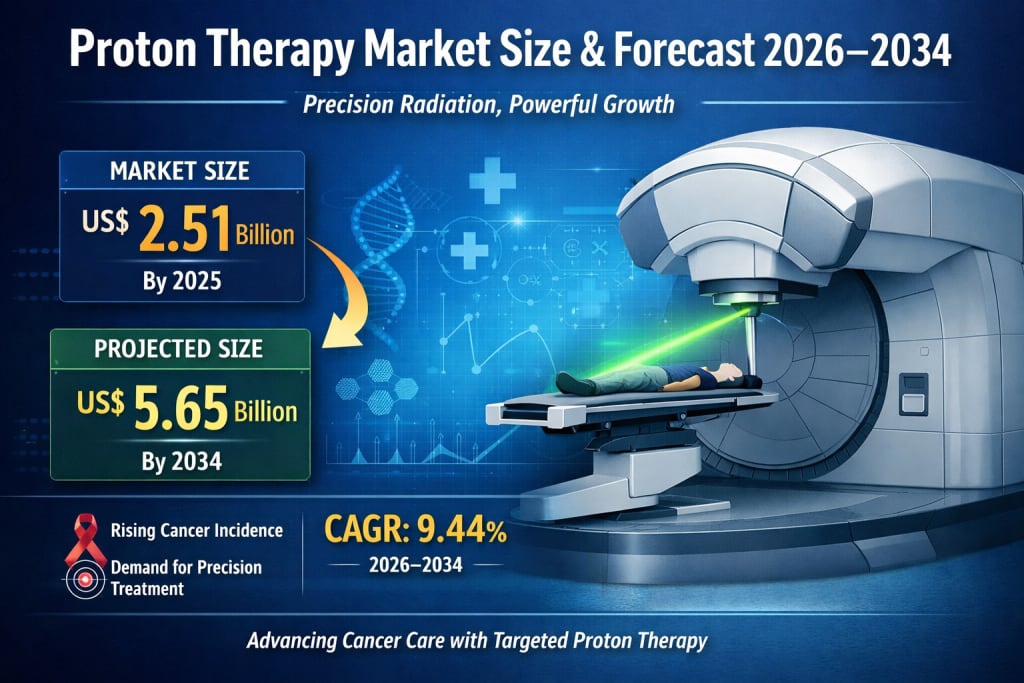
The global proton therapy market is anticipated to grow significantly during the forecast period, driven by the rising incidence of cancer and the increasing demand for sophisticated radiation therapy modalities that offer greater precision and fewer side effects. According to Renub Research, the market is expected to expand from US$ 2.51 billion in 2025 to US$ 5.65 billion by 2034, registering a compound annual growth rate (CAGR) of 9.44% from 2026 to 2034.
This growth reflects not just technological progress, but a broader shift in how cancer is treated—moving away from one-size-fits-all approaches toward highly targeted, patient-centric care.
Proton Therapy Market Outlook
Proton therapy is an advanced form of radiation therapy that uses high-energy proton beams to destroy cancer cells. Unlike conventional X-ray (photon) radiation therapy, proton therapy has a unique physical advantage: protons release most of their energy at a specific depth in tissue (known as the Bragg peak), allowing doctors to deposit the maximum dose directly in the tumor while minimizing damage to surrounding healthy organs.
This precision is especially valuable for tumors located near critical structures such as the brain, spinal cord, heart, eyes, and major blood vessels. As a result, proton therapy is widely used in the treatment of pediatric cancers, brain tumors, head and neck cancers, and selected prostate and lung cancers.
In recent years, proton therapy has gained increasing acceptance across both developed and emerging healthcare markets. Governments and private healthcare providers are investing in advanced cancer treatment infrastructure, recognizing the long-term benefits of reducing treatment-related complications and improving patient quality of life. As clinical evidence continues to grow and technology becomes more accessible, proton therapy is steadily moving from a niche treatment to a core component of modern oncology care.
Growth Drivers of the Proton Therapy Market
Rising Global Cancer Incidence and Demand for Advanced Treatments
One of the most powerful forces driving the proton therapy market is the growing global cancer burden. Cancers such as brain, prostate, lung, and pediatric malignancies are being diagnosed at increasing rates worldwide. Traditional radiation therapies, while effective, often expose healthy tissues to unnecessary radiation, leading to short-term side effects and long-term complications.
Proton therapy addresses this challenge by offering highly targeted treatment, reducing collateral damage to normal tissues. This is particularly important for children, whose developing organs are more sensitive to radiation, and for patients with tumors located near vital organs.
Globally, cancer remains one of the leading causes of death. In 2022 alone, an estimated 20 million new cancer cases and 9.7 million cancer-related deaths were reported. Around 53.5 million people were living five or more years after a cancer diagnosis, highlighting the growing population of cancer survivors who benefit from treatments with fewer long-term side effects. Looking ahead, the number of new cancer cases is projected to reach 35 million by 2050, representing a 77% increase compared to 2022.
This rising burden is pushing healthcare systems to adopt safer, more effective, and more precise treatment modalities—placing proton therapy in a strong position for sustained growth.
Technological Advancements in Proton Therapy Systems
Technology is another major catalyst behind the market’s expansion. Over the past decade, significant innovations have transformed proton therapy from a bulky, ultra-expensive solution into a more efficient, compact, and scalable technology.
Key advancements include:
Compact proton therapy systems, which reduce space and infrastructure requirements
Pencil beam scanning, enabling highly accurate dose delivery
Improved imaging integration for better treatment planning and real-time tumor tracking
Advanced software and automation, reducing treatment times and operational complexity
These innovations are making proton therapy more feasible for a wider range of hospitals and cancer centers. They also improve clinical outcomes by enhancing precision and consistency in treatment delivery.
In June 2025, for example, IBA (Ion Beam Applications SA)—a global leader in particle accelerator technology—announced the launch of the Proton Therapy Academy, a new international training and education initiative unveiled at the PTCOG conference in Buenos Aires. This move highlights how the industry is not only advancing technologically but also investing in skills, training, and global adoption.
Growing Focus on Pediatric and Precision Oncology
Proton therapy plays a particularly critical role in pediatric oncology, where minimizing radiation exposure to healthy, developing tissues is essential. Children treated with conventional radiation can face long-term side effects affecting growth, cognition, and organ function. Proton therapy significantly reduces these risks, making it a preferred option for many childhood cancers.
At the same time, the broader shift toward precision oncology—where treatments are tailored to individual patients and tumor characteristics—is strengthening proton therapy’s clinical and commercial appeal. Hospitals and cancer centers are increasingly focused on delivering treatments that not only extend survival but also preserve quality of life.
In India, for instance, initiatives such as Aster DM Healthcare’s precision oncology clinics, launched during the Aster Cancer Conclave 2024, reflect this growing emphasis on personalized, high-precision cancer care.
Key Challenges of the Proton Therapy Market
High Capital Investment and Operational Costs
Despite its clinical advantages, proton therapy faces a major barrier: cost. Building a proton therapy center requires massive capital investment, including:
Expensive particle accelerator systems
Large, specially shielded treatment rooms
Complex installation and infrastructure
Ongoing maintenance and technology upgrades
Highly trained technical and clinical staff
These high costs limit adoption mainly to large hospitals and specialized cancer centers, particularly in developed markets. In many regions, reimbursement policies do not fully cover proton therapy, making it harder for providers to justify the investment and for patients to access treatment.
Limited Accessibility and Clinical Evidence for Certain Indications
Another challenge is limited global access. The number of proton therapy centers worldwide is still relatively small, especially in developing countries. This creates geographical barriers, long waiting times, and uneven availability of care.
Additionally, while proton therapy has strong clinical evidence in areas such as pediatric cancers and complex tumors near critical organs, comparative evidence against advanced photon therapies is still evolving for some cancer types. This can slow adoption among clinicians and policymakers who rely on large-scale, long-term outcome data.
Key Market Segments by Indication
Head & Neck Cancer Proton Therapy Market
Head and neck cancers are among the most challenging to treat due to their proximity to vital structures like the brain, spinal cord, salivary glands, and eyes. Proton therapy’s precision allows doctors to target tumors while sparing surrounding tissues, reducing side effects such as dry mouth, difficulty swallowing, and speech problems. As awareness of these benefits grows, proton therapy is becoming an increasingly important option in this segment.
Prostate Cancer Proton Therapy Market
Prostate cancer is one of the most common cancers among men worldwide. Proton therapy offers highly focused radiation delivery, minimizing exposure to the bladder and rectum. This reduces the risk of urinary and bowel complications, which are common concerns with conventional radiation therapy. An aging male population and growing demand for quality-of-life–preserving treatments are driving adoption in this segment.
Lung Cancer Proton Therapy Market
Lung tumors are often located near critical organs such as the heart and spinal cord. Proton therapy enables precise dose delivery while protecting healthy lung tissue, making it especially valuable for patients with limited lung function or those requiring re-treatment. Advances in motion management and imaging are further improving outcomes in this segment.
Set-Up Type: The Rise of Single Room Proton Therapy
The single room proton therapy segment is growing rapidly due to its lower cost, smaller footprint, and faster installation compared to traditional multi-room systems. These systems make proton therapy accessible to mid-sized hospitals and regional cancer centers, significantly expanding the potential market. As healthcare providers seek cost-effective ways to offer advanced treatments, single room solutions are becoming a key growth driver.
Regional Market Highlights
United States
The United States remains the largest proton therapy market in the world, supported by strong healthcare infrastructure, high cancer incidence, and significant investment in advanced oncology technologies. The country hosts the highest number of operational proton therapy centers, driven by leading academic hospitals and research institutions. In January 2024, OncoRay launched the world’s first whole-body MRI-guided proton therapy system, enabling real-time tracking of moving tumors—an important milestone for precision treatment.
United Kingdom
The UK market is expanding steadily, supported by government investment and NHS-backed proton therapy centers. The focus on pediatric and complex cancers, combined with centralized referral systems, is helping improve utilization. In November 2025, Proton International London announced the availability of private proton therapy for selected gastrointestinal cancers, reflecting growing clinical confidence and market maturity.
India
India’s proton therapy market is still emerging but shows strong long-term potential due to rising cancer incidence, especially head and neck and pediatric cancers. Private investment, medical tourism, and improving healthcare infrastructure are supporting growth. Apollo Hospitals’ partnership with IBA to bring the Proteus One system to India marks a significant step toward expanding access to this advanced treatment.
Saudi Arabia
Saudi Arabia is developing its proton therapy capabilities as part of its Vision 2030 healthcare transformation. In December 2023, the Saudi Health Minister inaugurated the Saudi Proton Therapy Center in Riyadh, introducing precision cancer treatment to the country. Public-private partnerships and international collaborations are expected to further accelerate adoption.
Market Segmentation Overview
By Indication:
Head & Neck Cancer
Sarcoma
Pediatric Cancer
Gastro-intestinal Cancer
Prostate Cancer
Lung Cancer
By Set-up Type:
Single Room
Multi-Room
By Region:
North America: United States, Canada
Europe: France, Germany, Italy, Spain, United Kingdom, Belgium, Netherlands, Turkey
Asia Pacific: China, Japan, India, Australia, South Korea, Thailand, Malaysia, Indonesia, New Zealand
Latin America: Brazil, Mexico, Argentina
Middle East & Africa: South Africa, Saudi Arabia, United Arab Emirates
Competitive Landscape
Key players shaping the global proton therapy market include:
IBA
Varian Medical Systems
Hitachi Ltd.
Mevion Medical Systems
Mitsubishi Electric Corporation
Each company is evaluated across five key viewpoints: Overview, Key Persons, Recent Developments & Strategies, Product Portfolio, and Financial Insights, reflecting a competitive environment focused on innovation, expansion, and technological leadership.
Final Thoughts
The proton therapy market is entering a phase of sustained, high-impact growth. With the market projected to rise from US$ 2.51 billion in 2025 to US$ 5.65 billion by 2034 at a CAGR of 9.44%, the technology is steadily moving from a specialized solution to a mainstream pillar of advanced cancer care.
While high costs and limited accessibility remain challenges, ongoing technological innovation, expanding clinical evidence, and growing emphasis on precision and patient-centric oncology are reshaping the landscape. As more countries invest in advanced cancer infrastructure and more hospitals adopt compact, cost-effective systems, proton therapy is poised to play an increasingly central role in the global fight against cancer.
About the Creator
Day 4 of Quitting
If this is how sobriety feels, maybe it’s better to go through life a little buzzed… this, along with other hits like, I want to kill myself, I wish I was dead, and I’m going to throw myself off a bridge have been the only thoughts on rotation these past few days. I promise myself that if, in a month, I still feel like this (‘this’ meaning despondent, full of rage, and simultaneously numb) I can go back to smoking. Until mid-February though? Nicotine is off the table.
By sleepy drafts29 days ago in Longevity
How to Avoid Looking Old-Fashioned Without Losing Who You Are
Growing older does not automatically mean becoming disconnected, rigid, or outdated. Yet many seniors share a quiet fear: appearing “old-fashioned.” Not because they are ashamed of their age, but because they sometimes feel a growing gap between themselves and a world that seems to be moving faster every year.
By Bubble Chill Media 5 days ago in Longevity
Why Black History Matters in America?
The United States of America is celebrating their 250th anniversary in 2026. I'm proud to be an American and as someone who was born here, I wouldn't imagine myself living anywhere else. This is a country where opportunities are possible. Where anyone can be successful in anything they desire to do. Equality, community, and togetherness are the backbones of what America is and should be about. However, we have an administration who wants to erase and disregard those who have made positive, meaningful impacts in our country, specifically Black figures, such as Martin Luther King, Jr., Rosa Parks, and Maya Angelou. President Trump and his administration have been constantly complaining and fighting against what they call the "Woke agenda". They use this excuse as a distraction from other issues they refuse to address, such as the high cost of living, climate change, and inflation. That equality is dividing America, when in reality, it's bringing us together. Being woke is not tied to a specific political party. No matter where you stand on the political spectrum, you can still care about other people and their plights. Compassion and empathy for others isn't tied to a political party, either. We were taught as children to treat others the way we want to be treated and not judge others because they're different from us. Caring about others isn't a personal attack on your beliefs. It doesn't make you any less of a person. People who are easily offended over African American figures, past or present, or anything related to it, are grasping at straws. Current and future generations need to know who people like Harriet Tubman and Shirley Chisholm were, especially in the classroom. Black History is part of American History. It should be recognized, not hidden or forgotten. Besides, you can't shield children from everything, just because your feelings are easily hurt.
By Mark Wesley Pritchard 3 days ago in The Swamp



Comments
There are no comments for this story
Be the first to respond and start the conversation.