
United States Diabetes Devices Market Size & Forecast 2026–2034
Rising diabetes prevalence, rapid adoption of CGM systems, and smart insulin delivery technologies are reshaping the future of diabetes care across the United States.

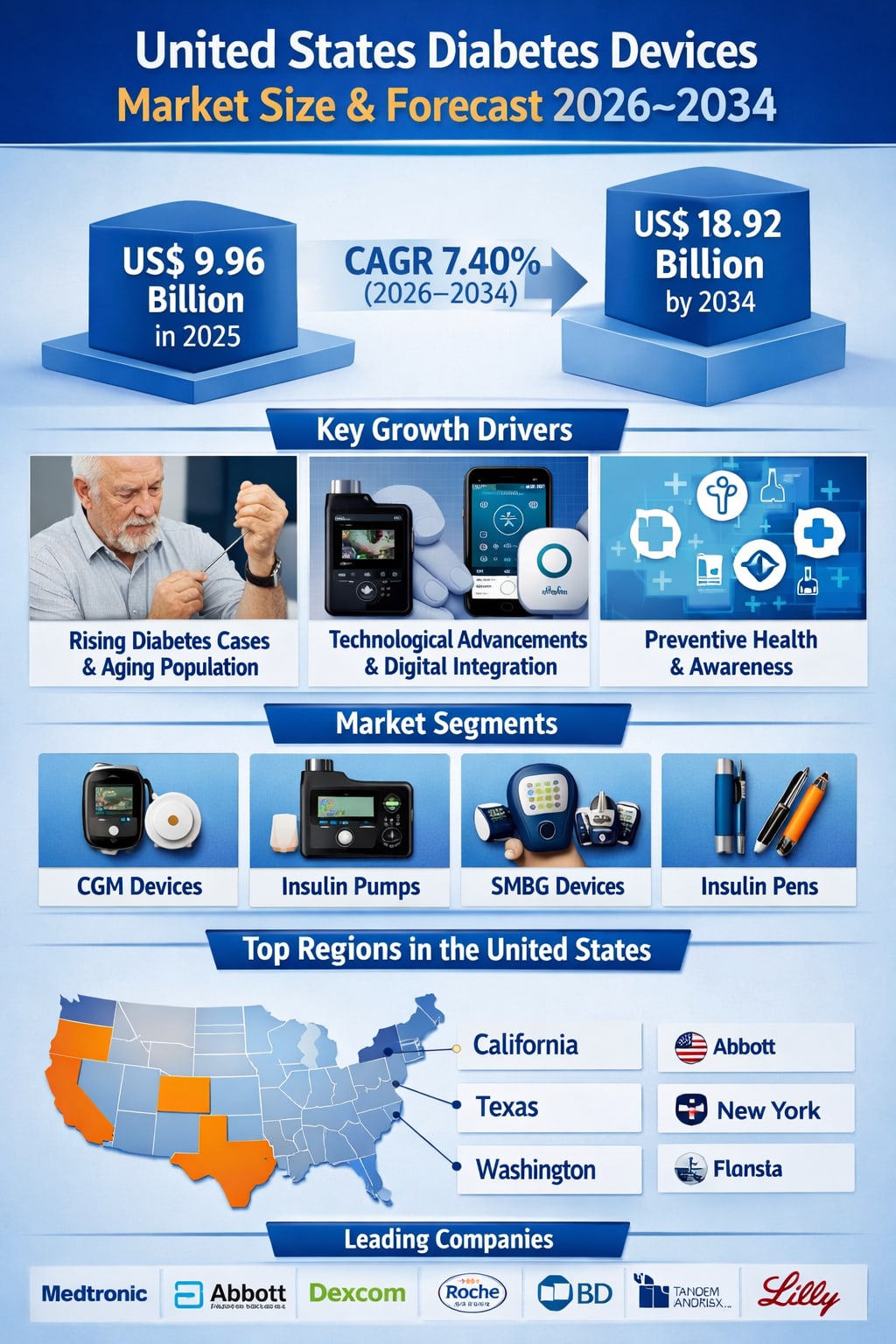
United States Diabetes Devices Market Outlook
The diabetes devices market in the United States is entering a decisive decade of transformation, driven by the growing burden of diabetes, rapid technological innovation, and a healthcare system increasingly focused on continuous monitoring and personalized treatment. According to Renub Research, the U.S. diabetes devices market is expected to expand from US$ 9.96 billion in 2025 to US$ 18.92 billion by 2034, registering a compound annual growth rate (CAGR) of 7.40% during 2026–2034.
Diabetes care devices are biomedical instruments designed to measure blood glucose levels and assist in the delivery of insulin or other therapies for effective disease management. These devices include traditional blood glucose meters, continuous glucose monitoring (CGM) systems, insulin pumps, insulin pens, smart infusion systems, and supportive mobile applications. Together, they play a crucial role in maintaining optimal glucose levels for people living with both type 1 and type 2 diabetes.
In the United States, the adoption of diabetes devices is strongly supported by a well-developed healthcare infrastructure, rising awareness about chronic disease management, and expanding insurance coverage for advanced technologies such as CGM systems and insulin pumps. Patients and healthcare professionals alike are increasingly favoring devices that are accurate, user-friendly, and capable of delivering real-time data. With the growing emphasis on preventive care, remote patient monitoring, and personalized treatment strategies, demand for connected and digital diabetes devices is accelerating across all age groups.
Market Growth Drivers
Rising Incidence of Diabetes and Aging Population
One of the most powerful drivers of the U.S. diabetes devices market is the steady rise in the number of people living with diabetes. Both type 1 and type 2 diabetes cases are increasing, largely due to lifestyle factors such as sedentary habits, obesity, and unhealthy dietary patterns. In parallel, the aging population is acting as a major multiplier, since older adults are more vulnerable to diabetes and its related complications.
As the diabetic population grows, so does the demand for continuous glucose monitoring systems, insulin pumps, insulin pens, and self-monitoring devices. These tools help patients manage their condition more effectively, reduce the risk of complications, and limit the need for frequent hospital visits. The long-term nature of diabetes ensures sustained demand for monitoring and treatment devices, making this market structurally resilient. With projections indicating a significant rise in diabetes prevalence in the coming decades, the need for reliable, easy-to-use, and accurate devices is only expected to intensify.
Technological Advancements and Digital Integration
Technological progress is reshaping diabetes care in the United States. The evolution from simple glucose meters to sophisticated CGM systems, smart insulin pens, and automated insulin delivery solutions has fundamentally changed how patients and clinicians manage the disease. Today’s devices are increasingly integrated with smartphones, cloud platforms, and wearable technologies, allowing real-time data sharing and remote monitoring.
Healthcare providers now rely more heavily on device-generated data to fine-tune treatment plans, while patients benefit from better insights into their daily glucose trends. The growing acceptance of digital health solutions is accelerating the adoption of advanced diabetes devices. A notable example came in December 2024, when Dexcom announced the launch of a generative AI platform built on Google Cloud Vertex AI and Gemini models, designed to analyze individual glucose patterns, activity levels, and sleep data to provide personalized recommendations. Such innovations highlight how artificial intelligence and data analytics are becoming central to modern diabetes care.
Rising Awareness and Preventive Healthcare Focus
Another important factor supporting market growth is the rising awareness of diabetes management and prevention across the United States. Patients are increasingly conscious of the importance of regular glucose monitoring and early intervention to avoid long-term complications. Preventive healthcare initiatives, supported by both public and private organizations, are encouraging individuals to adopt device-assisted self-management strategies.
Diabetes devices empower patients by giving them greater control over their condition, improving adherence to treatment plans, and supporting lifestyle adjustments. Programs aimed at prevention and early diagnosis have demonstrated promising real-world outcomes, even though challenges remain in reaching all at-risk populations. As the healthcare system continues to shift toward patient-centric and preventive models, the role of monitoring and management devices will become even more central.
Key Market Challenges
High Cost of Advanced Diabetes Technologies
Despite strong growth prospects, cost remains a significant barrier in the U.S. diabetes devices market. Advanced technologies such as CGM systems, insulin pumps, and smart delivery devices involve substantial upfront and recurring expenses. Although reimbursement coverage exists, it varies widely depending on insurance providers and patient eligibility.
Out-of-pocket costs can discourage adoption, particularly among uninsured or underinsured patients. In some cases, financial pressures also lead to discontinuation of device use, limiting the long-term benefits of these technologies. Addressing affordability and reimbursement consistency will be critical to ensuring broader access to advanced diabetes care solutions.
Device Complexity and User Adoption Barriers
While technological sophistication brings clear benefits, it can also create challenges related to usability. Some patients, especially older individuals or those less comfortable with technology, may find advanced devices difficult to operate. Issues related to calibration, data interpretation, or connectivity can reduce confidence and hinder consistent usage.
Device malfunctions or technical glitches can further affect patient trust. Moreover, the need for training and ongoing support increases the overall cost burden on healthcare systems. Simplifying device design and improving user education will be essential for maximizing adoption and long-term adherence.
Segment Analysis
United States SMBG Device Market
Self-monitoring of blood glucose (SMBG) devices, including glucometers and test strips, remain a foundational part of diabetes management in the United States. These systems are widely used by patients with both type 1 and type 2 diabetes, particularly those on insulin therapy or oral medications.
SMBG devices are valued for their affordability, simplicity, and accessibility. Although growth in this segment has slowed compared to newer technologies, steady demand for replacement products and continued use by cost-conscious consumers ensure that SMBG remains a stable and important part of the overall market.
United States CGM Device Market
Continuous glucose monitoring systems represent one of the fastest-growing segments in the U.S. diabetes devices market. CGM devices provide real-time glucose readings, trend data, and alerts, significantly reducing the need for frequent finger-stick testing.
These systems are especially popular among people with type 1 diabetes and are increasingly being adopted by insulin-dependent type 2 diabetes patients. Integration with smartphones, insulin pumps, and digital health platforms has further improved usability and patient engagement, making CGM a central pillar of modern diabetes care.
United States Insulin Pumps Market
The insulin pumps market in the United States is driven by the demand for precise and automated insulin delivery. Insulin pumps provide continuous subcutaneous insulin infusion and offer greater flexibility compared to multiple daily injections.
Technological advancements have led to the development of smart pumps and automated insulin delivery systems, enhancing safety and ease of use. When combined with CGM systems, closed-loop or semi-automated solutions significantly improve glucose control, further boosting adoption among patients requiring intensive insulin therapy.
United States Insulin Pen Devices Market
Insulin pens are widely used in the United States due to their convenience, portability, and dosing accuracy. They are preferred by both type 1 and type 2 diabetes patients, particularly those newly prescribed insulin.
The market includes both disposable and reusable pens, catering to different patient preferences. Recent innovations include smart insulin pens that record dosing data and connect with mobile applications, helping patients track their treatment more effectively. The ease of administration and growing patient acceptance continue to support steady growth in this segment.
End-User and Distribution Insights
Diagnostic Centers
Diagnostic centers play a crucial role in the U.S. diabetes devices market by supporting early diagnosis and ongoing monitoring. These centers use SMBG devices, CGMs, and professional monitoring systems to assess glucose patterns and treatment responses. As preventive healthcare and early intervention gain importance, diagnostic centers are becoming even more relevant in the diabetes care ecosystem.
Retail Pharmacies
Retail pharmacies are among the most important distribution channels for diabetes devices in the United States. They provide easy access to SMBG devices, insulin pens, CGM sensors, and related supplies. In addition to convenience, pharmacies offer patient education, prescription support, and insurance assistance, making them a critical link between manufacturers and end users.
Regional Market Highlights
California
California represents one of the largest and most advanced markets for diabetes devices in the United States. A large population base, high diabetes prevalence, and strong focus on preventive healthcare drive consistent demand for glucose monitoring and insulin delivery solutions. The state’s leadership in healthcare innovation supports rapid adoption of CGM systems, smart insulin pens, and insulin pumps, particularly solutions offering real-time monitoring and digital integration.
Texas
The Texas diabetes devices market is driven by a large and growing diabetic population across both urban and rural areas. High rates of type 2 diabetes, influenced by lifestyle and demographic factors, support strong demand for SMBG devices, insulin pens, and CGM systems. While cost-effective solutions remain important, awareness and adoption of advanced technologies are steadily increasing.
New York
New York benefits from strong healthcare infrastructure, high awareness levels, and a strong emphasis on prevention. Urban populations, in particular, show high demand for advanced glucose monitoring solutions integrated with mobile health platforms. Hospitals, specialty clinics, and diagnostic labs all contribute to steady demand across device categories.
Washington
Washington’s diabetes devices market is shaped by a strong focus on preventive care and digital health adoption. Wearable CGM devices and smart insulin pumps are especially popular among younger, tech-savvy populations. The state’s emphasis on early detection and chronic disease management supports continued growth across all major device segments.
Market Segmentation Overview
By Type:
Self-Monitoring Devices (Test Strips, Lancets, Blood Glucose Meters)
Continuous Glucose Monitoring Devices (Sensors, Transmitters, Receivers)
Insulin Pumps (Patch Pumps, Tethered Pumps, Consumables)
Insulin Pens (Disposable and Reusable)
By End User:
Hospitals
Diagnostic Centers
Homecare
By Distribution Channel:
Hospital Pharmacies
Retail Pharmacies
Diabetes Clinics/Centers
Online Pharmacies
By Geography (Top States):
California, Texas, New York, Florida, Illinois, Pennsylvania, Ohio, Georgia, New Jersey, Washington, North Carolina, Massachusetts, Virginia, Michigan, Maryland, Colorado, Tennessee, Indiana, Arizona, Minnesota, Wisconsin, Missouri, Connecticut, South Carolina, Oregon, Louisiana, Alabama, Kentucky, and the Rest of the United States.
Competitive Landscape
The U.S. diabetes devices market is highly competitive, with leading companies focusing on innovation, product expansion, and digital integration. Key players include BD, Roche, Medtronic, Insulet Corporation, Abbott Laboratories, Dexcom Inc., Tandem Diabetes Care, Ypsomed AG, Novo Nordisk A/S, and Eli Lilly. These companies are evaluated across multiple dimensions, including company overview, key personnel, recent developments, SWOT analysis, and revenue performance, reflecting a dynamic and innovation-driven competitive environment.
Final Thoughts
The United States diabetes devices market is on a strong and sustainable growth trajectory, underpinned by rising diabetes prevalence, rapid technological innovation, and a healthcare system increasingly focused on continuous, personalized care. With the market projected to nearly double from US$ 9.96 billion in 2025 to US$ 18.92 billion by 2034, opportunities abound for device manufacturers, healthcare providers, and digital health innovators.
While challenges related to cost and usability remain, ongoing advancements in smart devices, data integration, and patient-centric design are steadily reshaping diabetes management. As prevention, early diagnosis, and remote monitoring become central pillars of healthcare delivery, diabetes devices will play an even more critical role in improving outcomes and quality of life for millions of Americans living with this chronic condition.
About the Creator
Day 4 of Quitting
If this is how sobriety feels, maybe it’s better to go through life a little buzzed… this, along with other hits like, I want to kill myself, I wish I was dead, and I’m going to throw myself off a bridge have been the only thoughts on rotation these past few days. I promise myself that if, in a month, I still feel like this (‘this’ meaning despondent, full of rage, and simultaneously numb) I can go back to smoking. Until mid-February though? Nicotine is off the table.
By sleepy drafts29 days ago in Longevity
The Devil's Triangle
The sails ruffled in the breeze as we cruised along. The Sea Breeze was a mid-size catamaran that sailed out of Royal Naval Dockyard in Bermuda. We had booked this trip weeks in advance and were now looking at our Captain, Spike and two boat hands. Paddy and Wilson seemed like nice guys, joking around with the passengers and telling us some stories about Bermuda that only locals would know. Their island accents sounded almost British but they were pleasant to listen to.
By Barbara Gode Wiles2 days ago in Fiction


Comments
There are no comments for this story
Be the first to respond and start the conversation.