
Osteogenesis Imperfecta
They Call It Brittle Bones Disease


Osteogenesis Imperfecta (OI) or as it is more commonly known, brittle bones disease is a rare genetic disorder that people are born with. That I was born with. There is no known cure and individuals do not develop it like with osteoporosis.

If I had a penny for every time someone has said to me, 'why don't you just drink more milk?' I would be a very rich young woman. OI isn't something that there is a lot of awareness around because it is considered a rare disease. I've met GPs, nurses and Paramedics who know little if not nothing about it. When I was pregnant with my first child it took me three changes of consultant to find someone who understood my condition and the necessity for a C-Section.
The actual term Osteogenesis Imperfecta literally means genetically imperfect bones or imperfect bone formation (Genetics Home Reference, May 2017). OI is characterised by bones that break very easily sometimes with little or no apparent cause and some can even occur before an individual is born.
Not everyone experiences OI in the same way. There is a spectrum on which the extent of the disease can be judged for each individual that has OI; one person may not have it as severely as another and can experience hundreds of fractures in one lifetime. Everyone however, that has OI will experience more fractures in a lifetime than the average person (Osteogenesis Imperfecta Foundation, 2015).
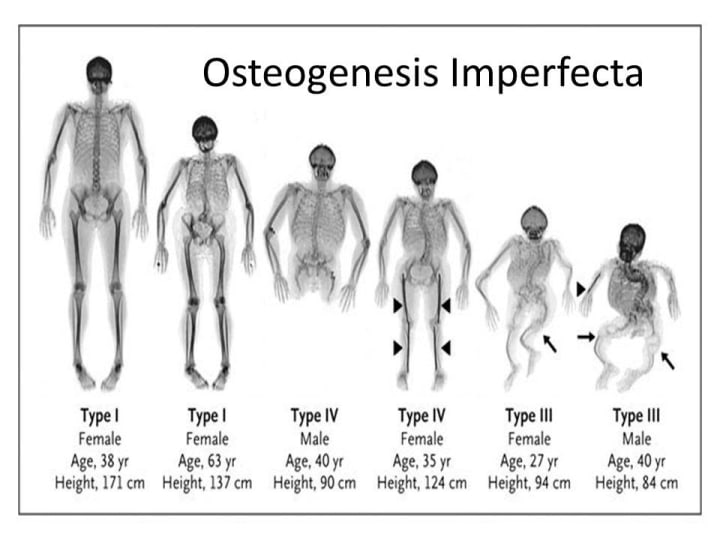
There are eight recorded types of O.I The milder forms of O.I (including type I which also happens to be the most common) feature characteristics such as bones that break easily in childhood and adolescence but begin to taper off after puberty and begin to occur far less frequently once an individual has matured into adulthood. Some of the signs for people with mild forms of O.I include; a blue or grey tint to the sclera of the eye, and may begin developing a level of hearing loss as they get older. Individuals who suffer from these mild types of O.I are also of normal or at the very least almost normal stature, unlike those with more severe types who often are often described as being abnormally small in stature with a fragile rib cage and underdeveloped lungs. Unfortunately infants with the very sever forms of O.I often do not live for long after they are born due to their inability to breathe properly. Those with more sever types who do survive will sometimes find that they are confined to a wheel chair for the majority of their lives and have a severely decreased life expectancy (Genetics Home Reference, 2017).
It is estimated that the condition affects 6 to 7 per 100,000 people worldwide. Types I and IV are the most common forms of O.I, affecting 4 to 5 per 100,000 people (Genetics Home Reference, 2017).
OI is inherited in an autosomal pattern. In an autosomal dominant disorder (like O.I), the mutated gene is a dominant gene located on one of the non-sex chromosomes (autosomes). You need only one mutated gene to be affected by this type of disorder (Mayo Clinic, 2017). In autosomal dominant inherited OI, a parent who has OI has one copy of a gene mutation that causes OI. With each of his/her pregnancies, there is a 1 in 2 (50 percent) chance to pass on the OI gene mutation to a child who would have OI, and a 1 in 2 (50 percent) chance to pass on the normal version of the gene to a child who would not have OI. Most infants however are born into families that do not have a history of O.I. The cause in these cases can usually be traced to a new mutation in the egg or sperm or very early embryo in the COL1A1 or COL1A2 gene (National Human Genome Institute, 2017).
When it comes to diagnosing an individual with Osteogenesis Imperfecta there are as I have already stated several obvious physical features that can point to the disease. For example; frequent fractures, short stature, the odd colouring of the sclera, problems with an individual’s teeth and hearing loss that degenerates throughout an individual’s life. These can be the first signs that a medical professional will look for. The diagnosis itself also include the individuals medical family history. X-ray findings include fractures that are at different stages of healing; an unexpected skull bone pattern called Wormian bones; and bones in the spine called "codfish vertebrae." Are also used as forms of diagnosis. There are also form of laboratory testing for OI. Some of these include either biochemical testing or DNA-based sequencing of COL1A1 and COL1A2. The biochemical testing involves a study of collagens taken from a small skin biopsy. Changes in type I collagen are an indication of OI. DNA sequencing of COL1A1 and COL1A2 is used to identify the type I collagen gene mutation responsible for the altered collagen protein. DNA testing requires a blood sample for DNA extraction. Both types of tesing are relatively effective and it is estimated that they are able to detect around 90 to 95% of cases of O.I in individuals (National Human Genome Institute, 2017).
Due to the fact the Osteogenesis Imperfecta is a genetic disease it cannot be cured. For those with milder types of O.I while life can be difficult due to the trauma caused by frequent fractures they are not entirely limited and find themselves generally able to manage their everyday life and lead relatively normal lives. For those who have more severe types of O.I the prognosis is rarely as good. For a very long time the only real forms of treatment that could help individuals with sever O.I manage their condition were surgical correction for their deformities, physiotherapy, and the use of orthotic support and devices to assist mobility. Now that we have a better understanding of what O.I is and its molecular mechanisms the medical community have begun to focus their treatment of O.I on increasing bone mass and strength which could have dramatic and positive affects for individuals suffering from O.I. An increased bone mass and strength could lead to individual being more independent and suffering from less fractures throughout their life. Surgery is now used more sparingly for functional improvement. In order to attempt to prevent progressive deformities, fracture and to stabilize lax joints orthotics (devices that are worn to correct foot and ankle problems without surgery) are used and have become a form of current management of the condition. It is still felt however that providing individual sufferers with walking aids and adapting their homes to improve their mobility and function are far more important to those with O.I. For infants with O.I it is especially important to provide Home visits and regular clinic assessments in order to ensure that parents are given sufficient help in managing their child’s condition. The close and effective of monitoring thereafter for those with O.I is also needed to ensure that fractures are healing correctly (Manoj Ramachandran, 12th August 2016).
OI patients also benefit from maintaining a healthy weight and eating a nutritious diet. OI patients should avoid smoking and excessive alcohol and caffeine consumption, which can decrease bone strength.
Drugs: Bisphosphonates are the best drug therapy available to treat OI. These are drugs that have been used to treat osteoporosis and have been proven to be very valuable in the treatment of OI symptoms, particularly in children. They work by inhibiting the breakdown of bone and its resorption by the body. Benefits of bisphosphonate treatment include decreased pain, lower fracture incidence, better mobility, and increased strength and bone density. Among the various bisphosphonates, pamidronate (brand name Aredia®) given intravenously (IV) has been shown to reduce bone pain and increase bone mass and density. However, the optimal treatment dose and the long-term effects of pamidronate treatment are not known. Treatment with bisphosphonates during growth may be reserved for patients who have severe or life-threatening symptoms.
About the Creator
Clara Elizabeth Hamilton Orr Burns
"I was always an unusual girl
My mother told me that I had a chameleon soul
No moral compass pointing due north
No fixed personality...
...With a fire for every experience and an obsession for freedom"
-Lana Del Ray
Ride
Keep reading
More stories from Clara Elizabeth Hamilton Orr Burns and writers in Longevity and other communities.
Walk Into Mindfulness
Throughout my life, my mother has been one of my greatest sources of inspiration. A practical woman, she more often than not, has a practical answer to most problems. One of her more popular solutions to anything negative that occurs in ones life, is to pull on her favourite pair of water proof, ready for anything, walking shoes and go for a walk.
By Clara Elizabeth Hamilton Orr Burns5 years ago in Longevity
Day 4 of Quitting
If this is how sobriety feels, maybe it’s better to go through life a little buzzed… this, along with other hits like, I want to kill myself, I wish I was dead, and I’m going to throw myself off a bridge have been the only thoughts on rotation these past few days. I promise myself that if, in a month, I still feel like this (‘this’ meaning despondent, full of rage, and simultaneously numb) I can go back to smoking. Until mid-February though? Nicotine is off the table.
By sleepy drafts8 days ago in Longevity
United States Colon Screening Market Size & Forecast 2025–2033
United States Colon Screening Market Outlook The United States Colon Screening Market is expected to surge considerably from US$ 4.95 billion in 2024 to US$ 6.56 billion by 2033, reflecting a steady compound annual growth rate (CAGR) of 3.18% between 2025 and 2033. This sustained expansion highlights the growing emphasis on preventive healthcare, early disease detection, and public health awareness across the country.
By Aaina Oberoi5 days ago in Longevity



Comments
There are no comments for this story
Be the first to respond and start the conversation.