
North America Mass Spectrometry Market Size & Forecast 2025–2033
Precision, Innovation & Expanding Applications Drive Strong Momentum in North America’s Analytical Technologies Market

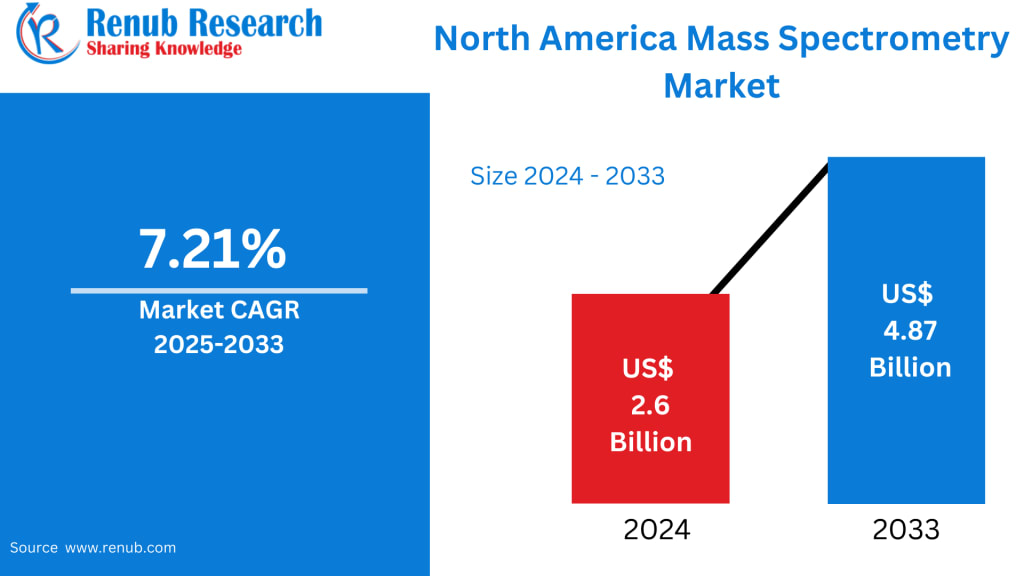
The North America Mass Spectrometry Market is on a powerful upward trajectory, projected to grow from US$ 2.6 Billion in 2024 to US$ 4.87 Billion by 2033, according to Renub Research. This impressive expansion reflects a robust 7.21% CAGR from 2025 to 2033, fueled by pharmaceutical innovation, environmental surveillance, advanced biological research, and the growing need for accurate analytical technologies.
In laboratories across the United States and Canada, mass spectrometry has become indispensable—powering everything from drug discovery and food safety to environmental compliance and clinical diagnostics. With advancing hybrid technologies, automation, and rising regulatory expectations, the region is poised to remain a global leader in mass spectrometry adoption.
North America Mass Spectrometry Market Outlook
Mass spectrometry (MS) is a pivotal analytical technique used to measure the mass-to-charge ratio of ions, enabling the identification and characterization of chemical compounds with remarkable precision. The process involves ionizing molecules, generating charged particles, and separating these ions to produce a detailed molecular signature.
In North America, mass spectrometry has extensive applications across pharmaceuticals, biotechnology, environmental monitoring, forensics, food safety, and academic research.
Pharmaceutical companies use MS to validate drug molecules, analyze impurities, identify metabolites, and support regulatory submissions.
Environmental agencies rely on it to detect trace pollutants in water, soil, and air.
Forensic labs implement MS in toxicology for detecting drugs, poisons, and chemical residues.
Food safety authorities utilize MS to identify allergens, pesticides, and adulterants.
As industries demand greater accuracy, sensitivity, and speed, mass spectrometry continues to evolve—making it central to both research and public safety.
Key Growth Drivers in the North America Mass Spectrometry Market
1. Rising Demand in Pharmaceuticals and Biotechnology
The pharmaceutical and biotechnology sectors remain the largest and fastest-growing adopters of mass spectrometry technologies in North America. The push toward precision medicine, biologics, and complex molecular therapeutics has intensified the demand for high-resolution analytical tools.
Mass spectrometry enables:
Drug identification and quantification
Pharmacokinetic analysis
Biomarker discovery
Structural elucidation of proteins and biologics
Quality assurance and regulatory compliance
With thousands of ongoing clinical trials across the region, the need for sensitive and reproducible analytical systems grows stronger.
Industry Insight:
In December 2024, Roche received CE mark approval for its cobas® Mass Spec solution, marking the beginning of a global rollout of automated, standardized clinical MS systems. The solution will support more than 60 analytes, including steroid hormones, vitamin D metabolites, and therapeutic drug monitoring—vastly expanding clinical mass spectrometry’s capabilities.
2. Technological Advances in Hybrid and High-Resolution Systems
The market is also propelled by breakthroughs in hybrid and high-resolution platforms such as:
Triple Quadrupole (QQQ)
Quadrupole-Time-of-Flight (Q-TOF)
Orbitrap
Ion trap hybrids
These instruments offer enhanced speed, mass accuracy, and sensitivity, enabling simultaneous qualitative and quantitative analysis. They support advanced research like proteomics, metabolomics, lipidomics, and genomics—fields experiencing rapid growth across North America.
Industry Development:
In June 2025, SCIEX updated its mass spectrometry portfolio with a focus on the ZenoTOF 8600 system, designed for high-throughput biological analysis to accelerate proteomic and metabolomic discovery.
3. Expanding Applications in Food Safety and Environmental Testing
Mass spectrometry plays a crucial role in meeting stringent regulatory requirements from agencies like the FDA, USDA, and EPA.
It is used to detect:
Pesticides
Mycotoxins
Heavy metals
Allergens
Chemical residues
Water and soil contaminants
With growing consumer awareness of food integrity and environmental sustainability, industries are adopting MS solutions to ensure safety, transparency, and compliance.
Mass spectrometry’s ultra-trace detection limits make it unmatched for identifying contaminants—even at parts per trillion (ppt) levels.
Major Challenges in the Market
1. High Instrument & Maintenance Costs
Premium hybrid systems like Orbitrap and Q-TOF can cost several hundred thousand dollars, making them unaffordable for smaller research labs or academic institutions. Additionally, annual service contracts, calibration, software upgrades, and analyst training significantly add to long-term costs.
While leasing and collaborative research models help bridge this gap, affordability remains a barrier to widespread adoption.
2. Need for Skilled Workforce & Complex Operation
Mass spectrometry instruments are sophisticated systems requiring specialized expertise for:
Calibration
Sample preparation
Data interpretation
Maintenance and troubleshooting
North America faces a shortage of trained professionals capable of operating advanced hybrid systems, particularly in proteomics and metabolomics. This talent gap slows adoption, limits throughput, and increases the risk of analytical errors.
To counter this, institutions are increasingly investing in workforce development and automated solutions that simplify workflows.
Market Deep Dive by Segment
1. North America Mass Spectrometry Instruments Market
The instruments segment is the foundation of market revenue. Key technologies include:
Single Quadrupole
Triple Quadrupole
Time-of-Flight (TOF)
Orbitrap
Pharma companies favor triple quadrupole instruments for drug quantification, while universities and research institutes adopt high-resolution Orbitrap and TOF systems for advanced biological research.
Ongoing replacement cycles, technological upgrades, and new product launches ensure steady demand across the region.
2. Hybrid Mass Spectrometry Market
Hybrid MS systems integrate multiple technologies—quadrupole, TOF, ion trap—to deliver comprehensive molecular characterization. They are widely used in:
Proteomics
Metabolomics
Genomics
Drug discovery
Environmental analysis
Despite higher costs, hybrid systems offer unmatched performance and long-term value.
3. Single Mass Spectrometry Market
Single quadrupole systems remain popular for routine, cost-effective analyses in:
Food testing
Academic research
Environmental labs
Pharmaceutical quality control
Though growth is slower compared to hybrid instruments, demand remains stable due to affordability and ease of operation.
Key Application Areas
1. Pharmaceutical & Biotechnology Companies
This sector remains the largest end-user, using MS for:
Clinical research
Pharmacokinetics
Drug development
Protein characterization
Biomarker discovery
Compliance with FDA and Health Canada regulations further boosts adoption.
2. Drug Discovery Applications
Mass spectrometry accelerates drug pipelines through:
Lead optimization
Target identification
Metabolic profiling
Mechanism-of-action studies
High-resolution hybrid MS platforms reduce development timelines, improve accuracy, and minimize costly failures during clinical trials.
3. Food Testing
North America’s food testing industry is rapidly integrating mass spectrometry to detect contaminants and verify food authenticity. With stricter regulations and rising food fraud concerns, MS has become the gold standard for food analysis.
Regional Breakdown
United States Mass Spectrometry Market
The United States dominates the region due to:
A strong pharmaceutical and biotech ecosystem
High federal R&D funding
Advanced academic infrastructure
Presence of global MS manufacturers
Recent Development:
In May 2025, Bruker Corporation launched the timsOmni™ system, built on the timsTOF platform, delivering groundbreaking insights for proteoform and oligonucleotide analysis.
Canada Mass Spectrometry Market
Canada is experiencing steady growth driven by investments in:
Healthcare research
Environmental sustainability
Food quality testing
Proteomics and metabolomics
The launch of TMIC 2.0 in 2023, supported by Genome Canada and CFI, has strengthened national capabilities in metabolomics, enabling advanced MS research across nine major nodes.
Market Segmentation
By Product
Instruments
Consumables & Services
By Technology
Hybrid Mass Spectrometry
Single Mass Spectrometry
ICP-MS
By End Use
Pharmaceutical & Biotechnology Companies
Government & Academic Institutions
Others
By Application
Drug Discovery
Life Science Research
Clinical Diagnostics
Food Testing
Environmental Testing
Others
By Country
United States
Canada
Leading Companies (Covered With 5 Key Viewpoints)
Agilent Technologies
Bruker Corporation
Danaher Corporation
Hitachi Ltd
JEOL Ltd
LECO Corporation
PerkinElmer Inc.
Thermo Fisher Scientific
Final Thoughts
The North America Mass Spectrometry Market is undergoing a transformative phase, powered by rapid technological advancements, soaring biotechnology and pharmaceutical research, and increasing regulatory scrutiny across food and environmental sectors. With a projected US$ 4.87 Billion market size by 2033, mass spectrometry remains at the heart of scientific innovation in the region.
As hybrid technologies become more accessible, and automation reduces operational complexity, North America is set to maintain its leadership position—fueling breakthroughs that will shape healthcare, food safety, and environmental sustainability for years to come.
About the Creator
Sushant. Renub Research
I’m Sushanta Halder, Digital Marketing Manager at Renub Research with 15+ years in SEO, content, PPC & lead generation. Passionate about data-driven growth strategies.
Keep reading
More stories from Sushant. Renub Research and writers in Longevity and other communities.
United States Botanical Supplements Market Size and Forecast 2025–2033
A Nation Turning to Nature The United States Botanical Supplements Market is undergoing a transformative shift, fueled by a new era of health consciousness and preference for natural, plant-based wellness solutions. According to Renub Research, the market is projected to grow from US$ 10.57 billion in 2024 to US$ 23.8 billion by 2033, registering a robust CAGR of 9.44% between 2025 and 2033.
By Sushant. Renub Research2 months ago in Longevity
Day 4 of Quitting
If this is how sobriety feels, maybe it’s better to go through life a little buzzed… this, along with other hits like, I want to kill myself, I wish I was dead, and I’m going to throw myself off a bridge have been the only thoughts on rotation these past few days. I promise myself that if, in a month, I still feel like this (‘this’ meaning despondent, full of rage, and simultaneously numb) I can go back to smoking. Until mid-February though? Nicotine is off the table.
By sleepy drafts5 days ago in Longevity
Common pain relievers may raise heart disease and stroke risk, doctors warn
Millions of people worldwide rely on over-the-counter (OTC) pain relievers every day to manage headaches, muscle pain, arthritis, and other ailments. However, recent studies and warnings from medical professionals suggest that frequent use of certain common painkillers may be linked to a heightened risk of heart disease and stroke. These findings have prompted doctors to advise patients to exercise caution, particularly those with pre-existing cardiovascular conditions or risk factors. Understanding Common Pain Relievers Pain relievers, also known as analgesics, come in various forms, including non-steroidal anti-inflammatory drugs (NSAIDs) such as ibuprofen, naproxen, and diclofenac. Acetaminophen (paracetamol) is another widely used painkiller, often considered gentler on the stomach than NSAIDs. While these medications can provide quick relief from discomfort, long-term or high-dose use may carry unintended health consequences. NSAIDs work by blocking enzymes involved in inflammation, thereby reducing pain and swelling. However, the same mechanisms that relieve pain can affect the cardiovascular system. By altering blood vessel function and promoting fluid retention, NSAIDs may increase blood pressure, strain the heart, and elevate the risk of clot formation—all of which can contribute to heart attacks or strokes. What the Research Says Several recent studies have shed light on the cardiovascular risks associated with regular NSAID use. For example, research published in major medical journals indicates that even short-term use of high-dose NSAIDs can slightly increase the risk of heart-related events. The risk grows with long-term, daily use, particularly among people who already have hypertension, diabetes, or a history of heart disease. Acetaminophen, while often considered safer for the heart, is not entirely risk-free. Some studies suggest that high doses over extended periods may affect blood pressure and liver function, indirectly influencing cardiovascular health. Doctors emphasize that dosage and frequency are critical factors, and taking more than the recommended amount can be dangerous. Who Is Most at Risk? While anyone can experience complications from frequent painkiller use, certain populations are particularly vulnerable. Adults over 50, individuals with high blood pressure, those with a family history of heart disease, and people with metabolic conditions such as diabetes are at heightened risk. Dr. Linda Thompson, a cardiologist at a leading U.S. hospital, explains: “Many patients underestimate the cardiovascular impact of medications they take for pain. People think, ‘It’s just ibuprofen, it’s safe.’ But repeated, long-term use can quietly increase the risk of heart attacks and strokes.” Practical Advice from Doctors Medical professionals urge patients not to panic but to be mindful of their painkiller use. Key recommendations include: Follow Dosage Guidelines: Always adhere to the instructions on the packaging or as prescribed by your doctor. Avoid exceeding recommended doses. Limit Duration: Avoid taking painkillers for extended periods unless advised by a healthcare provider. For chronic conditions, discuss safer long-term strategies. Monitor Cardiovascular Health: Regular blood pressure checks, cholesterol monitoring, and periodic heart evaluations are crucial for anyone who uses NSAIDs frequently. Consider Alternatives: Physical therapy, acupuncture, lifestyle changes such as weight management and exercise, and other non-drug interventions can reduce reliance on painkillers. Consult a Doctor: Before combining pain relievers with other medications or if you have existing heart conditions, seek professional guidance. The Importance of Awareness Public awareness about the cardiovascular risks associated with common pain relievers is limited. Many people take these drugs casually, assuming that over-the-counter availability equals safety. However, as Dr. Thompson notes, “Accessibility doesn’t guarantee harmlessness. Awareness is the first step in preventing serious complications.” Healthcare providers are also working to educate patients on the importance of individualized treatment plans. Some patients may benefit from alternating medications or using lower doses intermittently, reducing cumulative risk. Pharmacists play a role too, offering advice on safer options and potential interactions. Looking Ahead While painkillers remain essential tools for managing discomfort, ongoing research underscores the need for cautious use. The emerging data on cardiovascular risks highlights that what is convenient today may carry hidden consequences tomorrow. By understanding these risks, following medical guidance, and exploring alternative pain management strategies, patients can protect both their immediate well-being and long-term heart health. Conclusion The widespread use of common pain relievers comes with unexpected dangers. Doctors warn that NSAIDs and other analgesics, when used frequently or in high doses, can elevate the risk of heart disease and stroke. Awareness, moderation, and professional guidance are key to using these medications safely. As more research continues to emerge, it becomes increasingly clear that effective pain management requires a balance between relief and long-term health considerations.
By Fiazahmedbrohi 6 days ago in Longevity




Comments
There are no comments for this story
Be the first to respond and start the conversation.