
Myths about Cancer
And how they negatively impact cancer survivors


THE MYTHS ABOUT CANCER
A few days ago, I received a comment and a review (from the same person) on my facebook blog, stating that I didn’t have cancer, that I am a scam artist, and that I’m mentally ill.
First things first, I never asked for money for myself. I occasionally try to raise money for donations for various lung cancer organizations such as go2fundation or lcrf. I am passionate about raising money for lung cancer charities because they not only raise awareness, but they indirectly help cancer patients, by funding cancer research. Lung cancer is one of the least funded cancers, even though it has one of the highest mortality rates, and way more people get it than other types of cancer.
Anyway, I took it that he was just unaware about the truth of cancer. There are so many myths that people falsely believe about cancer due to the media. Also, sometimes, they have a family member who died from a certain type of cancer, so they mistakenly believe all people with cancer will have the same symptoms.
MYTHBUSTING TIME
Cancer is an umbrella term, used to describe a condition where a mutated cell uncontrollably, thus causing a tumor. However, different types of cancers cause different symptoms, mortality rates, and life span.
Let’s first talk about different symptoms. There is a popular myth that if you have cancer, you will lose all of your hair. This is not true. I did not lose my hair, and I know multiple people who did not lose the hair either. Losing hair depends on multiple factors. One factor is the type of chemotherapy. . All chemotherapy drugs are not the same. Some chemotherapy drugs have a higher rate of losing your hair compared to other chemotherapy drugs. I believe my doctor said the chance of me losing my hair would be 50%. So it was like basically flipping a coin. When I started chemotherapy, I fully believed all my hair would be gone. I went and got a wig and everything, which was dark brown and shorter than my original hair.. I would envision myself in various places with that haircut. However, the wig still remains unused. My hair thinned, but I retained the majority of it.
Also, if the person does another treatment that is not chemotherapy, such as immunotherapy(trains the immune system to kill cancer cells) or targeted therapy(treatment that ONLY kills cancer cells based on various factors). They will not lose their hair, because that’s not one of the side effects.
Another myth is that the person has to look sickly. We all have the image of a bald person, dying in a hospital bed with only months to live. While this happens with some people, and my heart hurts for them, not all cancer is like this. Sometimes, you can’t even tell a person has cancer from their energetic lifestyle. Another thing is that some cancer is chronic. This means they will never be cancer free. Even if they are NED (aka no “evidence of disease”, which is different from cured), they still have to do treatment for the rest of their life. It’s sort of like living with diabetes. You get diagnosed, you take medicine, and you live your life. I know many people who are living with cancer for 10+ years, because they have the chronic type, and they are thriving.
I’ll give you three examples
Bob: Bob has stage 4 brain cancer. He is very sickly, nauseous, and frail. He also has chronic, painful migraines. He lost all his hair from his treatments. He is living in hospice, and he ends up dying in three months.
Luna: Luna has stage 4 lung adenocarcinoma, despite never smoking a cigarette in her life. Despite this, she keeps active in her community by working a part time job, reading, and doing yoga. She still has hair because she takes targeted therapy, in the form of a pill, every day. She has had cancer for five years.
Ava: Ava also has stage 4 adenocarcinoma. Her hair has grown back from chemotherapy, and she is now on immunotherapy.. However, her tumor presses on a nerve, which causes pain, and she has more severe symptoms from the immunotherapy treatment. She takes oxycodone and morphine for her pain. However, she takes it as directed and you can’t tell she’s on any sort of opiate. She is currently on disability, but volunteers at her church occasionally. She has been living with cancer for 3 years.
See how each person is different. Every person with cancer is unique, even if they have the same kind of cancer. They all have a unique story to tell, and no two are alike.
Blaming someone of being a fake can be extremely distressing. Even if the person looks fine, they may be experiencing pain, anxiety, or other treatment related side effects. These people have to live and manage their symptoms for the rest of their life. The idea of one’s mortality is extremely common, and numerous cancer patients suffer this. Also, some cancers cause pain, which is not readily visible to the naked eye. Long story short, and I’m going to be blunt about this, but blaming someone for being a fake cancer patient is a jerk move.
This can cause extreme distress for some people. When this happened to me, it felt like I was being stabbed in my soul. It was like all my symptoms I have (depression, anxiety, pain, and diarrhea) and my lifestyle/ dietary changes (less sugar and creamy foods), were being discredited.
Don’t be a jerk. If someone tells you they have cancer, I can assure you, they do. I’m sure most people don’t go around saying they have cancer for the fun of it, or even for money. I know this happens sometimes, but this is VERY rare. Remember, everyone is a sentient being with emotions. They deserve respect.
As for my proof that I have cancer, here is one of my medications I used to take (I stopped taking it because it stopped working and now I’m on immunotherapy). It is around $16,000 a bottle, and can only be ordered by a doctor.
Anyway, I’m glad you read to the end. I hope that you gained more insight, and that you have a blessed day. God speed.
About the Creator
How China Is Challenging the U.S. to Become the Next Great Space Power
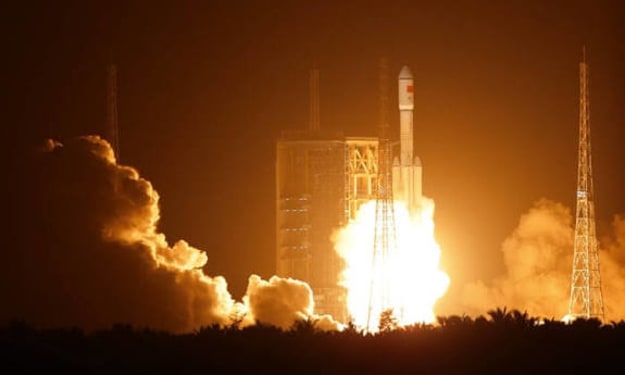
As Beijing’s space ambitions expand, Washington faces an intensifying geopolitical and technological rivalry in orbit and beyond. In the early decades of the 21st century, the United States long stood unchallenged as the dominant space power — a position built on decades of NASA leadership, unmatched launch capability, and a vibrant commercial space economy. But today, a determined China is mounting one of the most consequential strategic challenges in space since the Cold War, pushing to rival — and ultimately surpass — the U.S. in space influence, technology, and strategic advantage. National Strategy and Long‑Term Vision China’s leaders have openly signaled their ambition to become a global space powerhouse. Official space policy documents and state planning envision a broad array of capabilities — from heavy‑lift rockets to lunar exploration — aimed at reshaping the space order that has been U.S.‑dominated for decades. According to analyses of government planning, Beijing intends to establish a full suite of launch vehicles, satellites, and space infrastructure that could surpass current international norms by mid‑century. Underpinning this vision is a belief among Chinese space officials that self‑reliance and indigenous innovation are key to international competitiveness. Recent reports in state media emphasize that China’s aerospace industry is pushing far beyond imitation toward original technological breakthroughs in areas like rocket manufacturing, intelligent space systems, and advanced materials — all with the strategic goal of securing leadership in space. Commercial Space: From Government Giants to Private Innovators China’s rapid ascent isn’t limited to state space agencies. A growing ecosystem of private space companies — much like the commercial boom seen in the U.S. — has taken root, focusing on reusable rockets, satellite networks, and novel space services. A recent South China Morning Post report highlights Beijing’s push to encourage private innovation within its space sector, supporting technologies such as reusable launch vehicles, space debris monitoring, extraterrestrial resource utilization, and even in‑space biomanufacturing — fields long dominated by U.S. firms such as SpaceX or Blue Origin. This commercial expansion broadens China’s capabilities and compresses the technological gap with the U.S., challenging American assumptions that commercial innovation is exclusively an American forte. It also signals a shift in global space economics, where China may soon contend for commercial markets once dominated by Western companies. Military and Strategic Dimensions Alongside civil and commercial ambitions, China’s space strategy has clear military implications. U.S. strategic assessments note Beijing’s efforts to build counterspace capabilities — systems designed to deter, deny, or degrade another nation’s satellite operations — a key advantage in future conflicts. China has already deployed anti‑satellite weapons, jamming technologies, and sophisticated ground‑to‑space radar systems that could threaten U.S. space assets in a crisis. For the United States, which relies heavily on space systems for communication, navigation, and battlefield awareness, these capabilities represent a serious strategic challenge. Beijing’s ability to field space and counterspace technologies could blunt some of Washington’s military advantages in the Asia‑Pacific region and beyond. Lunar and Deep Space Objectives China’s Chang’e lunar exploration program is another marker of its space ambitions. With a series of increasingly complex robotic missions and plans for an International Lunar Research Station by the 2030s, Beijing aims to be a leading voice in lunar science and development — directly challenging the U.S. Artemis program and international partnerships spearheaded by NASA. � Wikipedia Missions like the strategically significant Queqiao‑2 communications relay satellite, which supports lunar missions over long distances, further demonstrate China’s growing sophistication in deep space operations and infrastructure deployment. U.S. Response: Maintaining Leadership Recognizing the challenge, U.S. policymakers are pushing legislative and strategic initiatives designed to preserve American competitiveness in space. A newly passed NASA authorization package includes provisions aimed at reinforcing U.S. lunar presence, strengthening Earth orbit assets, and countering Chinese influence in space science and technology — signaling a bipartisan consensus on the gravity of the space rivalry. A New Era of Cosmic Competition The emerging science and technological competition between China and the United States in space is unlike anything seen since the original Moon race. Today’s contest spans not only national prestige but military advantage, commercial opportunity, and scientific discovery. As each side pursues its vision of space dominance, the outcome will shape global power structures for decades to come — affecting diplomacy, security, and economic leadership both on Earth and beyond. If you’d like alternative versions, transcripts, or a set of headline + subtitle options for this topic, just let me know!
By Fiaz Ahmed 3 days ago in Longevity
Beginner Workout Routine at Home Without Equipment (Step-by-Step Full Body Guide)
Introduction Starting a fitness journey can feel overwhelming, especially for beginners who do not have access to a gym or expensive workout equipment. Many people want to improve their health and strength but are unsure where to begin or worry that working out at home may not be effective. The good news is that you do not need a gym membership or specialized machines to build a strong and healthy body. A well-structured beginner workout routine at home without equipment can help you develop strength, improve endurance, and establish a sustainable fitness habit.
By Core Well Fitabout 3 hours ago in Longevity



Comments
There are no comments for this story
Be the first to respond and start the conversation.