
Introduction to Holistic Health
Health for the Whole Person
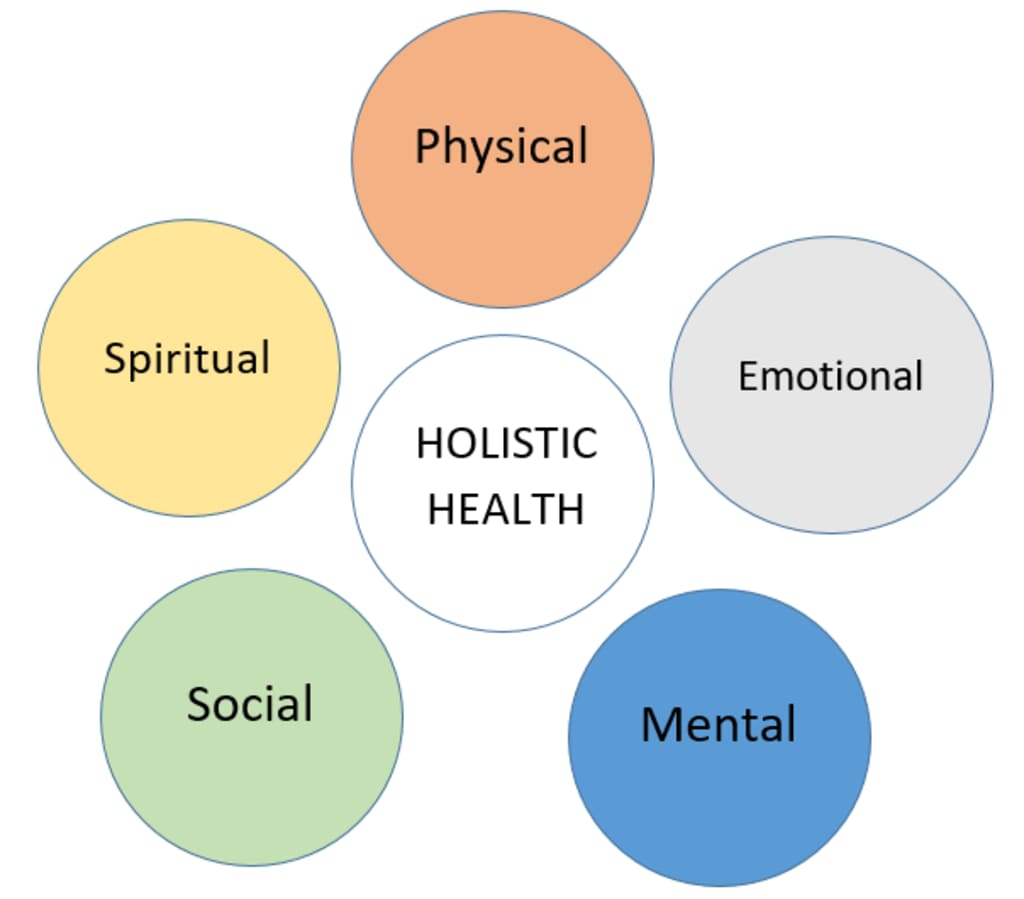
In this article, we will discuss the following topics which will help the reader to understand Holistic Health.
Subject for discussion.
1. What is Holistic Health?
2. What are the main facets of a person?
3. Physical Holistic Health
4. Spiritual Holistic Health
5. Emotional Holistic Health
6. Social Holistic Health
7. Mental Holistic Health
What is Holistic Health?
What is Holistic Health? The term Holistic in the realm of health, can be defined as, "characterized by the treatment of the whole person, taking into account mental and social factors, rather than just the symptoms of an illness." Health can be defined as, "the state of being free from illness or injury."
When most people think of health, it is mostly looked upon as being free from illness, and/or injury. We tend to overlook so many other aspects of ourselves beyond our own physical health. We are human beings that posses a complex array of emotions. We must interact with our environment and others within our environment. Many of us have belief in the divine, or are spiritual in one way or the other. It is crucial that the above aspects (physical, spiritual, emotional, social and mental) of ourselves are in balance in order to maximize our potential in life.
As eluded to above, holism is a way of addressing the entirety of a person in the above 5 dimensions. If one aspect of an individual is pristine, and in balance, while the other four major areas are in shambles, and imbalance, before long, the affected areas may affect the one most intact facet of the individual's life. Take for example the individual who have been given a clean bill of health by his/her doctor, who exercises each day, and eats, and drink healthy each day, and does all the thing necessary for optimal health. The above are all great lifestyle choices which will positively impact their life, but what if this same individual, is emotionally unstable with antisocial behavior, and is mentally unstable? This person is not holistically healthy, because they are nurturing their body alone, and have neglected the other aspects of their being.This individual require balance in the other aspects of their lives.
When an individual is holistically healthy in the five main areas of his/her being, they have arrived at Holistic Health.
2. What are the main facets of a person?
The five main facets of a human being is the physical, spiritual, emotional, social, and mental. These main facets can be broken down into subsections, or divisions. In this article we will deal with the main characteristics of each. As alluded to above, the 5 areas or facets of a person, is as follows.
Physical, spiritual, emotional, social and mental.
3. Physical Holistic Health

In order to perform everyday tasks and functions within our lives, we all must have a specific level of health. We all however, have varying degrees of health compared to others. For most people, the goal is to be healthy, and to possess optimal health in fact. It is not enough to simply exist without ailments, illnesses, diseases, and/or injury, but to ensure that you take the holistic approach to caring for your body.
Physical Holistic Health involves a number of body care activities such as appropriately cleansing the exterior of the body each day, brushing ones teeth, grooming of hair, fingernails and toenails, and eating a balance diet, along with consuming adequate quantities of water on a daily basis. Additionally, exercise, resting and getting sufficient hours of sleep will help to foster good physical health. It is also important to take great care of what you put on your skin, hair and scalp; as some personal care products contain chemicals that can negatively affect these areas of the body. There's a little known fact above some care products, and that is that many chemicals in care products applied to the skin can end up into the bloodstream.
In much the same way that the body require food on a daily basis, the body also requires fresh air, and at least 20 minutes of direct sunlight. Exposure to the sun will help the body to manufacture vitamin D, which is an essential vitamin that the body needs for a number of vital biological functions.
4. Spiritual Holistic Health

Spirituality mean different things to allot of people. Spirituality for some may be link to a supreme being and/or deity that may be linked to a specific religious belief or identity, or simply the belief that we human beings possess a spirit. Not all people however share in these beliefs.
If you are one such individual, please feel free to scroll beyond this item. If however you do have a belief in a supreme being, deity and/or religion, or specific set of rites, rituals or spiritual practices, it may be necessary for you to nurture this aspect.
I will not address this particular topic in any details because it is a very vast and complex one. I will however say, that whatever your custom, and/or belief entails, and if it is of importance to you, you should take the time out to practice and engage in your spirituality or practice. Whatever it may entail, whether praying, meditation, lighting candles or incense, ringing of bells, beating drums, supplication of some sort, singing, dancing, and/or reciting, et cetera, engage in it. If the spiritual and/or religious practice is important to you, do not neglect it.
An Holistic approach to your spirituality is to engage it wholeheartedly. Not only should you engage it, but to do so meaningfully. Immerse yourself in the its practice.
5. Emotional Holistic Health

As we go through life, we will at one time or another experience one emotion or another. Most, if not all of us have experienced happiness, anger, fear, and/or sadness in our lives. What is important is for us to possess and to maintain emotional stability and intelligence. There are those that are not emotionally stable. People who are not emotionally stable tend to experience challenges in their lives that affects them socially. They may have difficulties with relationships with family, friends, loved ones and coworkers. These challenges may cause the individual to isolate themselves from others. Many people who are emotionally unstable may view others as being the problem, especially if they cannot recognize that they are emotionally unstable.
Emotionally Unstable people may fall into a specific classification called Emotionally unstable personality disorder (EUPD). "Emotionally unstable personality disorder (EUPD) is the most common type of personality disorder. It usually causes you to experience intense and fluctuating emotions, which can last for anywhere between a few hours and several days at a time."
It important to note, that not all emotionally unstable people fall into the (EUPD) category. It is also important to note that emotional instability can stem from any number of factors. Recognizing the root cause of your emotional instability is the first step towards addressing this issue, and towards building a more emotionally stable mind.
Possessing emotional stability dies not mean that one should suppress their emotions. Possessing emotional stability will allow the individual to view and address challenges and/or situations in their lives with confidence, and a sense of balance and focus. Learning emotional intelligence is one way to nurture the emotional aspect of your being.
"Emotional intelligence is most often defined as the ability to perceive, use, understand, manage, and handle emotions."
In various societies, and cultures, we learn to respond to specific situations in a specific way. These responses may be taught or learned by observation. Responding to certain stimuli, or situations may harm you mentally, emotionally, or may put you in harm-sway of others. When one practices emotional intelligence, they'll learn to analyze each situation, and to respond appropriately. With enough practice, one can learn to respond with the most appropriate responses an/or emotions rather than responding with the wrong emotion or actions.
6. Social Holistic Health

One cannot go through life without interacting with other individuals. In fact, some studies suggest that people with good social skills have an easier time in finding a job, functions better in the workplace, tends to have better relationships, are better communicators than those with poor social skills.
People with good social skills usually develop those traits during their childhood, and most often may carry this trait into their adulthood. Good social skills however can be learned and developed as adults. There may be a number of factors that may have contributed to an individual lacking adequate social skills.
Developing good social skills entail learning how to communicate better, learning how to interact appropriately using emotional intelligence, and being courteous during your interactions. Learning good social skills will work to your benefit. Have fun on your journey in learning good social skills.
7. Mental Holistic Health

“ The line between sanity and insanity is very thin, if you are angry you are pushing the line, people keep pushing the line."
There is a widespread belief that only those who are significantly depressed, withdrawn, emotionally disturbed with periods of outbursts, and those experiencing visual and audible hallucinations are mentally disturbed. This couldn't be further from the truth.
There in fact exist individuals who may appear normal who are functioning adequately without any notable mental issues. The fact of the matter is, that many people hide their mental instability from others. We can say that the degree of some mental disabilities can be placed on a scale, from minor to severe. regardless of the degree, it is important to address any mental disability early before it intensifies.
Identifying the problem is the starting point to address the issue. Treatment can range from counselling, medication, and/or being institutionalized while receiving specific therapies. In my holistic health practice, I had occasion to counsel a student of mine one day after a lecture.
For the sake of confidentiality, let's call her Sue. Sue was 21 at the time when she approached me after a lecture I'd just conducted on Herbalism. She'd ask if she could retain my services; as she had not been sleeping well, had been experiencing mood swings, and had a rash on her back that would not go away no matter what she applied on it. I arrange a session with her, sat and listened to her complaints.
During the discussion, I'd asked her if she'd experienced any emotional traumas in her life. She told me about an incident that occurred that involved her being sexually abused at the age of 11 by her step-father. Sue kept the incident to herself for 10 grueling years until she shared it with me. She went on to explain that for the past 10 years of her life, she experienced bouts of depress, and self-guilt. She'd also cut herself periodically, but she never cried since the incident. So, for 10 years Sue had bottled up emotions that she did not release.
When asked how the incident made her feel, she replies with a burst of emotion, "Sad Dr. Rolle, sad!" She then, after 10 years, cried. I gave her an handkerchief, gave her a father's embrace, and allowed her to cry on my shoulder. I then counselled her, and has given her a few assignments to do as part of her Holistic Health Therapy. What happened after the session with Sue was so amazing!
One week after my session with Sue, she came to see me yet again in my office after another lecture. I sad intently as I waited to hear how she'd been doing. With a huge grin on her face, Sue told me that for the first time in years, she'd been able to sleep, and that she didn't feel as depressed as she normally would. She appeared happier, and more vibrant. Sue said that even the stubborn rash that she had, began disappearing. She thanked me, and had asked why she'd experience such a marked improvement in her situation. I tole her that she needed a release. That outburst of emotion followed by her intense weeping, gave her the release that she needed.
I'd also advise her against self isolation, and suggested that she engaged in recreational activities and hobbies that she could enjoy, and to surround herself with supportive company of friends, and family.
In the above case, Sue was mentally disturbed. She isolated herself, and did not receive any help for 10 years. It took one counselling session to turn her whole situation around.
Earlier, I'd mention that neglected, and unbalanced aspects of our lives may affect other areas of our being. In this case Sue mental instability affected her physically, and emotionally. I will share some suggestions on improving and maintaining good mental health. These are the suggestions given to Sue during our session.
- Rest when your body is tired.
- Get sufficient sleep at night.
- Engage in healthy social interactions with others.
- Eat as healthy as you possibly can.
- Engage in walks on the beach or nature-walks.
- Engage in enjoyable hobbies.
- Find time for recreational activities that you enjoy.
Summary
To summarize, holistic health is taking into the account and nurturing the 5 main aspect of an individual which are the physical aspect, the spiritual aspect, the emotional aspect, the social aspect, and the mental aspect. Nurturing the physical body entails consuming healthy foods and drinks, getting enough rest and sleep, and proper grooming and cleansing of the body.
Depending on your spiritual/religious practices if any, one must engage these practices, rites and/or rituals in a meaningful way. This aspect must be nurtured as much as the others.
Some person; but not all, may fall into the category and be diagnosed with Emotionally unstable personality disorder (EUPD). Emotional instability may have many root causes, and finding the cause of the emotional instability is the first step in addressing the issue. Using emotional intelligence will help the individual to learn how to respond to certain situations appropriately.
Having good social skills, will enable an individual to have healthy relationships, with people within their circle, an with total strangers in society. People with good social skills have better in finding jobs, and tends to be better communicators.
People have misconceptions on mental health. There are many people who hide their mental disabilities from society. Identifying that you may have a mental disability if the first step in addressing the disorder, whether minor, moderate or severe. Treatments for mental disorders can range from simple to more complex counselling sessions, to medication use, and/or being institutionalized while receiving treatment. To develop, and/or maintain good mental health and stability, get sufficient rest and sleep, engage in healthy social interactions, go for walks on the beach, or nature-walks, eat as healthy as you possibly can, and engage in enriching recreational activities.
It is important to note that it is ideal to have all 5 main aspects of your being healthy, nurtured, and in perfect balance. If one or more areas are not healthy, it may inevitably effect other areas.
Attaining Holistic Health can lead to a happier, more productive and fulfilling life. I wish you the very best as you seek to optimize all of the aspects of your self while achieving Holistic Health for body, spirit, emotional, social, and mental (mind)!
Cheers, to your holistic health!
About the Creator
Keep reading
More stories from writers in Longevity and other communities.
Day 4 of Quitting
If this is how sobriety feels, maybe it’s better to go through life a little buzzed… this, along with other hits like, I want to kill myself, I wish I was dead, and I’m going to throw myself off a bridge have been the only thoughts on rotation these past few days. I promise myself that if, in a month, I still feel like this (‘this’ meaning despondent, full of rage, and simultaneously numb) I can go back to smoking. Until mid-February though? Nicotine is off the table.
By sleepy drafts18 days ago in Longevity
Global In-Vitro Diagnostics Market Size and Forecast 2025–2033
Introduction: Diagnostics at the Heart of Modern Healthcare The global healthcare system is undergoing a quiet but powerful transformation—and at its center is the In-Vitro Diagnostics (IVD) market. From early disease detection to personalized treatment planning, diagnostic tests have become indispensable in clinical decision-making. According to Renub Research, the global In-Vitro Diagnostics market is expected to grow from US$ 97.56 billion in 2024 to approximately US$ 160.68 billion by 2033, expanding at a compound annual growth rate (CAGR) of 5.70% during 2025–2033.
By Aaina Oberoi4 days ago in Longevity




Comments
There are no comments for this story
Be the first to respond and start the conversation.