
Global Wound Care Market Size and Forecast 2025–2033
Rising Chronic Diseases, Aging Population, and Advanced Healing Technologies Drive Steady Market Expansion

Introduction
The global healthcare landscape is undergoing a rapid transformation, with wound management emerging as a critical component of patient care. From chronic diabetic ulcers to post-surgical incisions, effective wound care solutions are essential for preventing infections, reducing hospital stays, and improving quality of life. As healthcare systems worldwide prioritize faster healing and better patient outcomes, the wound care market is witnessing sustained growth driven by demographic changes, technological innovation, and rising disease prevalence.
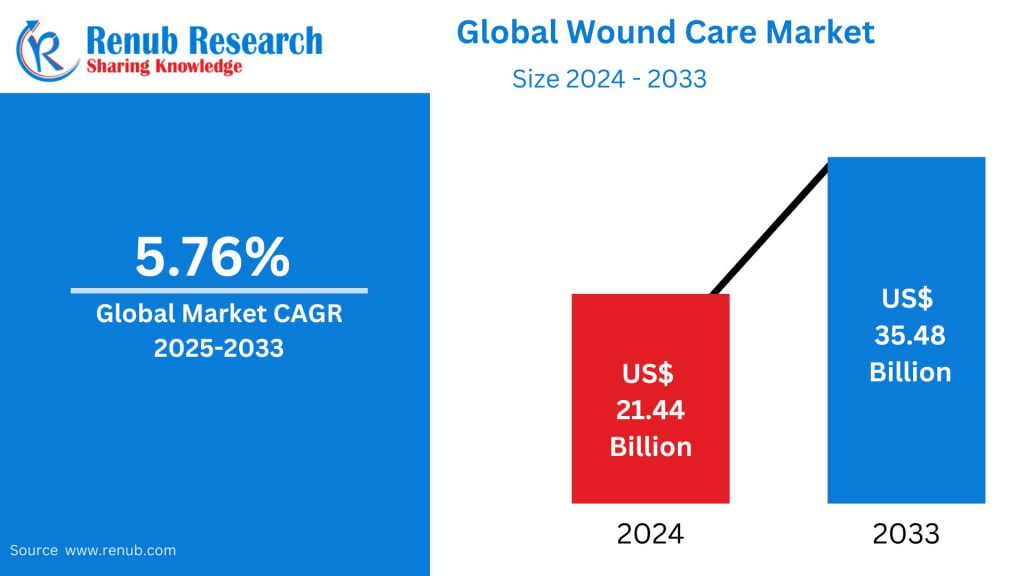
According to Renub Research, the Global Wound Care Market was valued at USD 21.44 billion in 2024 and is expected to grow at a compound annual growth rate (CAGR) of 5.76% from 2025 to 2033, reaching approximately USD 35.48 billion by 2033. This growth reflects increasing demand for advanced wound management solutions across hospitals, clinics, and home care settings worldwide.
Global Wound Care Market Overview
Wound care refers to the medical management of acute, chronic, and surgical wounds to promote healing, prevent infections, and avoid complications. The market encompasses a wide range of products and therapies, including traditional dressings, advanced wound dressings, negative pressure wound therapy (NPWT), antimicrobial solutions, bioactive products, and regenerative wound care technologies.
Globally, the importance of wound care has increased significantly due to the rising incidence of chronic wounds associated with diabetes, vascular diseases, pressure ulcers, and aging populations. Additionally, the growing number of surgical procedures and traumatic injuries has further fueled the need for effective wound care products. As awareness improves and healthcare providers increasingly adopt evidence-based practices, advanced wound care solutions are replacing conventional treatment methods.
Key Growth Drivers in the Global Wound Care Market
Rising Incidence of Chronic Diseases
One of the most powerful drivers of the global wound care market is the growing prevalence of chronic conditions such as diabetes, obesity, and cardiovascular disorders. Chronic wounds—including diabetic foot ulcers, venous leg ulcers, and pressure sores—require long-term treatment and specialized care.
The aging global population further intensifies this trend, as elderly patients are more prone to comorbidities that impair wound healing. According to the International Diabetes Federation, the number of people living with diabetes is projected to rise from 463 million in 2019 to 578 million by 2030, reaching nearly 700 million by 2045. This surge directly translates into increased demand for advanced wound care products such as moisture-retentive dressings, NPWT systems, and bioactive therapies.
Technological Advancements in Wound Care Products
Innovation is transforming wound care management worldwide. Advanced dressings with antimicrobial properties, growth factor-infused materials, bioengineered skin substitutes, and intelligent wound monitoring technologies are significantly improving healing outcomes.
Silver- and iodine-based antimicrobial dressings help control infections, while hydrogels and collagen-based products promote tissue regeneration. Digital wound assessment tools and telemedicine platforms are also gaining popularity, enabling remote monitoring and timely intervention, especially in home care settings.
In January 2023, ConvaTec Group (UK) launched ConvaFoam, a versatile dressing designed to support wound management across multiple healing stages, highlighting the industry’s focus on simplicity and clinical efficiency.
Increasing Surgical Procedures and Traumatic Injuries
The global rise in both elective and emergency surgeries is another major growth factor. Surgical wounds require precise post-operative management to reduce infection risks and ensure proper healing. As hospitals aim to shorten patient stays and improve outcomes, demand for advanced wound dressings and closure systems continues to rise.
Additionally, road accidents, workplace injuries, and sports-related trauma contribute significantly to acute wound cases. In June 2024, Axogen, Inc. introduced Avive+ Soft Tissue Matrix™, a resorbable amniotic membrane allograft designed to support nerve and tissue healing, underscoring ongoing innovation in surgical wound care.
Challenges Facing the Global Wound Care Market
High Cost of Advanced Wound Care Solutions
Despite their clinical effectiveness, advanced wound care products often come with high costs. Technologies such as NPWT systems, bioengineered skin substitutes, and growth factor-based therapies can be financially inaccessible for patients in low-income regions or those without comprehensive insurance coverage.
This cost barrier is particularly evident in home care settings and rural areas, where traditional wound care methods remain prevalent. Limited reimbursement policies further restrict widespread adoption of advanced wound care solutions.
Limited Awareness and Skilled Workforce in Emerging Markets
In many developing regions, lack of awareness about advanced wound care technologies and shortage of trained healthcare professionals pose significant challenges. Delayed diagnosis, inadequate infrastructure, and poor follow-up care often lead to prolonged healing times and higher infection rates, ultimately affecting patient outcomes and market growth.
Market Segment Analysis
Advanced Wound Dressings Market
Advanced wound dressings—including foam, hydrocolloid, hydrogel, and alginate dressings—play a central role in modern wound management. These products create a moist healing environment, reduce pain, and accelerate tissue regeneration, making them ideal for chronic wounds such as pressure ulcers and diabetic foot ulcers.
Their ability to reduce dressing changes and manage exudate effectively has made them popular in hospitals, outpatient clinics, and home care environments.
Bioactive Wound Care Market
Bioactive wound care products are designed to stimulate the body’s natural healing processes through biological interaction. These include collagen-based dressings, growth factors, and bioengineered skin substitutes.
Although relatively expensive, bioactive products are highly effective in treating complex and non-healing wounds, burns, and surgical sites. Their regenerative capabilities and reduced healing time justify their increasing adoption in specialized wound care centers.
Foam and Antimicrobial Wound Care Markets
Foam dressings are widely used due to their absorbency, cushioning effect, and patient comfort. They are suitable for both acute and chronic wounds and are increasingly combined with antimicrobial agents.
Antimicrobial wound care products, containing silver, iodine, or PHMB, are experiencing strong demand due to rising concerns over wound infections and antimicrobial resistance. Hospitals increasingly rely on these products to reduce infection rates and enhance patient safety.
Application-Based Market Outlook
Chronic Wound Care Market
Chronic wounds represent one of the fastest-growing segments of the wound care market. Managing these wounds requires long-term monitoring, advanced therapies, and multidisciplinary care approaches.
The growing use of NPWT, bioactive dressings, and moisture-retentive technologies is improving healing outcomes. Healthcare providers are investing heavily in training and infrastructure to address the rising chronic wound burden.
Acute Wound Care Market
Acute wounds, including surgical incisions and traumatic injuries, continue to drive steady demand for wound care products. Hospitals remain the primary consumers, although outpatient clinics and emergency care centers are seeing increasing adoption of advanced solutions for faster recovery and infection prevention.
End-User Insights
Home Care Settings
The home care segment is expanding rapidly as patients prefer convenient and cost-effective care options. Portable NPWT systems, foam dressings, and hydrocolloids are commonly used, supported by telemedicine and remote wound monitoring technologies.
Hospitals and Clinics
Hospitals and clinics remain the dominant end users, managing both acute and chronic wounds. Infection control protocols, reimbursement access, and trained staff support continued growth in this segment, particularly for advanced and antimicrobial wound care solutions.
Regional Market Highlights
United States
The U.S. is one of the largest wound care markets globally, driven by high chronic disease prevalence, advanced healthcare infrastructure, and strong reimbursement systems. In September 2022, MiMedx Group, Inc. launched AMNIOEFFECT, a multi-layer human tissue allograft designed to enhance wound healing.
Germany
Germany represents a mature European wound care market with strong adoption of advanced technologies. In July 2023, JeNaCell (Evonik) introduced epicite balance, targeting chronic wounds with low to medium exudate.
India
India’s wound care market is expanding due to rising diabetes prevalence and improving healthcare access. In September 2024, HCAH partnered with Aroa Biosurgery to strengthen advanced wound care delivery across home and hospital settings.
Saudi Arabia
Saudi Arabia’s wound care market is growing rapidly, supported by government healthcare investments under Vision 2030. In March 2025, AMS BioteQ announced plans to introduce its SIPSIP® wound care products across the Middle East.
Competitive Landscape
Key players shaping the global wound care market include:
Mölnlycke Healthcare
Smith & Nephew
Ethicon Inc. (Johnson & Johnson)
Coloplast Corp
ConvaTec Group PLC
Derma Sciences Inc. (Integra LifeSciences)
These companies compete through innovation, product diversification, strategic partnerships, and geographic expansion.
Final Thoughts
The Global Wound Care Market is positioned for consistent growth through 2033, driven by rising chronic diseases, aging populations, and technological advancements. While cost and awareness challenges persist, continued innovation, expanding home care solutions, and supportive healthcare policies are expected to unlock new opportunities.
As healthcare systems increasingly focus on faster healing, reduced complications, and patient-centric care, wound care will remain a vital and evolving segment of the global medical industry.
About the Creator
Marthan Sir
Educator with 30+ years of teaching experience | Passionate about sharing knowledge, life lessons & insights | Writing to inspire, inform, and empower readers.
Keep reading
More stories from Marthan Sir and writers in Longevity and other communities.
Global Diagnostic Imaging Market Size and Forecast 2025
Introduction The global healthcare ecosystem is undergoing a profound transformation, driven by technological innovation, demographic shifts, and a growing emphasis on early and accurate disease diagnosis. At the center of this transformation lies diagnostic imaging—a critical pillar of modern medicine that enables clinicians to detect, monitor, and manage a wide range of health conditions with precision.
By Marthan Sirabout a month ago in Longevity
Day 4 of Quitting
If this is how sobriety feels, maybe it’s better to go through life a little buzzed… this, along with other hits like, I want to kill myself, I wish I was dead, and I’m going to throw myself off a bridge have been the only thoughts on rotation these past few days. I promise myself that if, in a month, I still feel like this (‘this’ meaning despondent, full of rage, and simultaneously numb) I can go back to smoking. Until mid-February though? Nicotine is off the table.
By sleepy drafts10 days ago in Longevity
More Than 5 Million Native Plants Reintroduced in Deserts Are Slowing Land Degradation and Rebooting Arid Ecosystems
Deserts are often seen as barren, unforgiving landscapes, but they are far from lifeless. These ecosystems, while harsh, support unique biodiversity and provide critical environmental services, from carbon sequestration to regulating local climates. Yet, decades of overgrazing, unsustainable land use, and climate change have taken their toll, leaving many arid regions struggling with soil erosion, loss of native vegetation, and diminished ecological resilience. Now, a bold rewilding effort is turning the tide: over five million native plants have been reintroduced into deserts worldwide, and the early results are promising. The scale of the initiative Across regions from the deserts of the Middle East and North Africa to the arid plains of Australia and North America, conservation organizations, local communities, and governments have collaborated to replant native species that were once nearly wiped out. These plants range from hardy shrubs and grasses to iconic desert flowers, all carefully selected for their ability to survive in extreme conditions and restore ecological balance. The numbers are staggering: more than 5 million individual plants have been transplanted over the last five years, covering thousands of hectares. While this effort is labor-intensive, involving soil preparation, irrigation during establishment phases, and ongoing monitoring, the environmental payoff has been remarkable. Slowing land degradation One of the primary goals of these reintroductions is to combat land degradation, a process that affects over 40% of the planet’s land surface. In deserts, degradation is particularly acute because soil erosion occurs rapidly in the absence of stabilizing vegetation. Without plants to anchor the soil, wind and water can strip away fertile topsoil, creating a feedback loop of declining vegetation and worsening erosion. Early monitoring reports suggest that reintroduced native plants are helping to stabilize sandy soils and reduce the spread of desertification. In some areas of the Middle East, for instance, wind erosion rates have decreased by up to 30% in regions where shrubs and grasses were replanted. This stabilization not only benefits the environment but also local communities that rely on the land for grazing, agriculture, and other livelihoods. Rebooting arid ecosystems Beyond slowing soil loss, these plant reintroductions are rebooting entire desert ecosystems. Deserts are home to a diverse array of wildlife, including insects, birds, and mammals that rely on native plants for food and shelter. By re-establishing vegetation cover, these efforts have triggered a cascade of ecological benefits. In parts of the Sonoran Desert in North America, researchers observed a noticeable increase in pollinator populations, such as bees and butterflies, following the reintroduction of native flowering plants. Similarly, small mammals and reptiles that had disappeared from degraded areas are gradually returning, attracted by improved habitat structure and food availability. Climate resilience Another key advantage of reintroducing native plants is enhancing climate resilience. Many desert plants are adapted to survive extreme heat, drought, and poor soils. By re-establishing these species, ecosystems can better withstand climate-related stresses, such as prolonged droughts or extreme heatwaves. Additionally, some species improve soil moisture retention and reduce surface temperatures, creating microclimates that further support biodiversity. Community engagement and knowledge transfer What makes these rewilding efforts particularly successful is the integration of local communities. Indigenous knowledge about native species, planting techniques, and seasonal cycles has been invaluable. In some regions, schools and community groups participate in planting days, turning conservation into a source of pride and education. This engagement ensures that restored areas are maintained, monitored, and valued over the long term. Looking ahead While the reintroduction of five million native plants is a significant achievement, experts caution that long-term success requires continued investment, monitoring, and protection from overgrazing, development, and climate pressures. However, the initiative provides a compelling example of how targeted, science-backed restoration can reverse environmental damage. For arid ecosystems, these efforts are more than just planting trees and shrubs—they represent hope. They demonstrate that even the most fragile landscapes can recover when humans actively collaborate with nature, restoring not only plants but the entire web of life that depends on them. As the world grapples with climate change and land degradation, the lessons from these desert rewilding projects offer a blueprint for action: by investing in native biodiversity, we can slow degradation, rebuild ecosystems, and create landscapes that are resilient, productive, and teeming with life once again.
By Fiaz Ahmed Brohi3 days ago in Longevity



Comments
There are no comments for this story
Be the first to respond and start the conversation.