
Global Ophthalmic Devices Market Trends & Summary
How Technology, Aging Populations, and Rising Vision Disorders Are Shaping the Future of Eye Care Worldwide

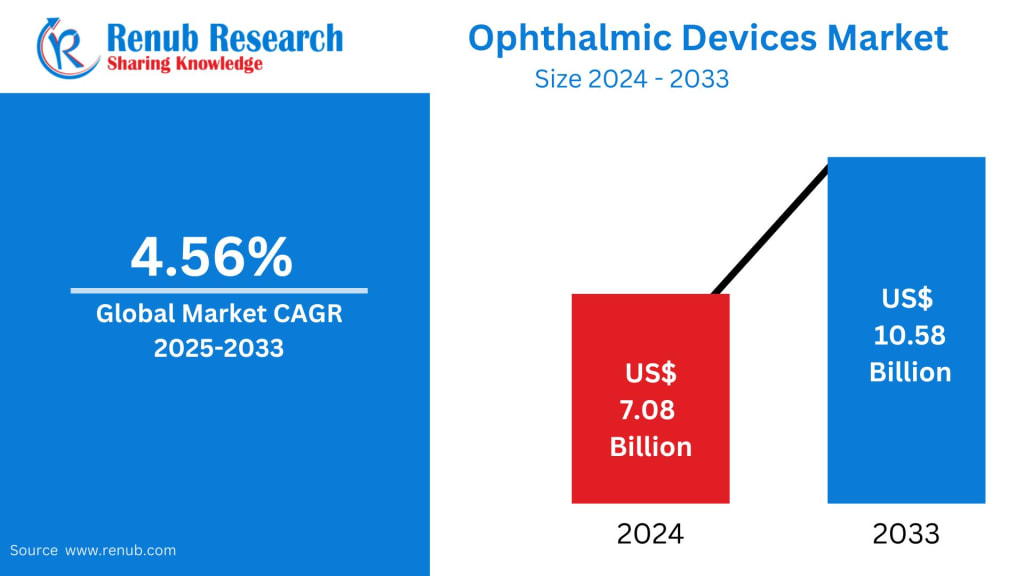
The Global Ophthalmic Devices Market, valued at USD 7.08 billion in 2024, is projected to reach USD 10.58 billion by 2033, according to Renub Research. This translates into a steady CAGR of 4.56% from 2025 to 2033. Much of this growth is driven by escalating rates of eye disorders, breakthroughs in diagnostic and surgical technology, and an increasing global demand for vision correction solutions such as spectacles, contact lenses, and minimally invasive surgical tools.
As eye diseases continue to rise—cataracts, glaucoma, diabetic retinopathy, and refractive errors—the demand for accurate diagnostics and advanced treatment systems has never been higher. With aging populations expanding faster than ever, vision health is emerging as a global public health priority. Emerging technologies like AI diagnostics, robot-assisted surgery, and smart wearable optics are transforming this once-traditional industry into one of the fastest-modernizing segments of healthcare.
Understanding the Global Ophthalmic Devices Market
Ophthalmic devices include a comprehensive array of medical systems used to diagnose, monitor, treat, and correct eye conditions. The ecosystem spans:
Diagnostic tools such as ophthalmoscopes, autorefractors, OCT scanners, and keratometers
Surgical devices including lasers, intraocular lenses (IOLs), stents, and glaucoma drainage implants
Vision correction solutions such as spectacles and contact lenses
These instruments are instrumental in treating widespread vision disorders—from routine refractive errors to sight-threatening diseases like cataracts and glaucoma.
As global life expectancy increases, demand for precise and patient-friendly ophthalmic care grows sharply. Advances in AI, imaging, and minimally invasive surgeries further accelerate adoption across developed and developing markets.
Key Growth Drivers in the Global Ophthalmic Devices Market
1. Rising Prevalence of Eye Disorders and Rapid Population Aging
Eye diseases are soaring globally, particularly among older adults. WHO reports that over 2.2 billion people worldwide are currently living with some form of vision impairment or blindness. Cataracts remain the leading cause, while glaucoma and age-related macular degeneration (AMD) are increasing in prevalence.
Two major demographic trends are fueling demand:
Increasing life expectancy worldwide
Growing incidence of diabetes, which elevates risks of diabetic retinopathy
WHO estimates that by 2030, 1 in every 6 people on Earth will be aged 60 or older, rising from 1 billion in 2020 to 1.4 billion—and reaching 2.1 billion by 2050. With this shift comes higher demand for surgical devices, advanced imaging systems, and vision correction tools.
2. Rapid Technological Advancements in Ophthalmic Care
Ophthalmology is undergoing a technological revolution. Innovations like:
Femtosecond laser-assisted cataract surgery
Minimally invasive glaucoma surgery (MIGS)
AI-driven diagnostic platforms
Optical coherence tomography (OCT) advancements
Robot-assisted microsurgery techniques
are reshaping how eye conditions are diagnosed and treated.
A notable example came in October 2024, when RetinAI launched its AI-based Discovery for Clinics platform, enabling ophthalmologists and optometrists to enhance workflow precision through machine learning-driven diagnostics.
The future promises even more innovations—such as smart contact lenses, augmented reality (AR) eyewear, and deeper AI integration across diagnostic workflows.
3. Government Initiatives and Public Awareness Campaigns
Many governments are prioritizing eye health as preventable blindness becomes a global public health concern.
Key initiatives include:
WHO’s SPECS 2030 program (launched May 2024), aiming to increase affordable spectacle access by 40% globally
The International Agency for the Prevention of Blindness (IAPB) advocating for early diagnosis and eye-screening programs
National programs in developing countries, particularly in Asia and Africa, to expand access to cataract surgeries and vision correction
Public-private partnerships are increasing the availability of screenings, diagnostics, and low-cost treatments, especially in underserved regions.
Challenges Impacting Market Growth
1. High Cost of Advanced Ophthalmic Equipment
Cutting-edge technologies—femtosecond lasers, robotic surgical tools, and premium intraocular lenses—are often prohibitively expensive. Limited insurance coverage and high surgical costs further impede accessibility, especially in low- and middle-income countries.
2. Lack of Trained Ophthalmologists
Even where technology exists, the shortage of specialists capable of using advanced equipment remains severe. Developing regions in particular struggle with:
Limited training programs
Low specialist-to-patient ratios
Underutilization of high-end diagnostic and surgical systems
Expanding workforce training is essential to ensuring equitable access to modern eye care technologies.
Segment Analysis of the Ophthalmic Devices Market
1. Surgical Devices
Ophthalmic Glaucoma Drainage Devices
Growing glaucoma prevalence—one of the leading causes of irreversible blindness—redefines demand for:
Micro-bypass stents
Tube shunts
MIGS devices
As long-term pressure control through medications sometimes fails, surgical interventions are becoming more sought after.
Intraocular Lenses (IOLs)
With cataract surgeries increasing worldwide, IOLs represent one of the fastest-growing segments. Innovations include:
Multifocal IOLs
Toric lenses for astigmatism
EDOF (Extended Depth of Focus) IOLs
Government-backed cataract programs in emerging markets significantly boost adoption.
Laser Ophthalmic Systems
Used widely in cataract, refractive, and glaucoma surgeries, laser systems continue to advance toward higher precision and patient safety.
2. Diagnostic & Monitoring Devices
Autorefractors and Keratometers
The surge in myopia, especially among younger populations, is driving demand for automated refractive systems. AI-enhanced devices are becoming increasingly common in clinics and optical centers.
Ophthalmoscopes
Crucial for detecting diabetic retinopathy and AMD, digital ophthalmoscopes and smartphone-based systems are making screenings more accessible worldwide.
Optical Coherence Tomography (OCT)
OCT systems remain the gold standard for retinal imaging and glaucoma monitoring, benefiting from continuous technological enhancements.
3. Vision Correction Devices
Spectacles Market
Driven by lifestyle changes, increased screen exposure, and aging populations, the spectacles market is expanding rapidly. Trends include:
Blue-light filtering lenses
Ultralight frames
Smart glasses
E-commerce platforms are further accelerating market penetration.
Contact Lenses Market
Innovations reshaping this segment include:
Silicone hydrogel lenses
Daily disposable lenses
Specialty lenses for presbyopia and astigmatism
Emerging smart contact lenses equipped with biosensors
Fashion lenses and online distribution channels also boost sales.
Regional Market Snapshots
United States
The U.S. leads due to:
Advanced healthcare infrastructure
High adoption of cutting-edge technologies
Strong reimbursement frameworks
In March 2025, Bausch + Lomb introduced Arise, a cloud-based system for orthokeratology lens design—underscoring the nation’s early adoption of intelligent vision solutions.
France
France benefits from:
Government-funded eye care
High rates of refractive surgeries
Strong innovation ecosystem in ophthalmology
Théa’s expansion in 2022 strengthened France’s influence in European ophthalmic innovation.
India
India is among the world’s fastest-growing ophthalmic device markets due to:
High prevalence of cataracts and diabetic retinopathy
Large population requiring vision correction
Expanding teleophthalmology infrastructure
Government programs such as NPCBVI
In February 2025, Kerala launched Nayanamritham 2.0, the world’s first government-led AI screening platform for chronic eye diseases.
Saudi Arabia
Saudi Arabia’s Vision 2030 program continues to transform its healthcare ecosystem. Key market drivers include:
High diabetes-induced retinopathy rates
Rising demand for premium eyewear
Expanding specialty eye hospitals
Increased investment in advanced surgical and diagnostic systems
Market Segmentation Overview
Surgical Devices
Glaucoma Drainage Devices
Glaucoma Stents & Implants
Intraocular Lenses
Lasers
Other Surgical Devices
Diagnostic & Monitoring Devices
Autorefractors & Keratometers
Corneal Topography Systems
Ultrasound Imaging Systems
Ophthalmoscopes
OCT Scanners
Others
Vision Correction Devices
Spectacles
Contact Lenses
Geographical Coverage
North America: U.S., Canada
Europe: France, Germany, Italy, Spain, U.K., Belgium, Netherlands, Turkey
Asia-Pacific: China, Japan, India, Australia, South Korea, Thailand, Malaysia, Indonesia, New Zealand
Latin America: Brazil, Mexico, Argentina
Middle East & Africa: South Africa, Saudi Arabia, UAE
Leading Companies Covered
Alcon Inc.
Bausch Health Companies Inc.
Carl Zeiss Meditec AG
EssilorLuxottica SA
HAAG-Streit Group
Hoya Corporation
Johnson & Johnson
Nidek Co. Ltd
Topcon Corporation
Ziemer Ophthalmic Systems AG
Each company is analyzed through:
Overview • Key Persons • Recent Developments • Revenue
Final Thoughts
The global ophthalmic devices market is entering a transformative era. The convergence of AI, wearable technologies, minimally invasive surgical tools, and teleophthalmology is reshaping how eye care is delivered. With an aging world and rising rates of vision impairment, the demand for advanced diagnostics and affordable treatment solutions will continue to grow.
While challenges remain—particularly cost barriers and workforce shortages—the industry’s innovation pipeline is strong. From smart lenses to robotic microsurgery, the future of ophthalmology is poised to become more accessible, precise, and technologically advanced than ever.
About the Creator
Janine Root
Janine Root is a skilled content writer with a passion for creating engaging, informative, and SEO-optimized content. She excels in crafting compelling narratives that resonate with audiences and drive results.
Keep reading
More stories from Janine Root and writers in Longevity and other communities.
United States Molecular Diagnostics Market Trends & Summary
The United States molecular diagnostics market continues to strengthen its position as a global powerhouse, driven by innovations in technology, rising cases of infectious diseases and cancer, and accelerated adoption of personalized medicine. According to Renub Research, the U.S. market stood at USD 4.91 billion in 2024 and is projected to reach USD 8.40 billion by 2033, expanding at a CAGR of 6.15% from 2025 to 2033. This momentum reflects the nation’s focus on improving early detection, enhancing treatment accuracy, and supporting a healthcare ecosystem increasingly reliant on genetic insight.
By Janine Root about a month ago in Longevity
Day 4 of Quitting
If this is how sobriety feels, maybe it’s better to go through life a little buzzed… this, along with other hits like, I want to kill myself, I wish I was dead, and I’m going to throw myself off a bridge have been the only thoughts on rotation these past few days. I promise myself that if, in a month, I still feel like this (‘this’ meaning despondent, full of rage, and simultaneously numb) I can go back to smoking. Until mid-February though? Nicotine is off the table.
By sleepy drafts7 days ago in Longevity
Bacterial Skin Infections
Introduction: When it comes to skin irritation, not every one of them is a simple rash. There are some bacteria that can enter the skin through tiny cuts and hair follicles. These bacteria include Staphylococcus aureus (Staph) or Streptococcus pyogenes (Strep) that can cause infections ranging from irritation and bothersome to dangerous.
By benjamin taylora day ago in Longevity




Comments
There are no comments for this story
Be the first to respond and start the conversation.