
Global Liquid Biopsy Market Size & Forecast 2026–2034
How Non-Invasive Cancer Diagnostics Are Reshaping Precision Oncology Worldwide

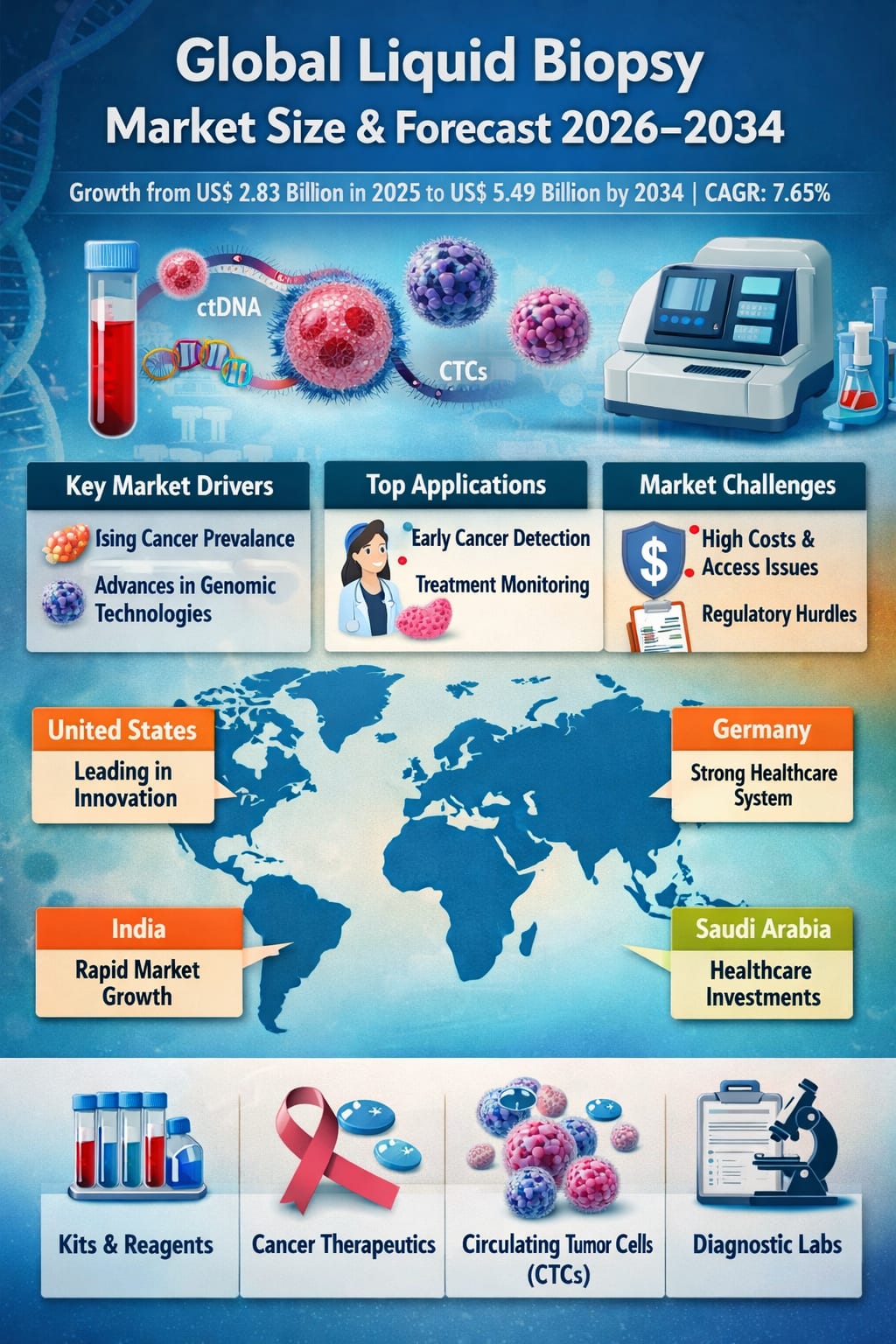
Introduction: A New Era in Cancer Diagnostics
The global healthcare landscape is undergoing a profound transformation, driven by the convergence of biotechnology, genomics, and data-driven medicine. Among the most promising advancements in modern oncology is liquid biopsy—a minimally invasive diagnostic approach that is redefining how cancer is detected, monitored, and treated. Unlike conventional tissue biopsies, liquid biopsy relies on analyzing biomarkers such as circulating tumor DNA (ctDNA), circulating tumor cells (CTCs), exosomes, and other nucleic acids found in body fluids, primarily blood.
According to Renub Research-based market estimates, the global liquid biopsy market is expected to grow from US$ 2.83 billion in 2025 to US$ 5.49 billion by 2034, registering a compound annual growth rate (CAGR) of 7.63% from 2026 to 2034. This growth reflects not only the rising burden of cancer worldwide, but also the increasing demand for non-invasive, accurate, and repeatable diagnostic tools that align with the principles of precision medicine.
Liquid biopsy has already proven its value in early cancer detection, therapy selection, treatment monitoring, and recurrence surveillance. As healthcare systems shift toward personalized treatment pathways, this technology is rapidly moving from a niche innovation to a core component of modern oncology practice.
Liquid Biopsy Market Outlook: Technology That Changes the Rules
Liquid biopsy represents a significant departure from traditional diagnostic methods. Instead of surgically extracting tumor tissue, clinicians can now analyze tumor-derived material circulating in the bloodstream. This approach offers several advantages: reduced patient discomfort, lower procedural risk, faster turnaround times, and the ability to perform serial testing over the course of treatment.
Clinically, liquid biopsy is widely used in oncology to:
Detect genetic mutations and tumor-specific biomarkers
Monitor disease progression and treatment response
Identify early signs of relapse
Evaluate tumor heterogeneity and emerging drug resistance
The integration of next-generation sequencing (NGS), digital PCR, and advanced bioinformatics has further enhanced the sensitivity and specificity of these tests. As a result, liquid biopsy is increasingly being viewed not just as an alternative to tissue biopsy, but as a complementary and, in some cases, superior diagnostic tool.
Globally, the rising incidence of cancer and the growing emphasis on early diagnosis have accelerated adoption. Healthcare providers and researchers alike recognize the potential of liquid biopsy to deliver real-time insights into tumor biology—something traditional biopsies cannot easily achieve due to their invasive nature and limited sampling frequency.
Key Growth Drivers in the Global Liquid Biopsy Market
Rising Prevalence of Cancer and Demand for Early Diagnosis
Cancer remains one of the leading causes of mortality worldwide, creating an urgent need for diagnostic solutions that are early, accurate, and patient-friendly. Liquid biopsy meets this demand by enabling the detection of cancer-related genetic alterations at very early stages—sometimes even before clinical symptoms appear.
In 2025 alone, the United States is expected to record over 2 million new cancer cases and more than 600,000 deaths, underscoring the scale of the challenge. Common cancers such as breast, prostate, lung, colorectal, and pancreatic cancers continue to drive demand for improved diagnostic and monitoring tools.
One of the greatest strengths of liquid biopsy is its suitability for longitudinal monitoring. Because the test can be repeated easily, clinicians can track how a tumor evolves over time and how it responds to therapy. This capability is transforming cancer care from a static, one-time diagnostic event into a dynamic, data-driven process.
Advancements in Genomic and Molecular Diagnostic Technologies
Technological progress is another major catalyst behind market expansion. Innovations in NGS, digital PCR, and molecular profiling platforms are enabling the detection of extremely low-frequency mutations and subtle genetic changes associated with cancer progression.
Biotechnology companies and diagnostic laboratories are investing heavily in research and development to expand the clinical utility of liquid biopsy. In April 2025, Labcorp expanded its precision oncology portfolio with new plasma-based tests designed to support post-surgery relapse risk assessment and targeted therapy selection. Such developments highlight how liquid biopsy is moving beyond simple detection toward comprehensive clinical decision support.
These advancements are also improving test reliability, scalability, and turnaround time, making liquid biopsy more practical for routine clinical use across diverse healthcare settings.
Growing Adoption of Personalized and Precision Medicine
The shift toward personalized and precision medicine is perhaps the most powerful long-term driver of the liquid biopsy market. Modern oncology increasingly focuses on tailoring treatments based on a patient’s unique genetic profile rather than relying on one-size-fits-all therapies.
Liquid biopsy plays a crucial role in this approach by identifying actionable mutations and guiding targeted therapy selection. It also helps clinicians detect early signs of treatment resistance, allowing them to adjust therapy before clinical deterioration occurs.
In April 2025, Guardant Health announced a strategic partnership with Bayshore HealthCare in Canada, expanding access to precision oncology solutions across a nationwide clinical network. Such collaborations illustrate how liquid biopsy is becoming embedded in the broader precision healthcare ecosystem.
Challenges Facing the Global Liquid Biopsy Market
High Cost and Limited Accessibility
Despite its clinical promise, liquid biopsy remains cost-intensive, particularly in low- and middle-income countries. Advanced sequencing equipment, specialized reagents, and skilled personnel contribute to high testing costs. Limited reimbursement policies in many regions further restrict widespread adoption.
Although technological maturation and local manufacturing are gradually reducing costs, affordability and accessibility remain key barriers to truly global penetration.
Regulatory Complexity and Clinical Validation
Another major challenge is the regulatory and clinical validation landscape. Regulatory authorities require strong evidence of accuracy, reliability, and clinical utility before approving new liquid biopsy tests. Large-scale clinical trials are expensive and time-consuming, slowing the pace of commercialization.
However, as more tests gain regulatory approval and clinical guidelines increasingly incorporate liquid biopsy, these barriers are expected to ease over time.
Market by Segment: Where the Growth Is Coming From
Liquid Biopsy Kits & Reagents Market
Kits and reagents form the backbone of liquid biopsy testing. These products enable the isolation and preparation of tumor DNA, RNA, and cells from blood and other body fluids. Their ease of use, consistency, and reliability make them highly attractive to diagnostic and research laboratories.
With the expanding application of liquid biopsy in oncology and research, demand for ready-to-use, high-quality kits and reagents is expected to remain strong throughout the forecast period.
Cancer Therapeutic Liquid Biopsy Market
This segment focuses on using liquid biopsy to guide and monitor cancer treatment. By identifying actionable genomic alterations and tracking treatment response in real time, liquid biopsy helps optimize therapy selection and improve outcomes.
Pharmaceutical companies also rely on liquid biopsy in clinical trials to stratify patients and evaluate drug efficacy, further strengthening this segment’s growth prospects.
Liquid Biopsy Circulating Tumor Cell (CTC) Market
CTC-based liquid biopsy analyzes whole tumor cells circulating in the bloodstream, offering deep insights into tumor biology and metastasis. Although technically challenging due to the rarity of these cells, ongoing innovations in capture and analysis technologies are expanding both research and clinical applications.
Liquid Biopsy Diagnostic Laboratories Market
Specialized diagnostic laboratories are central to the commercialization of liquid biopsy. These labs invest heavily in sequencing platforms, automation, and bioinformatics, benefiting from scale, efficiency, and centralized expertise. Partnerships with hospitals and oncology centers are further increasing testing volumes and market reach.
Liquid Biopsy Academic Institutes Market
Academic and research institutions play a critical role in advancing liquid biopsy technology. Their work in biomarker discovery, method validation, and clinical research forms the foundation for future commercial products and regulatory approvals.
Regional Insights: A Global Market with Local Dynamics
United States
The U.S. represents the most advanced liquid biopsy market, supported by strong healthcare infrastructure, high cancer prevalence, and early adoption of innovative diagnostics. The presence of leading biotech companies and diagnostic labs accelerates product development and clinical integration. Precision medicine initiatives and favorable reimbursement for certain tests further support growth.
Germany
Germany’s market benefits from a robust healthcare system, strong research ecosystem, and high awareness of early cancer detection. Active participation by research institutions and a supportive reimbursement framework are helping integrate liquid biopsy into routine clinical practice.
India
India’s liquid biopsy market is growing rapidly due to rising cancer incidence, increasing awareness, and expanding private diagnostics infrastructure. Strategic partnerships, such as the February 2025 collaboration between Lucence and Agilus Diagnostics, are helping bring advanced NGS-based liquid biopsy testing to a broader patient population at more accessible costs.
Saudi Arabia
Saudi Arabia is steadily adopting liquid biopsy as part of its broader healthcare modernization efforts. Investments in hospital infrastructure, cancer care services, and international collaborations are laying the groundwork for long-term market expansion across the region.
Competitive Landscape: Innovation at the Core
The global liquid biopsy market is highly competitive, with leading players focusing on innovation, partnerships, and portfolio expansion. Key companies include:
F. Hoffmann-La Roche Ltd.
Bio-Rad Laboratories
Thermo Fisher Scientific Inc.
Johnson & Johnson
Biocept Inc.
Guardant Health
Illumina, Inc.
Laboratory Corporation of America Holdings
QIAGEN N.V.
Exact Sciences Corporation
These companies are evaluated across five viewpoints: Overview, Key Persons, Recent Developments & Strategies, Product Portfolio, and Financial Insights, reflecting a dynamic and innovation-driven competitive environment.
Market Segmentation Overview
By Product:
Kits & Reagents
Platforms & Instruments
Services
By Application:
Cancer Therapeutic Application
Reproductive Health
Other Therapeutic
By Circulating Biomarkers:
Circulating Tumor Cells
Circulating Tumor DNA
Cell-free DNA
By End User:
Hospitals
Diagnostic Laboratories
Point-of-Care Testing
Academic Institutes
Others
By Region:
North America
Europe
Asia Pacific
Latin America
Middle East & Africa
Final Thoughts: The Future of Cancer Care Is Liquid
The global liquid biopsy market is entering a decisive growth phase, driven by the twin forces of rising cancer burden and the global shift toward precision medicine. With the market projected to nearly double in value by 2034, liquid biopsy is no longer a futuristic concept—it is becoming a clinical reality.
While challenges related to cost, regulation, and accessibility remain, ongoing technological innovation and expanding clinical evidence are steadily overcoming these barriers. As healthcare systems worldwide continue to prioritize early detection, personalized treatment, and real-time disease monitoring, liquid biopsy is poised to become a cornerstone of modern oncology—changing not only how cancer is diagnosed, but how it is understood and treated.
About the Creator
Tom Shane
Tom Shane is a content writer specializing in SEO-driven blogs, product descriptions, and thought leadership. He crafts engaging, research-backed content that connects with audiences and drives results.
Keep That Winter Jacket Handy, Another Polar Vortex is Coming
As the winter months continue to tighten their grip, meteorologists are issuing a fresh warning for North America: another polar vortex is on its way, bringing with it an intense blast of cold air that could cause significant disruptions. This latest wave of Arctic air will likely extend its reach across much of the United States and Canada, ushering in dangerously low temperatures, potential power outages, and treacherous travel conditions. For many, the polar vortex is more than just an inconvenience—it’s a reminder that winter is far from over. What is a Polar Vortex? The term "polar vortex" has become a buzzword in recent years, but for those unfamiliar, it refers to a massive area of cold, dense air that typically resides in the stratosphere over the Arctic. During certain conditions, the vortex can break free from its usual position, spilling cold air southward toward lower latitudes. This surge of Arctic air causes dramatic drops in temperatures and can result in extreme weather events, including snowstorms, ice storms, and widespread cold spells. While the polar vortex is a natural atmospheric phenomenon, its increased frequency and intensity in recent years have raised concerns among climate scientists. Some studies suggest that climate change may be playing a role in weakening the polar vortex, leading to more erratic and intense weather patterns. The Impact of the Upcoming Polar Vortex The latest polar vortex is expected to hit parts of the U.S. and Canada in the coming days, with the brunt of the cold air descending on the Midwest, Great Plains, and Northeast. Experts predict that temperatures could plunge to record lows, with some areas experiencing wind chills that make it feel like 30°F below zero or colder. For regions already reeling from previous winter storms, this new round of frigid weather will add another layer of strain. Meteorologists warn that the cold air will have the potential to disrupt daily life, from travel delays to power grid strain and even health risks. The cold snap is expected to arrive with little warning, catching many unprepared for the intensity of the chill. Health Risks: Staying Safe in Extreme Cold While some may enjoy the winter season and the snow it brings, the bitter cold of a polar vortex can be dangerous, especially for vulnerable populations. Health experts are advising residents of affected areas to take extra precautions when venturing outdoors. Frostbite and hypothermia are serious concerns during extreme cold spells. Frostbite occurs when skin and tissue freeze due to prolonged exposure to low temperatures, while hypothermia happens when the body loses heat faster than it can produce it, causing the body temperature to drop to dangerously low levels. "The risk of frostbite increases significantly when wind chills fall below -15°F, especially if people are not properly dressed," said Dr. Lisa Thompson, a public health official. "We urge people to limit their time outdoors, wear layers of warm clothing, and cover exposed skin as much as possible. If you must go out, take breaks indoors to warm up." Additionally, the cold temperatures pose a particular risk to the elderly and those with pre-existing health conditions, such as heart disease and respiratory issues. Cold weather can put additional strain on the heart and lungs, exacerbating underlying medical conditions. It's also essential to keep an eye on your neighbors, especially the elderly and those without access to heat, to ensure they remain safe during the cold snap. Power Outages and Infrastructure Stress Another consequence of a polar vortex is the strain it places on the power grid. As temperatures plummet, the demand for heating spikes, which can lead to power outages and disruptions in service. In regions where the power grid is already aging or underfunded, the added pressure can cause widespread blackouts. Utility companies in affected regions are bracing for increased demand, and some are warning customers to prepare for the possibility of rolling blackouts to prevent the grid from becoming overloaded. The combination of high electricity usage and potentially icy conditions on power lines makes it challenging for utility crews to quickly restore power in the event of an outage. In addition to power grid concerns, the extreme cold can affect transportation infrastructure. Icy roads and snow accumulation could make driving hazardous, especially in areas where road crews are not equipped to handle such severe weather. Travelers are advised to monitor local weather reports, avoid unnecessary travel, and have emergency kits ready in their vehicles in case of delays or accidents. Preparing for the Polar Vortex With the threat of another polar vortex looming, it’s important for individuals and communities to prepare in advance. Here are some essential tips to help mitigate the risks associated with extreme cold: Dress Appropriately: Layering is key to staying warm. Wear moisture-wicking clothing, followed by insulating layers, and finish with a waterproof outer layer. Don't forget to cover your extremities—hats, gloves, and scarves are essential. Check Your Heating System: Ensure your heating system is functioning properly before the cold arrives. Replace furnace filters, check insulation, and seal any drafts around windows and doors. Stock Up on Essentials: If a snowstorm or cold snap is expected, consider stocking up on food, water, medications, and other necessities in case of a power outage or travel disruptions. Stay Informed: Keep a close watch on weather forecasts and updates from local authorities. Sign up for emergency alerts, especially if you're in an area prone to extreme winter weather. Prepare Your Car: If you must travel, ensure your vehicle is winter-ready. This includes checking tire pressure, ensuring your car has antifreeze, and keeping an emergency kit with blankets, non-perishable food, and a flashlight. Help Vulnerable Neighbors: Reach out to elderly or disabled neighbors to ensure they have heat, supplies, and a safe place to stay. Consider offering assistance in clearing driveways or walkways to prevent slip-and-fall accidents. The Long-Term Effects of a Polar Vortex As the cold air settles in, the immediate effects of the polar vortex will be felt in homes, businesses, and communities. However, the long-term implications of these events are more concerning. The intense cold and prolonged winter weather can have ripple effects on the economy, with potential disruptions in the supply chain, delays in deliveries, and challenges for businesses in sectors like agriculture and retail. Moreover, as the climate continues to warm, experts suggest that we may see more erratic and extreme winter weather patterns, including stronger and more frequent polar vortex events. This has raised questions about the resilience of infrastructure and the ability of communities to adapt to the increasing frequency of extreme weather events. Conclusion As another polar vortex makes its way across North America, the challenges posed by extreme winter weather cannot be underestimated. The risks to health, infrastructure, and daily life are significant, and communities must be prepared for the cold temperatures and potential disruptions that lie ahead. By taking proactive steps to stay safe, monitor local conditions, and support vulnerable populations, we can weather this latest cold snap and prepare for the growing challenges posed by a changing climate.
By Fiaz Ahmed 3 days ago in Longevity
📢 Raise Your Voice Thread: 02/05/2026
Our “Raise Your Voice Threads” are hosted most alternating Thursdays at 12PM ET to offer creators more avenues to uncover exceptional stories on Vocal. As we are continuously searching for fresh creators and inspiring stories, this thread provides an opportunity to exchange and discuss the stories that have moved and motivated us on Vocal.
By Raise Your Voice by Vocal3 days ago in Resources




Comments
There are no comments for this story
Be the first to respond and start the conversation.