
Australia Lung Cancer Diagnostics Market Size and Forecast 2025–2033
How advanced diagnostics, government screening programs, and precision oncology are reshaping early cancer detection in Australia

Australia Lung Cancer Diagnostics Market Overview
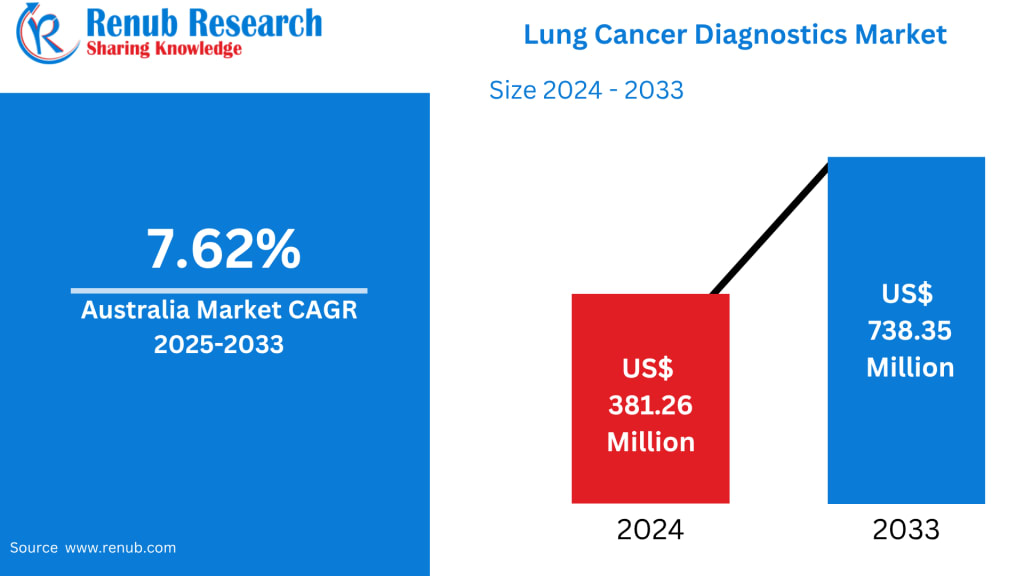
Australia’s lung cancer diagnostics market is entering a new phase of accelerated growth, driven by a powerful combination of technological innovation, government-backed screening initiatives, and a rising national focus on early cancer detection. According to Renub Research, the Australia Lung Cancer Diagnostics Market is expected to reach US$ 738.35 million by 2033, up from US$ 381.26 million in 2024, expanding at a robust CAGR of 7.62% from 2025 to 2033.
This growth reflects a major transformation in how lung cancer is detected, diagnosed, and managed across the country. Once largely dependent on conventional imaging and invasive biopsies, the diagnostic landscape is now rapidly adopting AI-powered imaging, liquid biopsies, molecular testing, and next-generation sequencing (NGS). These innovations are enabling earlier, faster, and more accurate diagnosis, which is critical for improving survival rates in one of Australia’s deadliest cancers.
Lung cancer remains the leading cause of cancer-related deaths in Australia, accounting for thousands of fatalities each year. However, increased awareness, improved access to diagnostics, and national screening programs are shifting the narrative from late-stage detection to proactive prevention and early intervention. This shift is fundamentally reshaping the market and positioning Australia as a leader in advanced cancer diagnostics within the Asia-Pacific region.
Australia Lung Cancer Diagnostics Industry Landscape
The Australian lung cancer diagnostics industry is being transformed by the integration of cutting-edge technology into clinical practice. AI-assisted imaging tools are enhancing the accuracy of CT scans and X-rays by identifying suspicious lung nodules at earlier stages. At the same time, liquid biopsy technologies—capable of detecting circulating tumor DNA (ctDNA) through blood samples—are offering non-invasive diagnostic alternatives that reduce patient discomfort and diagnostic delays.
The widespread adoption of next-generation sequencing (NGS) is also enabling clinicians to conduct comprehensive genetic profiling of tumors, paving the way for personalized treatment strategies. This integration of diagnostics with precision oncology is particularly important in lung cancer, where genetic mutations such as EGFR, ALK, and KRAS directly influence therapy selection.
Government involvement is playing a crucial role in market expansion. The establishment of the Australian Comprehensive Cancer Network and increased funding for cancer research and diagnostic infrastructure demonstrate a long-term commitment to improving outcomes. These initiatives are not only enhancing clinical capabilities but also strengthening the overall ecosystem of diagnostic laboratories, imaging centers, and research institutes.
Key Drivers of Growth in the Australia Lung Cancer Diagnostics Market
1. Rising Incidence of Lung Cancer
The growing incidence of lung cancer is a primary driver of diagnostic demand in Australia. While smoking remains a major risk factor, increasing cases among non-smokers, elderly populations, and individuals exposed to environmental and occupational hazards have expanded the at-risk population.
Australia’s aging demographic further amplifies the need for advanced diagnostics, as lung cancer risk increases significantly with age. The healthcare system is responding by investing heavily in early detection technologies, knowing that early-stage diagnosis dramatically improves survival rates and reduces treatment costs.
2. Technological Advancements in Diagnostics
Innovation is at the heart of this market’s growth. The adoption of AI-enhanced imaging systems has reduced diagnostic errors and improved the consistency of radiological interpretations. Meanwhile, liquid biopsies are revolutionizing the diagnostic process by enabling repeated testing without invasive procedures, making them ideal for monitoring disease progression and treatment response.
The use of molecular and genetic testing is expanding rapidly as oncologists increasingly rely on biomarker-driven therapies. Next-generation sequencing allows clinicians to identify specific mutations and select targeted treatments, transforming lung cancer care from a one-size-fits-all approach to precision medicine.
3. Growing Awareness and Screening Programs
Public awareness campaigns are playing a major role in increasing early detection rates. Government agencies, cancer organizations, and healthcare providers are educating the population about risk factors, symptoms, and the importance of regular screening for high-risk individuals.
The announcement of the National Lung Cancer Screening Program in April 2025, set to launch in July 2025, marks a historic milestone. This is the first new national cancer screening program in nearly two decades and is expected to significantly boost diagnostic volumes across Australia. By offering low-dose CT scans to high-risk individuals, the program aims to detect cancer at a stage where treatment is most effective.
Challenges Facing the Australia Lung Cancer Diagnostics Market
High Cost of Advanced Diagnostic Technologies
Despite rapid innovation, cost remains a significant barrier. Advanced tools such as liquid biopsies, molecular diagnostics, and NGS panels are expensive, limiting access for patients without comprehensive insurance coverage. Public hospitals and diagnostic labs also face financial challenges when adopting these technologies due to high equipment and operational costs.
This cost burden can slow market penetration and create disparities in diagnostic access, particularly for low-income populations. Addressing this challenge will require policy-level intervention, reimbursement reforms, and continued public investment.
Limited Access in Rural and Remote Regions
Australia’s vast geography presents another major obstacle. Many rural and remote communities lack access to specialized diagnostic facilities, including imaging centers and molecular testing labs. Patients often must travel long distances for testing, resulting in delayed diagnoses and poorer outcomes.
Although telehealth and mobile screening units are helping bridge this gap, infrastructure limitations and workforce shortages remain persistent challenges. Expanding diagnostic reach into underserved areas will be essential for achieving equitable healthcare outcomes nationwide.
Recent Developments in the Australia Lung Cancer Diagnostics Industry
One of the most significant recent developments is the launch of the National Lung Cancer Screening Program, announced in April 2025 and scheduled for rollout in July 2025. This program represents a major policy shift toward preventive care and is expected to dramatically increase the number of early-stage diagnoses across the country.
Additionally, public and private investment in AI-based imaging platforms, molecular diagnostics, and research collaborations has accelerated. Diagnostic labs are increasingly partnering with global biotech companies to bring the latest testing technologies to Australian patients.
Market Segmentation Analysis
By Diagnosis Test Type
Imaging Tests
Imaging remains the cornerstone of lung cancer diagnosis, with CT scans, X-rays, and PET scans accounting for the largest share of diagnostic procedures. The integration of AI is enhancing accuracy and speed, supporting continued growth in this segment.
Biopsy
Traditional tissue biopsies remain critical for definitive diagnosis and tumor profiling, particularly when molecular testing is required.
Sputum Cytology
Although less commonly used, sputum cytology still plays a role in certain clinical settings, particularly for high-risk patients.
Molecular Tests
This is the fastest-growing segment, driven by the rising adoption of precision medicine and targeted therapies.
Others
Includes emerging technologies and adjunct diagnostic tools that complement mainstream testing methods.
By Cancer Type
Non-Small Cell Lung Cancer (NSCLC)
NSCLC dominates the market, accounting for the majority of diagnosed cases. The growing use of biomarker testing and targeted therapies is driving demand for advanced diagnostics in this segment.
Small Cell Lung Cancer (SCLC)
Although less common, SCLC requires rapid and accurate diagnosis due to its aggressive nature, supporting steady demand for diagnostic testing.
By End-User
Hospital-Associated Laboratories
These labs hold the largest market share due to their integration with treatment centers and access to advanced equipment.
Independent Diagnostic Laboratories
Independent labs are expanding rapidly, offering specialized molecular and genetic testing services.
Diagnostic Imaging Centers
With increasing screening programs, imaging centers are experiencing strong growth.
Cancer Research Institutes
These institutions play a vital role in innovation, clinical trials, and the validation of new diagnostic technologies.
Others
Includes government and private healthcare facilities offering diagnostic services.
Company Analysis: Key Players in the Australian Market
The Australian lung cancer diagnostics market is supported by a strong presence of global and regional diagnostic leaders, including:
Abbott Laboratories – Known for molecular diagnostics and biomarker testing solutions
Thermo Fisher Scientific, Inc. – A major supplier of NGS and molecular testing platforms
QIAGEN N.V. – Leader in sample preparation and molecular diagnostics
Roche Holding AG – Strong portfolio in cancer diagnostics and personalized medicine
Agilent Technologies – Provider of genomic and pathology solutions
bioMérieux – Specializes in in vitro diagnostics and molecular testing
Sanofi S.A. – Active in oncology research and diagnostics collaboration
Llumina – Emerging player focusing on innovative diagnostic technologies
These companies are investing heavily in research, partnerships, and product launches to strengthen their presence in the Australian market.
Future Outlook: A Market Defined by Early Detection and Precision Medicine
The future of the Australia lung cancer diagnostics market is strongly aligned with the country’s broader healthcare vision: early detection, personalized treatment, and equitable access. With government-backed screening programs, continued technological innovation, and growing awareness among the public, diagnostic volumes are expected to rise steadily through 2033.
The integration of AI, molecular diagnostics, and liquid biopsies will continue to reshape clinical workflows, enabling faster diagnosis and better outcomes. At the same time, increased public investment and policy support will be essential to ensure that these advancements reach all Australians, regardless of geography or income level.
Final Thoughts
Australia is at a pivotal moment in its fight against lung cancer. The combination of advanced diagnostic technologies, national screening initiatives, and precision oncology is fundamentally changing how lung cancer is detected and treated. With the market expected to nearly double in value by 2033, the lung cancer diagnostics industry is set to play a central role in improving survival rates and reducing the burden of cancer nationwide.
As early detection becomes the standard rather than the exception, Australia’s lung cancer diagnostics market will not only grow in size but also in impact—saving lives, improving care, and setting new benchmarks for cancer diagnostics globally.
About the Creator
jaiklin Fanandish
Jaiklin Fanandish, a passionate storyteller with 10 years of experience, crafts engaging narratives that blend creativity, emotion, and imagination to inspire and connect with readers worldwide.
Keep reading
More stories from jaiklin Fanandish and writers in Longevity and other communities.
Australia Bionic Devices Market Size and Forecast 2025–2033
Australia Bionic Devices Market at a Glance Australia’s healthcare sector is undergoing a remarkable transformation, driven by cutting-edge medical technology that blurs the line between biology and engineering. Among the most impactful innovations are bionic devices—advanced medical implants and wearable systems designed to restore or enhance human body functions lost due to injury, disease, or congenital conditions.
By jaiklin Fanandishabout 4 hours ago in Longevity
Day 4 of Quitting
If this is how sobriety feels, maybe it’s better to go through life a little buzzed… this, along with other hits like, I want to kill myself, I wish I was dead, and I’m going to throw myself off a bridge have been the only thoughts on rotation these past few days. I promise myself that if, in a month, I still feel like this (‘this’ meaning despondent, full of rage, and simultaneously numb) I can go back to smoking. Until mid-February though? Nicotine is off the table.
By sleepy drafts15 days ago in Longevity
Saudi Arabia Osteoporosis Drugs Market Poised for Steady Growth Through 2033
Saudi Arabia Osteoporosis Drugs Market Size and Forecast 2025–2033 The Saudi Arabia Osteoporosis Drugs Market is projected to grow from US$ 210.89 million in 2024 to US$ 308.84 million by 2033, registering a compound annual growth rate (CAGR) of 4.33% between 2025 and 2033. This steady expansion reflects the growing burden of osteoporosis, increased screening rates, rapid uptake of biologics, and government-led healthcare reforms under Vision 2030.
By Renub Research3 days ago in Longevity



Comments
There are no comments for this story
Be the first to respond and start the conversation.