
Australia Diabetes Devices Market Size and Forecast 2026–2034
Rising Diabetes Burden, Government Support, and Smart Technologies Drive the Next Phase of Australia’s Diabetes Care Revolution

Introduction: A Market Shaped by Need and Innovation
Australia’s healthcare system is facing a quiet but persistent challenge: the rising burden of diabetes. As lifestyle patterns shift, populations age, and chronic diseases become more prevalent, diabetes has emerged as one of the country’s most pressing long-term health concerns. In this context, medical technology is no longer just a supporting tool—it is becoming a central pillar of disease management.
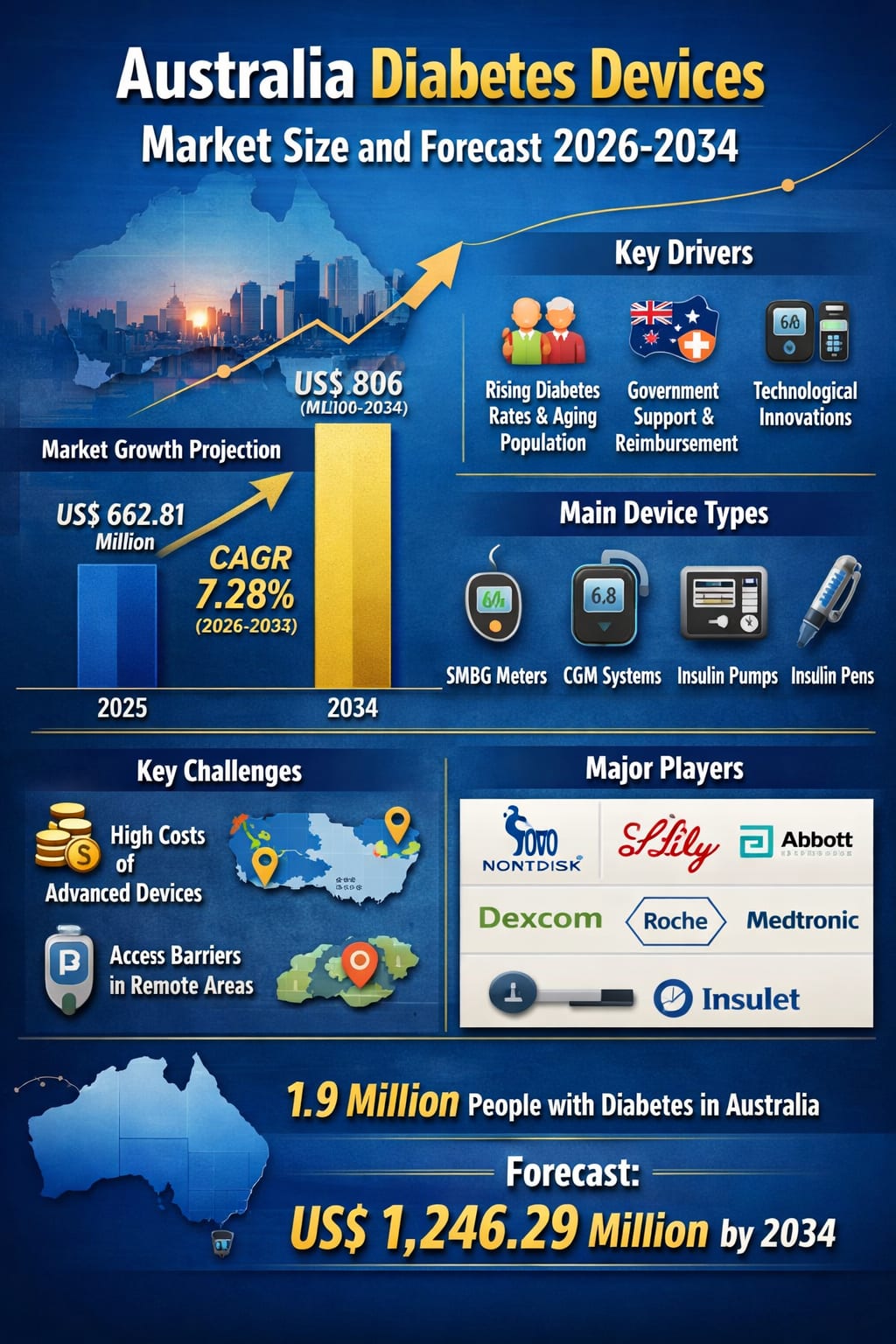
The Australia Diabetes Devices Market is forecasted to grow from US$ 662.81 million in 2025 to US$ 1,246.29 million by 2034, registering a compound annual growth rate (CAGR) of 7.28% between 2026 and 2034. This growth reflects more than just rising sales of medical equipment. It signals a broader transformation in how diabetes is monitored, treated, and managed across hospitals, clinics, and homes.
Key forces behind this expansion include the increasing prevalence of diabetes, strong government support for healthcare access, and a growing appetite for advanced technologies such as Continuous Glucose Monitoring (CGM) systems, insulin pumps, and connected insulin pens. Together, these trends are reshaping Australia’s diabetes care landscape into one that is more data-driven, patient-centric, and digitally connected.
Understanding Diabetes Devices in Modern Healthcare
A diabetes device is any medical tool designed to help individuals monitor blood glucose levels and manage insulin delivery. These devices play a critical role in preventing complications, improving quality of life, and enabling patients to take more control over their condition.
The main categories of diabetes devices include:
Self-Monitoring of Blood Glucose (SMBG) meters
Continuous Glucose Monitoring (CGM) systems
Insulin pumps
Insulin pens
In recent years, digital health innovations have significantly improved these devices. Many are now connected to smartphones, cloud platforms, and telehealth systems, allowing real-time data sharing between patients and healthcare providers. This shift toward connected care is particularly relevant in Australia, where geographical distances and dispersed populations make remote monitoring and home-based management increasingly important.
With a strong public healthcare system, supportive reimbursement frameworks, and a growing emphasis on preventive care, Australia provides a fertile environment for the adoption of diabetes technologies.
Market Drivers: Why Demand Is Accelerating
1. Rising Diabetes Rates and an Aging Population
Australia’s demographic trends are a major growth engine for the diabetes devices market. More than 16% of the population is already over the age of 65, and this share is expected to rise significantly in the coming decades. Aging is closely linked to a higher prevalence of Type 2 diabetes, as well as increased risks of complications that require close and continuous monitoring.
Currently, Australia has around 1.9 million people living with diabetes, including approximately 1.5 million diagnosed patients and an estimated 500,000 individuals with undiagnosed Type 2 diabetes. Lifestyle factors such as physical inactivity, obesity, and dietary changes continue to push these numbers upward.
As people live longer with diabetes, the need for long-term disease management grows. This translates into sustained demand for SMBG devices, CGM systems, insulin pens, and insulin pumps. Older patients, in particular, benefit from technologies that enable frequent monitoring at home and reduce the need for repeated hospital visits.
In short, the expanding patient base and the chronic nature of diabetes make this a structurally strong market for the foreseeable future.
2. Strong Government Support and Reimbursement Systems
Australia’s healthcare system plays a crucial role in driving device adoption. Government-funded programs and insurance schemes help subsidize the cost of glucose meters, insulin delivery devices, and consumables, significantly lowering financial barriers for patients.
This support encourages:
Early diagnosis
Regular glucose monitoring
Wider adoption of advanced technologies like CGM and insulin pumps
With more predictable funding and reimbursement structures, healthcare providers are more willing to prescribe modern devices, and manufacturers benefit from a more stable demand environment. From a policy perspective, investing in diabetes management tools also makes economic sense, as better monitoring and control reduce the risk of costly long-term complications such as cardiovascular disease, kidney failure, and vision loss.
Public health initiatives focused on prevention, early intervention, and chronic disease management further reinforce the importance of diabetes devices within Australia’s broader healthcare strategy.
Key Challenges Facing the Market
1. High Costs of Advanced Devices and Consumables
Despite reimbursement support, cost remains a significant barrier, especially for advanced technologies like CGM systems and insulin pumps. Ongoing expenses for sensors, accessories, and device upgrades can strain household budgets, particularly for patients on long-term therapy.
This cost sensitivity is more pronounced among lower-income groups and those requiring continuous monitoring. At the same time, manufacturers face pricing pressures from government agencies and insurers, which can limit profit margins and potentially slow the rollout of newer innovations.
Balancing affordability with technological progress remains one of the market’s central challenges.
2. Access Barriers in Rural and Remote Areas
Australia’s vast geography creates uneven access to specialist care and advanced diabetes technologies. In rural and remote regions, shortages of trained healthcare professionals can delay diagnosis, limit patient education, and slow the adoption of complex devices like insulin pumps and CGM systems.
Telehealth has helped bridge some of these gaps, enabling remote consultations and data sharing. However, physical access to devices, training, and support services remains an issue in many parts of the country. Improving distribution networks and expanding remote care infrastructure will be critical to ensuring more equitable access nationwide.
Segment Insights: Where the Market Is Growing
Australia SMBG Device Market
Self-Monitoring of Blood Glucose (SMBG) devices continue to form the backbone of diabetes care in Australia, particularly for Type 2 diabetes patients, early-stage management, and those not yet using CGM systems. Glucose meters and test strips are widely used in daily clinical practice for therapy adjustments and lifestyle monitoring.
Government subsidies and insurance coverage support widespread adoption, especially among older patients and those in regional areas. While CGM usage is rising, SMBG remains a trusted and essential tool for confirmation testing and short-term monitoring.
Competition in this segment focuses on accuracy, ease of use, minimal blood sample requirements, and digital connectivity, making it a stable and mature part of the market.
Australia CGM Device Market
The CGM segment is one of the fastest-growing areas in Australia’s diabetes technology landscape. Real-time glucose tracking offers clear clinical benefits, particularly for Type 1 diabetes patients and insulin-dependent Type 2 patients.
The integration of CGM with telehealth platforms allows doctors to remotely monitor patients, adjust treatments, and identify risks more quickly. Patients, meanwhile, benefit from reduced finger-prick testing, better glucose control, and improved quality of life.
Government reimbursement support has further accelerated adoption, making CGM a central growth driver for the overall market.
Australia Insulin Pump Device Market
Insulin pumps remain a specialized but important segment, primarily serving Type 1 diabetes patients and selected Type 2 patients who require intensive insulin management. These devices are usually prescribed through specialist clinics and hospitals, where structured training and education are available.
Demand is driven by the need for precise dosing, flexible insulin delivery, and better glycemic control. The integration of CGM with insulin pumps is also paving the way toward semi-automated insulin delivery systems.
However, high upfront costs and the need for patient training continue to limit widespread adoption, keeping this segment relatively niche but technologically advanced.
Australia Insulin Pen Device Market
Insulin pens are among the most widely used insulin delivery systems in Australia, especially for Type 2 diabetes patients and the elderly. Their popularity stems from convenience, accuracy, portability, and ease of use.
Both prefilled and reusable pens reduce preparation time, minimize dosing errors, and improve treatment adherence compared to traditional vial-and-syringe methods. More recently, “connected” insulin pens that can record and share dosing data have started gaining attention, adding a digital layer to an already well-established segment.
End-User Landscape: Hospitals vs Homecare
Hospitals
Hospitals play a critical role in diagnosis, treatment initiation, and patient education. Many patients are first introduced to SMBG systems, CGM, or insulin pumps during hospital stays. Procurement decisions are often guided by clinical guidelines and reimbursement policies, ensuring consistent demand for devices in this segment.
Homecare
Homecare is the fastest-expanding end-user segment, driven by the growing preference for self-management and remote monitoring. Devices such as SMBG meters, CGM systems, insulin pens, and connected tools are increasingly used at home, supported by telehealth services and digital platforms.
For patients in rural and remote areas, home-based care is not just convenient—it is essential. Government support for chronic disease management further strengthens this trend, making homecare a major growth pillar of the market.
Regional Dynamics Across Australia
Victoria stands out as one of the most advanced markets, with high adoption of CGM, insulin pumps, and digital health solutions, supported by strong healthcare infrastructure and high health literacy.
Queensland shows strong demand for SMBG systems and insulin pens, especially in regional areas, with CGM adoption rising thanks to telehealth expansion.
South Australia is characterized by a more cost-sensitive, volume-driven market, with steady use of established technologies and gradual adoption of newer solutions.
Tasmania, with one of the highest diabetes incidence rates, focuses heavily on access and affordability, relying mainly on SMBG systems and insulin pens, supported by telemedicine and home-delivery models.
Competitive Landscape
Major players shaping the Australian diabetes devices market include:
Novo Nordisk A/S
Eli Lilly
Roche
Abbott Laboratories
Insulet Corporation
Dexcom Inc
Medtronic
Ypsomed AG
These companies compete across product innovation, digital integration, pricing strategies, and partnerships with healthcare providers, while continuously expanding their portfolios to address evolving patient needs.
Final Thoughts: A Market Built for the Long Term
The Australia Diabetes Devices Market is not just growing—it is evolving. With the market expected to nearly double from US$ 662.81 million in 2025 to US$ 1,246.29 million by 2034, the next decade will be defined by smarter technologies, stronger homecare models, and deeper integration between devices and digital health platforms.
Rising diabetes prevalence, an aging population, and supportive government policies provide a solid foundation for sustained growth. While challenges around cost and access remain, ongoing innovation and expanding telehealth infrastructure are steadily lowering these barriers.
In many ways, Australia’s diabetes devices market reflects a broader shift in healthcare: from reactive treatment to proactive, data-driven, and patient-centered care. And in that transformation, medical devices are no longer just tools—they are becoming essential partners in everyday health management.
About the Creator
Day 4 of Quitting
If this is how sobriety feels, maybe it’s better to go through life a little buzzed… this, along with other hits like, I want to kill myself, I wish I was dead, and I’m going to throw myself off a bridge have been the only thoughts on rotation these past few days. I promise myself that if, in a month, I still feel like this (‘this’ meaning despondent, full of rage, and simultaneously numb) I can go back to smoking. Until mid-February though? Nicotine is off the table.
By sleepy drafts28 days ago in Longevity
Rare Fungus Spotted for First Time in 50 Years
Scientists have confirmed the discovery of a rare fungus species that had not been seen in the wild for more than half a century, marking a major breakthrough in biodiversity research and conservation science. The fungus, believed to have vanished due to habitat loss and environmental changes, was found during a routine ecological survey in a remote forest region. Researchers described the find as “extraordinary,” noting that many species disappear quietly without ever being rediscovered. The reappearance of this fungus offers new hope for conservation efforts and raises important questions about what other organisms may still survive undetected. A Surprise Discovery The fungus was identified by a team of mycologists conducting a long-term study of forest ecosystems. While collecting soil and plant samples, researchers noticed unusual fruiting bodies growing on decaying tree bark. Laboratory analysis later confirmed it was the same species last recorded in the early 1970s. “It was completely unexpected,” said one of the lead scientists involved in the study. “We assumed this species was either extinct or extremely close to it. Finding it again shows how little we still know about fungal diversity.” The fungus is known for its distinctive pale coloring and fragile structure, which makes it difficult to detect. It only appears under very specific environmental conditions, including high humidity, stable temperatures, and the presence of certain tree species. Why It Disappeared Experts believe the fungus vanished from records due to deforestation, climate shifts, and pollution. Fungi are especially sensitive to changes in moisture and soil chemistry. Even small alterations in forest environments can disrupt their life cycles. In the decades following its last sighting, large areas of woodland were cleared for agriculture and development. The loss of old-growth trees removed the fungus’s natural habitat, making survival difficult. Climate change may have played a role as well. Warmer temperatures and unpredictable rainfall patterns likely reduced the narrow window in which the fungus could grow and reproduce. Importance to the Ecosystem Although small and easily overlooked, fungi play a critical role in ecosystems. They break down organic matter, recycle nutrients, and form symbiotic relationships with plants. This rare species is believed to help decompose specific types of hardwood, contributing to soil health and forest regeneration. “This fungus is part of a hidden network that supports entire ecosystems,” explained a forest ecologist. “Its return suggests the environment may be recovering in subtle ways.” Scientists are now studying the fungus’s genetic makeup to understand how it survived for so long undetected. Some believe it may have adapted to new conditions or retreated into isolated microhabitats. Conservation Implications The rediscovery highlights the importance of protecting remaining natural forests. Conservation groups argue that this finding proves even heavily impacted environments can still shelter rare life forms. Following the discovery, local authorities announced plans to limit logging and increase monitoring in the area. The site where the fungus was found will likely be designated a protected research zone. Environmental organizations welcomed the news but warned that protection must be long-term. “One rediscovery does not mean the species is safe,” said a conservation spokesperson. “It means we have been given a second chance.” A Growing Trend of Rediscoveries The fungus is not the only species to reappear after decades of absence. In recent years, scientists have rediscovered rare frogs, birds, and insects once thought extinct. Improved technology, satellite mapping, and DNA analysis have made it easier to identify species in hard-to-reach locations. However, experts caution that such success stories are rare compared to the number of species quietly disappearing each year. “Rediscoveries make headlines, but extinction happens every day without notice,” said a biodiversity researcher. “This is why protecting habitats is so urgent.” Public Interest and Scientific Curiosity News of the fungus’s return has sparked excitement among scientists and nature enthusiasts alike. Social media images of the tiny organism have circulated widely, drawing attention to fungi as an often-ignored part of biodiversity. Schools and universities are already discussing the discovery in biology classes as an example of resilience and the importance of field research. For scientists, the fungus offers a valuable opportunity to study long-term survival under environmental stress. Understanding how it endured decades of change could help researchers predict which species are most likely to survive future climate challenges. What Happens Next Researchers will continue to monitor the area over the coming months to see if more specimens appear. They plan to map its distribution and analyze soil and tree conditions to understand why it survived there. Strict guidelines have been issued to prevent tourists or collectors from disturbing the site. Scientists stress that human interference could easily destroy the fragile population. “This fungus survived half a century in silence,” said one researcher. “Our responsibility now is to make sure it does not disappear again.” A Symbol of Hope The rediscovery of the rare fungus serves as a powerful reminder that nature still holds secrets, even in a world shaped by human activity. It also underscores the need for patience, protection, and respect for ecosystems that operate beyond human notice. While many environmental stories focus on loss, this one offers a rare moment of hope. A species once thought gone has quietly returned, proving that life can persist even under the most challenging conditions. For scientists and conservationists, it is not just a scientific achievement—it is a call to safeguard what remains before more wonders vanish unseen.
By Fiaz Ahmed 3 days ago in Longevity


Comments
There are no comments for this story
Be the first to respond and start the conversation.