
Australia Bionic Devices Market Size and Forecast 2025–2033
From Cochlear Breakthroughs to Artificial Hearts, Australia Strengthens Its Global Leadership in Bionic Healthcare


Australia Bionic Devices Market Overview
Australia’s healthcare innovation ecosystem continues to deliver world-class advancements, and bionic technology stands at the center of this transformation. According to Renub Research, the Australia Bionic Devices Market was valued at US$ 107.91 million in 2024 and is projected to reach US$ 229.01 million by 2033, expanding at a CAGR of 8.72% during 2025–2033.
This strong growth reflects the nation’s growing reliance on advanced medical solutions to address disabilities, chronic illnesses, and age-related health challenges. Bionic devices—ranging from cochlear implants and orthopedic prosthetics to neural interfaces and artificial hearts—are no longer niche innovations. Instead, they are becoming essential tools within Australia’s modern healthcare system.
Rising rates of physical disabilities, increasing adoption of advanced prosthetics, and strong government backing for healthcare technologies are collectively reshaping the country’s medical device landscape. With world-leading research institutions, advanced hospitals, and a robust regulatory environment, Australia remains one of the most influential bionics hubs globally.
Australia Bionic Devices Market Outlook
Bionic devices are advanced medical implants or wearable technologies designed to restore or enhance lost bodily functions caused by injury, disease, or congenital conditions. These devices mimic natural biological functions through a combination of electronic, mechanical, and biological components, offering patients improved mobility, sensory perception, and independence.
Australia’s global recognition in bionics is deeply rooted in its pioneering work on cochlear implants, an Australian invention that has restored hearing to thousands of individuals worldwide. Beyond auditory solutions, the country has expanded into bionic limbs, retinal implants, spinal stimulators, and neural interfaces, enabling patients to regain movement, vision, or communication abilities.
An aging population, high-quality healthcare infrastructure, and continuous research efforts from organizations such as the Bionics Institute are driving widespread adoption. Moreover, public-private collaborations and favorable reimbursement frameworks make bionic solutions increasingly accessible, positioning Australia as a global leader in next-generation medical technology.
Key Growth Drivers in the Australia Bionic Devices Market
Technological Advancements in Biomedical Engineering
Australia’s strong R&D culture has fueled significant progress in bionic innovation. Next-generation prosthetics, neural implants, and bio-integrated sensors now offer improved precision, faster response times, and enhanced comfort.
Research partnerships between universities, hospitals, and technology firms continue to produce smarter and more adaptive devices. These advancements simulate natural organ or limb functionality more accurately, improving patient outcomes and long-term adoption rates.
A notable milestone occurred in February 2022, when Australia’s world-first Bionic Eye System received Breakthrough Device designation from the US FDA. Developed by the Centre for Eye Research Australia, the Bionics Institute, CSIRO’s Data61, and the University of Melbourne, this innovation aims to restore functional vision to patients affected by retinitis pigmentosa, reinforcing Australia’s global leadership in bionic research.
Government Support and Healthcare Investment
The Australian federal and state governments play a crucial role in accelerating bionic device adoption. Programs such as the National Disability Insurance Scheme (NDIS), targeted biotech funding, and innovation grants are making advanced bionic solutions more accessible to patients.
Regulatory support and streamlined approval pathways further encourage domestic manufacturing and international investment. Australia’s commitment to medical technology innovation was highlighted in February 2024, when the government announced a US$ 50 million investment to develop and commercialize the world’s most advanced artificial heart. This initiative has the potential to halve global heart-failure deaths while contributing US$ 1.8 billion to Australia’s economy.
Rising Prevalence of Chronic Diseases and Disabilities
Chronic illnesses such as diabetes, cardiovascular disease, neurological disorders, and trauma-related injuries continue to rise across Australia. These conditions significantly increase demand for implantable and wearable bionic solutions.
In 2024, over 64% of Australia’s disease burden was attributed to the top five disease groups, largely dominated by chronic conditions. As the population ages, cases of hearing loss, arthritis, mobility impairment, and neurodegenerative diseases are expected to increase, further driving long-term demand for bionic interventions.
Challenges Facing the Australia Bionic Devices Market
High Costs and Accessibility Barriers
Despite technological progress, bionic devices remain expensive due to complex manufacturing processes and advanced materials. Even with government subsidies, not all patients qualify for financial assistance, limiting adoption among lower-income groups.
Geographic disparities also persist. Rural and Indigenous communities often face limited access to specialized surgical facilities and rehabilitation services, creating uneven market penetration across regions.
Technical Limitations and Patient Adaptability
While bionic devices offer transformative benefits, challenges such as device rejection, infection risks, mechanical failure, and user adaptability remain. Some patients, particularly older adults, may struggle with device training or long-term maintenance.
Ensuring ongoing technical support, software upgrades, and personalized rehabilitation programs is essential to maximizing patient satisfaction and device longevity.
Segment-Wise Market Insights
Australia Heart Transplant Bionic Devices Market
Bionic heart technologies, including ventricular assist devices (VADs) and total artificial hearts, are gaining momentum due to rising end-stage heart failure cases and donor organ shortages. Australia’s advanced cardiac care facilities and skilled surgical teams are driving adoption.
In March 2025, St Vincent’s Hospital achieved a historic milestone by successfully implanting Australia’s first BiVACOR Total Artificial Heart, marking a new era in heart-failure treatment and reinforcing Australia’s leadership in cardiac bionics.
Australia Orthopedic Bionic Devices Market
Orthopedic bionics—including prosthetic limbs, exoskeletons, and spinal implants—address mobility impairments caused by aging, trauma, and musculoskeletal disorders. Demand is rising due to Australia’s aging population and increased sports-related injuries.
Advanced technologies such as AI-enabled motion sensors and adaptive joint systems enhance device responsiveness, helping patients regain independence and mobility. Strong rehabilitation networks and government support further boost adoption.
Australia Implantable Bionic Devices Market
Implantable bionic devices such as cochlear implants, retinal implants, and neural stimulators are well established in Australia. These solutions provide long-term functional restoration for hearing loss, Parkinson’s disease, and spinal injuries.
Australia’s global reputation in cochlear implant development continues to attract investment, while ongoing clinical trials expand applications for implantable technologies.
Australia Electronics Bionic Devices Market
Electronics form the backbone of modern bionics. Microprocessors, biosensors, and actuators enable real-time feedback, precise control, and seamless integration with the human nervous system.
Australian companies and research institutions are investing heavily in miniaturization, wireless connectivity, and energy-efficient designs, enhancing device durability and user comfort.
Australia Bionic Devices Market by End User
Hospitals & Clinics
Hospitals and clinics remain the primary centers for bionic device implantation, consultation, and rehabilitation. Major urban hospitals are equipped to perform complex procedures, supported by specialized multidisciplinary teams.
Healthcare Facilities
Rehabilitation centers and outpatient facilities play a critical role in long-term patient support. These facilities focus on personalized therapy, device calibration, and remote monitoring, ensuring sustained effectiveness and improved quality of life.
Market Segmentation Summary
By Product
Auditory Bionic / Cochlear Implants
Heart Transplant
Orthopedic Bionics
Neural Bionics
By Fixation
Implantable
Wearable / Externally Worn
By Technology
Electronics
Mechanical
By End User
Hospitals & Clinics
Ambulatory Surgical Centers
Healthcare Facilities
Key Players Analysis
The Australian bionic devices market is highly competitive, with global and domestic players driving innovation. Each company is evaluated across four viewpoints: overview, key personnel, recent developments, and revenue.
Leading Companies Include:
Cochlear Ltd.
Medtronic Australasia Pty Ltd
Edwards Lifesciences Australia Pty Ltd
Baxter International Inc.
Boston Scientific Corp
Abiomed Australia Pty Ltd
Abbott Laboratories
These companies focus on product innovation, clinical partnerships, and regional expansion to strengthen their market presence.
Final Thoughts
Australia’s bionic devices market is entering a transformative growth phase. Supported by strong government initiatives, cutting-edge research, and rising healthcare needs, the sector is redefining patient care and quality of life.
From cochlear implants to artificial hearts, Australia continues to set global benchmarks in bionic innovation. As technology evolves and accessibility improves, bionic devices will play an increasingly vital role in shaping the future of healthcare—not only within Australia, but worldwide.
With sustained investment and innovation, the Australia Bionic Devices Market is well positioned to more than double in value by 2033, cementing its status as a global leader in medical technology.
About the Creator
Renub Research
Renub Research is a Market Research and Consulting Company. We have more than 15 years of experience especially in international Business-to-Business Researches, Surveys and Consulting. Call Us : +1-478-202-3244
Keep reading
More stories from Renub Research and writers in Longevity and other communities.
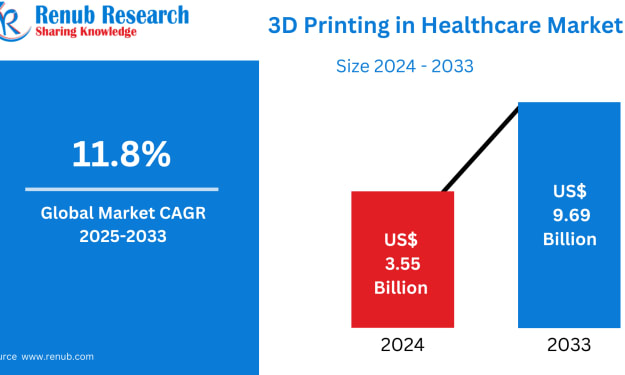
3D Printing in Healthcare Market Size and Forecast 2025–2033
Introduction: A New Era of Precision Healthcare The healthcare industry is undergoing a profound technological transformation, and at the center of this evolution is 3D printing, also known as additive manufacturing. What was once considered a niche prototyping technology has rapidly matured into a powerful healthcare tool capable of producing patient-specific implants, prosthetics, surgical guides, medical models, and even living tissues.
By Renub Research21 days ago in Longevity
Day 4 of Quitting
If this is how sobriety feels, maybe it’s better to go through life a little buzzed… this, along with other hits like, I want to kill myself, I wish I was dead, and I’m going to throw myself off a bridge have been the only thoughts on rotation these past few days. I promise myself that if, in a month, I still feel like this (‘this’ meaning despondent, full of rage, and simultaneously numb) I can go back to smoking. Until mid-February though? Nicotine is off the table.
By sleepy drafts5 days ago in Longevity
Why does the Netherlands seize up at the first sign of snow?
Every winter, as the first snowflakes drift down in the Netherlands, a familiar scene unfolds: traffic jams, delayed trains, crowded streets, and a general sense of chaos. For many outsiders, it seems baffling—after all, the Dutch are known for their engineering prowess, meticulous urban planning, and well-organized infrastructure. Yet, a few centimeters of snow appear to paralyze the country. So why does this happen, and what lies behind the Netherlands’ winter woes? A Country Built for Rain, Not Snow The Netherlands is famous for its flat landscape, extensive canal systems, and miles of cycle paths. Its infrastructure is designed primarily to handle rain and occasional floods rather than heavy snow. Roads are typically built with asphalt that can become slippery under snow or ice, and while bridges, highways, and train tracks are maintained year-round, snow presents unique challenges that the system isn’t fully optimized for. Unlike countries accustomed to prolonged snowfall, such as Sweden or Canada, Dutch municipalities rarely experience conditions severe enough to justify constant snow-specific infrastructure. The Role of Geography and Climate Geography plays a crucial role in the country’s winter vulnerabilities. The Netherlands sits in a low-lying delta region where water management is a daily necessity. Its proximity to the North Sea moderates winter temperatures, meaning snowfalls are often light, wet, and fleeting rather than consistent and powdery. This unpredictability makes it difficult for local authorities to prepare in advance. A sudden snowfall can quickly coat roads and railways with a layer of slush or ice, creating unsafe conditions before any effective response can be deployed. Public Transport Challenges Dutch public transport is widely regarded as efficient, yet snow quickly disrupts the system. Trains, trams, and buses can experience delays due to icy tracks, snow accumulation, or reduced visibility. Even a small amount of snow can cause switches to freeze or overhead lines to malfunction. Since the entire transport network is interconnected, a minor disruption in one area can ripple across the country, affecting thousands of commuters. Unlike in some northern countries where rail systems are built to operate in snowy conditions, the Netherlands’ network is optimized for punctuality under moderate weather, making even light snow a significant hurdle. Cultural and Behavioral Factors Dutch society, in general, isn’t accustomed to daily life under snowy conditions. Snow days are rare, and people often lack the experience of driving in wintry weather. Cars are often equipped with standard tires rather than winter-specific ones, and drivers may underestimate stopping distances or lose confidence on slick roads. This caution—while understandable—exacerbates congestion and slows down overall traffic flow. Moreover, cyclists, who make up a significant portion of commuters, are particularly vulnerable to icy roads, prompting many to stay off their bikes entirely and add to pressure on other transport modes. Snow Removal and Municipal Priorities Municipalities in the Netherlands prioritize snow removal based on necessity and likelihood. Major roads and highways usually get attention first, but smaller streets, bike lanes, and local thoroughfares may be left untreated until it is clear that snow will persist. Salt and grit are used sparingly, both to protect the environment and because heavy snowfall is rare. This approach works well most of the time, but even a minor winter storm can expose the gaps in preparedness. The Psychological Factor There’s also a psychological element at play. Dutch citizens know that snow is unusual, and the perception of danger can amplify reactions. Schools may close, offices delay opening, and parents keep children home, creating a self-reinforcing cycle of disruption. The result is a sudden, nation-wide pause that can feel like a complete shutdown—even if the actual snow depth is minimal. Lessons and Future Outlook Despite these challenges, the Netherlands has learned to manage snow with experience and planning. Meteorological services now issue early warnings, municipalities are better equipped for rapid responses, and public awareness campaigns encourage safe behavior during winter weather. Still, the country’s unique combination of geography, climate, infrastructure, and cultural behavior ensures that snow will continue to be a disruptive force rather than a routine winter experience. In essence, the Netherlands’ winter paralysis isn’t a sign of incompetence; it’s a reflection of a society built around a temperate climate, low-lying land, and infrastructure optimized for efficiency under non-winter conditions. The first snowfall remains a dramatic reminder that, in the Dutch context, snow is more than a seasonal change—it’s a temporary national emergency.
By Fiazahmedbrohi 6 days ago in Longevity


Comments
There are no comments for this story
Be the first to respond and start the conversation.