
Asia Pacific Non-Invasive Prenatal Testing Market Size & Forecast 2025–2033
Rising Demand for Safer Genetic Screening Accelerates Prenatal Care Transformation Across Asia Pacific


Asia Pacific Non-Invasive Prenatal Testing Market Overview
The Asia Pacific Non-Invasive Prenatal Testing (NIPT) Market is witnessing remarkable momentum, driven by technological innovation, rising maternal age, and increasing awareness around early prenatal screening. According to Renub Research, the Asia Pacific NIPT market is expected to reach US$ 4,576.51 million by 2033, growing from US$ 1,338.51 million in 2024, at a robust CAGR of 14.64% during 2025–2033.
This accelerated growth reflects a broader transformation in prenatal care, where healthcare systems are shifting from invasive diagnostic procedures to safer, more accurate blood-based genetic screening methods. NIPT has emerged as a preferred prenatal screening option, enabling early detection of chromosomal abnormalities without posing risks to the fetus or mother.
The Asia Pacific region—home to over half of the world’s population—presents a diverse healthcare landscape. While developed markets such as Japan, South Korea, Singapore, and Australia have rapidly integrated NIPT into standard prenatal care, emerging economies including China, India, and Southeast Asia are witnessing fast-growing adoption fueled by expanding healthcare access and private sector participation.
Understanding Non-Invasive Prenatal Testing (NIPT)
Non-invasive prenatal testing is a screening method that analyzes cell-free fetal DNA (cfDNA) circulating in the mother’s bloodstream. Typically performed after the 10th week of pregnancy, NIPT helps identify chromosomal abnormalities such as:
Down syndrome (Trisomy 21)
Edwards syndrome (Trisomy 18)
Patau syndrome (Trisomy 13)
Turner syndrome and other sex chromosome anomalies
Unlike invasive methods such as amniocentesis or chorionic villus sampling (CVS), NIPT eliminates the risk of miscarriage while offering high sensitivity and specificity, making it a critical advancement in modern prenatal diagnostics.
Asia Pacific Non-Invasive Prenatal Testing Industry Outlook
The Asia Pacific NIPT industry is expanding rapidly due to demographic shifts, technological progress, and evolving healthcare policies. One of the strongest demand drivers is the rising average maternal age, particularly in countries like Japan, China, and South Korea, where delayed childbirth has become increasingly common.
In high-income Asia Pacific nations, NIPT has become an integral part of prenatal care for high-risk pregnancies, supported by well-established healthcare infrastructure, trained genetic counselors, and national screening initiatives. In contrast, developing markets are experiencing rapid growth as awareness increases and private diagnostic laboratories expand testing availability.
However, disparities remain. While urban populations benefit from easy access to advanced genetic screening, rural and underserved regions continue to face limitations due to cost, infrastructure gaps, and cultural hesitations toward prenatal genetic testing.
Market Size and Forecast (Renub Research)
2024 Market Size: US$ 1,338.51 million
2033 Market Size: US$ 4,576.51 million
Forecast CAGR (2025–2033): 14.64%
This strong growth trajectory highlights the growing role of NIPT as a first-line prenatal screening tool across the Asia Pacific region.
Key Growth Drivers in the Asia Pacific NIPT Market
Advancements in Genetic Testing Technologies
Continuous improvements in next-generation sequencing (NGS) and bioinformatics have significantly enhanced the accuracy, speed, and scalability of NIPT. These technologies allow precise detection of fetal chromosomal abnormalities using minimal blood samples, reducing testing time and improving diagnostic confidence.
As sequencing costs decline and data analysis becomes more efficient, NIPT is becoming increasingly accessible across both developed and emerging Asia Pacific markets.
Government Support and National Screening Programs
Several Asia Pacific governments have introduced policy support, public awareness campaigns, and insurance coverage for prenatal screening. Countries such as Japan and Singapore have integrated NIPT into national maternal health programs, encouraging early diagnosis and improved pregnancy outcomes.
Government backing not only boosts adoption but also promotes standardization, quality assurance, and ethical oversight, strengthening trust in NIPT services.
Expansion of Private Healthcare and Diagnostic Labs
The rapid expansion of private healthcare providers in India, Thailand, Malaysia, and Indonesia has played a crucial role in increasing NIPT accessibility. Private diagnostic laboratories often introduce advanced testing services earlier than public hospitals, catering to patients seeking faster results and personalized care.
This competitive environment has contributed to improved service quality and gradual cost rationalization across the region.
Challenges Facing the Asia Pacific NIPT Market
High Cost and Limited Affordability
Despite technological progress, cost remains a major barrier in developing markets. In India, the average NIPT price ranges between USD 350–400, while in Australia it can reach USD 500, creating significant out-of-pocket expenses for families.
High costs have limited adoption among middle- and low-income populations and raised ethical concerns regarding pregnancy decision-making after positive test results.
Inconsistent Regulatory Frameworks
The lack of uniform regulations and testing standards across Asia Pacific countries poses challenges for market expansion. Variations in certification requirements, laboratory accreditation, and genetic counseling practices can impact test reliability and patient confidence.
Harmonizing regulatory standards remains essential for sustained regional growth.
Infrastructure Gaps in Emerging Economies
Many rural and semi-urban areas lack access to specialized laboratories required for NIPT processing. Limited healthcare infrastructure and shortages of trained professionals restrict the availability of advanced prenatal screening outside major cities.
Addressing these gaps will require long-term investment in healthcare systems and diagnostic networks.
Country-Level Market Insights
China Non-Invasive Prenatal Testing Market
China represents one of the largest and fastest-growing NIPT markets in Asia Pacific. Rising awareness, improved healthcare infrastructure, and government initiatives to enhance maternal care are accelerating adoption. While urban centers show high penetration, rural access remains limited, prompting increased investment in diagnostic expansion.
India Non-Invasive Prenatal Testing Market
India’s NIPT market is growing steadily, driven by increasing maternal age, private healthcare growth, and expanding insurance coverage. However, affordability challenges, regulatory complexities, and cultural considerations continue to influence adoption rates, particularly outside metropolitan regions.
Japan Non-Invasive Prenatal Testing Market
Japan is among the most mature NIPT markets in Asia Pacific. Advanced healthcare infrastructure, high public awareness, and government support have integrated NIPT into routine prenatal care, especially for high-risk pregnancies. Continued technological innovation and insurance expansion are expected to sustain growth.
Asia Pacific NIPT Market Segmentation
By Component
Instruments
Kits and Reagents
Services
By Application
Down Syndrome (Trisomy 21)
Edwards Syndrome (Trisomy 18)
Patau Syndrome (Trisomy 13)
Turner Syndrome
Other Applications
By End User
Hospitals
Diagnostic Laboratories
By Country
China, Japan, India, Australia, South Korea, Thailand, Malaysia, Indonesia, New Zealand
Competitive Landscape and Key Companies
The Asia Pacific NIPT market is highly competitive, with both global and regional players focusing on innovation, partnerships, and geographic expansion.
Key Companies Covered:
Eurofins Scientific
F. Hoffmann-La Roche Ltd
Invitae Corporation
Illumina Inc.
Natera Inc.
Centogene NV
Qiagen
Each company is analyzed across:
Company Overview
Key Management
Recent Developments & Strategies
Financial Performance
Final Thoughts
The Asia Pacific Non-Invasive Prenatal Testing Market is entering a transformative growth phase, supported by strong technological foundations, rising healthcare awareness, and favorable demographic trends. While challenges related to cost, regulation, and infrastructure persist, ongoing investments and policy initiatives are expected to make NIPT more accessible and affordable across the region.
As prenatal care increasingly prioritizes safety, accuracy, and early diagnosis, NIPT is poised to become a cornerstone of maternal healthcare in Asia Pacific, offering long-term opportunities for diagnostic companies, healthcare providers, and policymakers alike.
About the Creator
Keep reading
More stories from Aaina Oberoi and writers in Longevity and other communities.
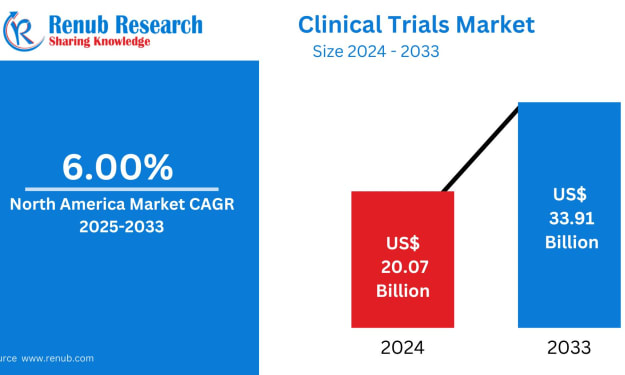
North America Clinical Trials Market Size and Forecast 2025–2033
Introduction The North America Clinical Trials Market is undergoing a significant transformation as pharmaceutical innovation accelerates and healthcare systems prioritize evidence-based medicine. Clinical trials remain the backbone of drug discovery and medical device validation, enabling researchers to evaluate safety, efficacy, and long-term outcomes before commercial approval.
By Aaina Oberoi25 days ago in Longevity
Day 4 of Quitting
If this is how sobriety feels, maybe it’s better to go through life a little buzzed… this, along with other hits like, I want to kill myself, I wish I was dead, and I’m going to throw myself off a bridge have been the only thoughts on rotation these past few days. I promise myself that if, in a month, I still feel like this (‘this’ meaning despondent, full of rage, and simultaneously numb) I can go back to smoking. Until mid-February though? Nicotine is off the table.
By sleepy drafts5 days ago in Longevity
Talking to Yourself Isn’t Crazy: How Self-Talk Reveals Mental Strength and Exceptional Abilities
For decades, talking to yourself in public was often seen as a sign of eccentricity or even instability. Whispering into empty rooms, muttering plans aloud, or narrating your own thoughts quietly while alone has long carried a social stigma. Yet modern psychology suggests that this behavior is far from a bad habit. In fact, self-talk can reveal powerful mental traits, bolster cognitive abilities, and even enhance emotional resilience. Why Humans Talk to Themselves At its core, self-talk is a natural cognitive process. Psychologists describe it as “private speech,” a phenomenon first studied extensively in children. Young children frequently talk out loud while playing or solving problems. This behavior helps them organize thoughts, plan actions, and regulate behavior. While most people grow out of speaking aloud to themselves as they age, the practice persists in many adults, especially during moments of concentration or stress. Research indicates that talking to yourself can serve multiple functions. It can guide problem-solving, aid in memory retention, reinforce motivation, and even act as a coping mechanism during emotionally challenging situations. Far from indicating instability, it often signals self-awareness and advanced mental organization. Self-Talk as a Cognitive Tool One of the most compelling benefits of self-talk is its role in cognitive performance. Neuroscience research shows that verbalizing thoughts engages different brain regions compared to silent thinking alone. When people talk themselves through tasks, they activate the prefrontal cortex—the area responsible for planning, decision-making, and controlling impulses. For example, athletes often use self-talk to improve performance, repeating instructions or motivational phrases to stay focused and calm. Students, similarly, might repeat steps aloud when learning complex mathematical problems or practicing new skills. This method is not random chatter; it is a conscious strategy that enhances attention, memory, and task execution. Emotional Resilience and Self-Talk Beyond cognitive benefits, self-talk has profound emotional advantages. Speaking aloud can help individuals process stress, regulate emotions, and clarify thoughts. Psychologists note that naming feelings—saying “I’m frustrated” or “I’m anxious”—can reduce emotional intensity and promote rational responses. This mechanism is linked to the concept of emotional labeling. By putting emotions into words, we externalize and examine them, which reduces their grip over our mental state. People who habitually engage in constructive self-talk tend to demonstrate higher emotional intelligence, better problem-solving under pressure, and a greater ability to navigate interpersonal conflicts. Exceptional Abilities and Self-Insight Interestingly, self-talk is also associated with creativity, self-reflection, and strategic thinking. Many highly accomplished individuals—from writers to entrepreneurs—credit verbalizing ideas as a key step in their creative or analytical processes. Talking through a plan, a story, or a concept aloud allows them to hear gaps, anticipate challenges, and refine their ideas more effectively than thinking silently alone. Studies have even suggested a link between self-talk and metacognition—the ability to think about one’s own thinking. Individuals who engage in self-directed speech are often more introspective and capable of evaluating their own mental strategies. This self-awareness is a hallmark of exceptional mental traits, from leadership and innovation to problem-solving in complex environments. Overcoming the Stigma Despite the growing evidence of its benefits, social stigma still discourages many from openly acknowledging their self-talk. People often fear judgment or being perceived as “weird” or “unstable.” Yet reframing this behavior as a tool for mental organization and emotional regulation can empower individuals to embrace it without shame. Experts recommend a few practical ways to leverage self-talk: Task-Oriented Self-Talk: Narrate steps when tackling complex tasks to reinforce focus. Motivational Self-Talk: Use positive affirmations to boost confidence and persistence. Emotional Labeling: Name your emotions aloud to process stress or frustration. Reflective Dialogue: Discuss your ideas with yourself to explore multiple perspectives. Conclusion Talking to yourself is far from a mental flaw; it’s a window into powerful cognitive traits, emotional resilience, and exceptional abilities. Far from undermining intelligence, self-talk can enhance memory, focus, creativity, and self-awareness. It helps people navigate complex tasks, manage stress, and reflect deeply on their choices. So, the next time you find yourself quietly narrating your day, planning out loud, or reasoning through a problem in your own voice, take pride. You’re engaging in a practice that has deep roots in human development and is backed by science as a hallmark of mental strength. The habit of self-talk doesn’t just organize thoughts—it reveals a mind capable of insight, strategy, and exceptional achievement. Embrace it. It might just be the secret superpower your brain has been quietly practicing all along.
By Fiazahmedbrohi 6 days ago in Longevity


Comments
There are no comments for this story
Be the first to respond and start the conversation.