
5 Ways to Overcome Overthinking in a Busy World
Quiet Your Mind for Clarity and Peace

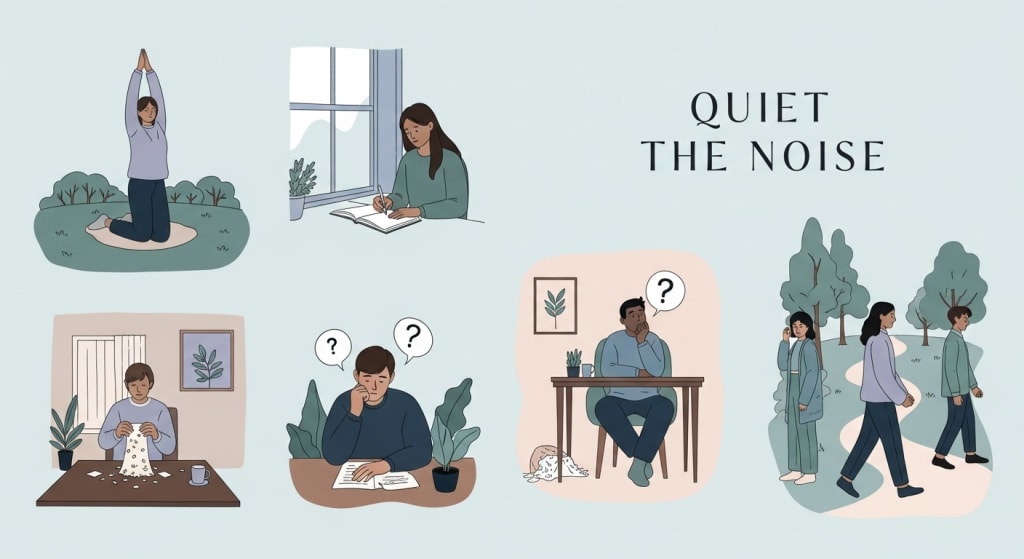
In the relentless pace of 2025, where constant connectivity and decision overload bombard us daily, overthinking can feel like a constant companion—draining our energy and clouding our judgment. It’s that loop of "what ifs" and second-guessing that keeps us stuck instead of moving forward. I’ve been there, obsessing over a work email long after hitting send, only to realize it was robbing my peace. The good news? You can break free with simple, evidence-based strategies. These five ways, drawn from cognitive psychology and mindfulness practices, have helped me quiet my mind and regain clarity. Whether you’re juggling deadlines or personal dilemmas, they’ll empower you to think less and live more. Let’s tame that overactive mind together.
1. Practice Grounding Techniques
When thoughts spiral, ground yourself in the present: Name five things you see, four you can touch, three you hear, two you smell, and one you taste. I use this during stressful commutes, focusing on the feel of my steering wheel to pull me back.
Why it works: Grounding interrupts rumination by engaging your senses, per a 2024 study in Cognitive Therapy and Research. In 2025’s distraction-filled world, it’s a quick anchor.
Pro tip: Set a phone reminder for high-stress times to make it a habit.
2. Set a "Worry Window"
Dedicate 10-15 minutes a day to jot down worries, then close the "window" and move on. I schedule mine for evenings, writing concerns in a notebook—it feels like offloading a heavy backpack.
The scence: Time-boxing worries reduces their intensity, according to anxiety research from the American Psychological Association. It prevents overthinking from spilling into your day. Keep a dedicated journal to track patterns over time.
3. Challenge Thoughts with Questions
Ask yourself: "Is this thought helpful? What’s the evidence for and against it?" When I overthought a presentation, questioning its usefulness shifted my focus to preparation instead.
Why it’s effective: Cognitive restructuring, a core CBT technique, reframes unhelpful thoughts, as shown in 2025 meta-analyses in Behavior Therapy. It builds mental resilience.
Pro tip: Use a app like MoodKit for guided prompts.
4. Engage in Expressive Writing
Spend five minutes free-writing your thoughts without judgment, then shred or delete it. I did this after a tough breakup, pouring out emotions on paper—it was cathartic and clarifying.
The payoff: Expressive writing processes emotions and reduces rumination, per James Pennebaker’s long-term studies. In our fast-paced era, it’s a private release valve. Try it before bed to clear your mind for sleep.
5. Move Your Body Mindfully
Take a short walk or do gentle yoga, focusing on your breath and steps rather than thoughts. My daily 10-minute strolls, noticing the breeze and sounds, have become my overthinking antidote.
Why it matters: Physical activity diverts mental energy and boosts endorphins, according to a 2024 review in Frontiers in Psychology. It’s especially vital in sedentary 2025 lifestyles. Pair it with nature for double the calm.
Overcoming overthinking isn’t about stopping thoughts entirely—it’s about managing them so they don’t control you. These strategies have quieted my inner chatter, giving me more space for joy and action. Start with one that resonates—what’s yours? Share in the comments; let’s support each other’s journeys to peace! Here’s to a clearer mind in 2025.
AI Disclosure: This article was developed with the help of Grok, an AI by xAI, to provide practical and empathetic strategies. As someone who’s spent countless nights replaying conversations in my head, I’ve added my own stories to make these tips feel relatable and actionable for you.
About the Creator
NotesByLiza
Exploring creativity, digital life, and mindful living. Sharing stories and visuals that inspire calm, growth, and curiosity — one post at a time. 🌿✨
Keep reading
More stories from NotesByLiza and writers in Longevity and other communities.
How to Create a Personal Sanctuary at Home
In the hustle of 2025, where smart homes buzz with notifications and work-from-home setups blur boundaries, carving out a personal sanctuary at home is a game-changer for your mental health. It’s not about having a big space or fancy decor—it’s about crafting a corner that feels uniquely yours, a place to recharge, reflect, or create. After moving into a tiny apartment and craving calm, I learned that small tweaks can turn any space into a haven. These five strategies, grounded in environmental psychology and wellness trends, will help you design a sanctuary that nurtures your soul. Whether you’re in a studio or a sprawling house, let’s make your home a place of peace.
By NotesByLiza4 months ago in Longevity
Day 4 of Quitting
If this is how sobriety feels, maybe it’s better to go through life a little buzzed… this, along with other hits like, I want to kill myself, I wish I was dead, and I’m going to throw myself off a bridge have been the only thoughts on rotation these past few days. I promise myself that if, in a month, I still feel like this (‘this’ meaning despondent, full of rage, and simultaneously numb) I can go back to smoking. Until mid-February though? Nicotine is off the table.
By sleepy drafts13 days ago in Longevity
Global Nano Robotics Market Size & Forecast 2025–2033
Introduction: The Rise of Machines Too Small to See In the world of frontier technologies, few areas capture imagination quite like nanorobotics. These are not the mechanical robots of factory floors, but devices engineered at the nanoscale—typically between 1 and 100 nanometers—capable of interacting with matter at the atomic and molecular level. Once confined to theoretical physics and science fiction, nanorobots are now stepping into laboratories, hospitals, and advanced manufacturing environments across the globe.
By Janine Root 7 days ago in Longevity
Smart phones, Humans and Aliens.
WARNING. I will be tapping into one of your favorite creative tensions: The absurdity of humans worshipping their glowing rectangles as if they were tiny oracles. There’s something deliciously poetic about that contradiction, and it lends itself beautifully to an instructive proviso.
By Novel Allen4 days ago in Poets


Comments
There are no comments for this story
Be the first to respond and start the conversation.