
Understanding Explanation of Benefits (EOBs)
In this article, I’ll walk you through everything you need to know about EOBs.

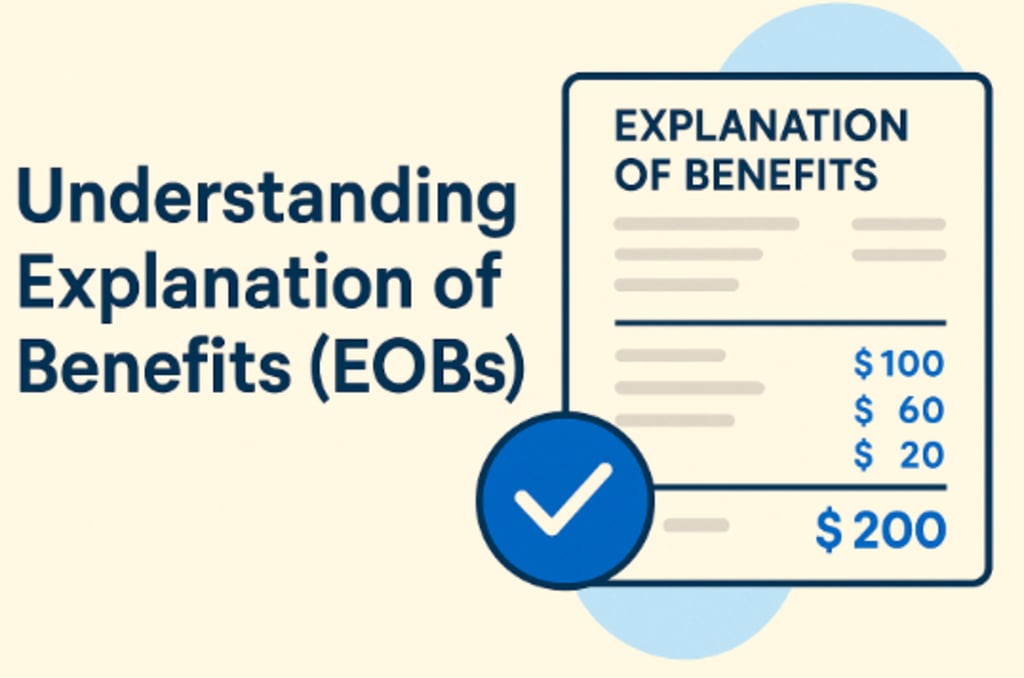
If you've ever visited a doctor, received treatment, and used health insurance, you've probably received a document in the mail or your patient portal called an Explanation of Benefits, or EOB. While it might look like a bill at first glance, it’s not—though it plays an important role in the medical billing process.
Understanding an EOB can help you avoid paying more than you should, catch billing mistakes, and better manage your healthcare expenses.
What is an Explanation of Benefits (EOB)?
An Explanation of Benefits is a summary statement sent by your health insurance provider after you receive medical services. It explains:
What medical treatments or services you received
How much was billed by the healthcare provider
How much the insurance paid
What portion of the cost, if any, you may be responsible for
Important: An EOB is not a bill. It simply shows how your insurance handled the claim and what you might owe to the provider. Your actual bill will come directly from the clinic, hospital, or doctor’s office.
Key Components of an EOB
A standard EOB includes the following important details:
✅ Patient Information
Your name, insurance ID, and other identification details.
✅ Provider Information
The name of the doctor, clinic, or hospital where you received services.
✅ Date(s) of Service
When the medical service or treatment was provided.
✅ Procedure Codes
These are medical codes (CPT, HCPCS, ICD-10) that describe the services performed, such as blood tests, physical exams, or X-rays.
✅ Amount Billed
The total charge submitted by your provider to the insurance company.
✅ Allowed Amount
The amount your insurance agrees to pay based on its contract with the provider.
✅ Paid Amount
The amount the insurance company actually pays the provider.
✅ Patient Responsibility
The part you need to pay. This may include:
Deductibles
Copayments
Coinsurance
Any non-covered services
✅ Denial Codes or Messages
If something wasn’t covered, you'll see a short message or code explaining why.
Common Terms Found in EOBs
Understanding the language of an EOB is essential:
Deductible – The amount you must pay before your insurance starts covering services.
Copay – A fixed amount you pay for a service (e.g., $20 per doctor visit).
Coinsurance – The percentage of costs you share with the insurance company after meeting your deductible.
Adjustment – The difference between the provider's charge and the allowed amount (often written off).
Reason Codes – Short codes that explain why a claim was partially paid, denied, or adjusted.
How to Read an EOB
Reading an EOB can seem intimidating, but breaking it down helps:
Start with the provider and date – Confirm you actually had this appointment or service.
Review the services – Look at the procedure codes or descriptions and verify they match your treatment.
Compare billed vs. allowed amounts – This shows how much was reduced due to insurance network agreements.
Check what insurance paid – The amount your insurer covered.
Note your responsibility – This is what you may still owe.
Look for denial reasons – If anything was denied, check the code and explanation.
If anything seems wrong—like a service you didn’t receive or a denial you don’t understand—don’t ignore it.
What to Do If You Don’t Understand Your EOB
If your EOB is confusing or you think there's a mistake:
Call your insurance company’s customer service. Their number is usually printed on the EOB.
Ask your healthcare provider’s billing office to explain the charges.
Request a corrected EOB if any errors are found.
EOB vs. Medical Bill: What’s the Difference?
Many patients confuse EOBs with actual medical bills. Here’s the key difference:
EOB: Sent by your insurance company. It explains how your claim was processed. It is not a request for payment.
Medical Bill: Sent by your provider (clinic or hospital). This tells you what you actually owe them.
If your medical bill and EOB don’t match, that may indicate a billing error or a claim denial.
Digital EOBs and Patient Portals
Most insurance companies now offer digital EOBs through member portals or email. This allows:
Faster access to your documents
Easier tracking of your claims and expenses
Less paper clutter
You can log in to your insurance company’s website to view, download, or print your EOBs anytime.
The Role of Medical Billing Companies in EOBs
Understanding EOBs is just one part of the medical billing process. Behind the scenes, medical billing companies play a big role in ensuring accurate claim submission and follow-up.
A reliable billing company can:
Submit clean claims to insurance
Interpret denial codes and appeal rejections
Help practices and patients understand EOBs
Reduce billing errors that lead to confusion
Need Help Understanding EOBs and Denied Claims?
If you're a medical practice looking for help with billing and denial management, My Medical Billing Solution is a top-tier choice in the USA.
They specialize in:
Accurate claims processing
EOB interpretation and issue resolution
Appealing denied claims quickly
Improving cash flow for practices of all sizes
Their expert team ensures you and your patients don’t get lost in complex paperwork. Let My Medical Billing Solution handle your billing—so you can focus on patient care.
Conclusion
Explanation of Benefits (EOBs) can be confusing, but understanding them is key to managing your healthcare finances. They help clarify what your insurance paid, what your provider billed, and what you might owe.
Take the time to read your EOBs, ask questions when something doesn’t make sense, and don’t hesitate to work with professionals like My Medical Billing Solution if you want help managing your billing and improving the financial health of your practice.
About the Creator
Keep reading
More stories from Susan Clinton and writers in Lifehack and other communities.
The Future of Water Treatment: Emerging Technologies to Watch
Clean and safe water is the foundation of healthy communities and thriving industries. But as populations grow and climate challenges increase, demand for advanced water treatment solutions is higher than ever. Traditional systems—though effective—are not enough to meet modern challenges.
By Susan Clinton7 months ago in Trader
Worth the Wait: Puerto Viejo, Costa Rica
Beach bumming in a small Caribbean beach town sounded like a perfect way to end our 6-month trip through Mexico and Central America. Or so we thought. The foul, fishy stench of rotten seaweed hit our nostrils as we stepped from the cramped bus and looked out at a rather depressing, empty, and underwhelming black sand beach. It was pouring with rain, and we had to quickly fish out our ponchos. We thought, this couldn’t be it, could it?
By Sh*t Happens - Lost Girl Travel7 days ago in Wander




Comments
There are no comments for this story
Be the first to respond and start the conversation.