
Are engineered timber floors better than laminate for kitchens
A renovation guide on Kitchen, Kitchen Flooring & Tiling

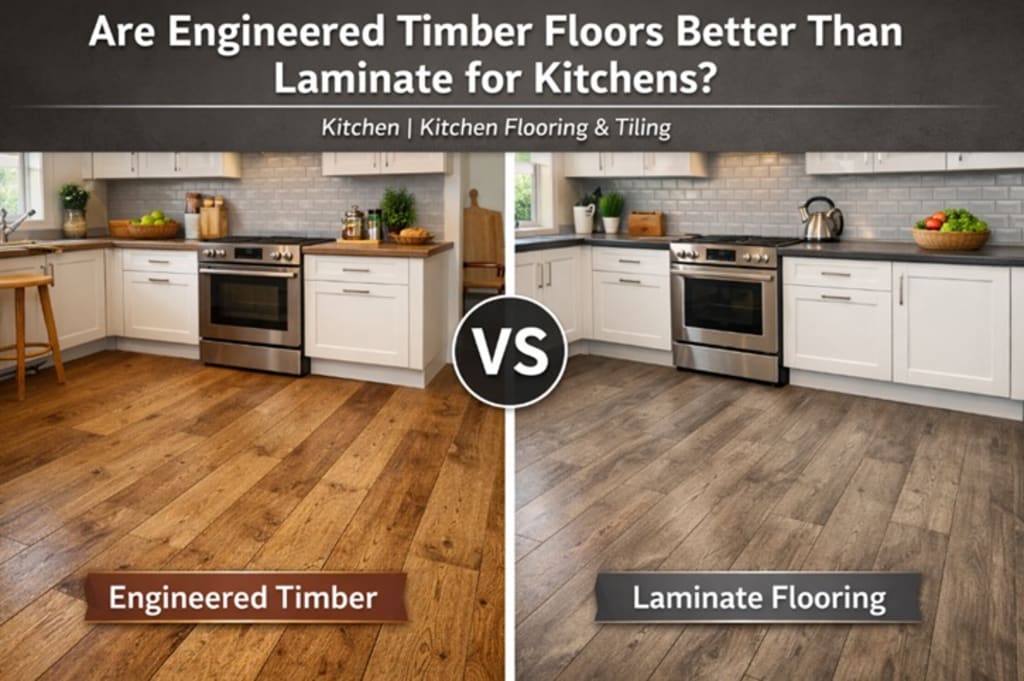
When homeowners in Sydney start planning a kitchen renovation, one question pops up again and again:
**“Should I choose engineered timber flooring or laminate flooring?”**
It sounds like a simple choice… but it actually shapes the entire feel of the kitchen.
Flooring affects **durability, comfort, resale value, and the overall design style of the home**. And in a kitchen — the busiest room in the house — the wrong flooring can become a daily annoyance.
So let’s break this down in a practical way.
Short answer first:
**Engineered timber usually offers better aesthetics and long-term value, while laminate wins on price and practicality.**
Now let’s dig deeper.
---
## First: What’s the Actual Difference?
Many people think laminate is just a cheaper timber floor. Not exactly.
### Engineered Timber Flooring
Engineered timber is made from **real hardwood on the surface**, supported by several layers underneath.
Typical structure includes:
* A genuine hardwood top layer (such as oak, blackbutt, or spotted gum)
* Multiple layers of plywood or composite backing
* A protective coating finish
Because the surface is real wood, the floor **looks, feels, and ages like natural timber**.
But the layered construction makes it **far more stable than solid timber**, which is why it’s widely used in modern homes.
---
### Laminate Flooring
Laminate flooring is a completely different product.
It consists of:
* A **printed image layer** that looks like timber
* A high-density fibreboard core
* A protective wear layer on top
* A stabilizing backing layer
In simple words, laminate is **a highly realistic photo of timber sealed under a tough surface**.
From a distance it can look convincing, but it doesn’t have the natural grain or texture of real wood.
---
## How Do They Perform in a Sydney Kitchen?
Kitchens are tough environments for flooring.
Think about what happens every day:
* Water spills
* Cooking heat
* Heavy foot traffic
* Dropped utensils
* Kids running through the house
And Sydney adds another layer of complexity — the climate.
Homes here experience **humidity changes, hot summers, and coastal moisture** depending on the suburb.
Let’s see how each flooring type handles that.
---
## Moisture and Water Resistance
Kitchens and water always go hand in hand.
### Engineered Timber
Engineered timber is **more stable than solid timber**, but it’s still real wood.
That means:
* It handles normal humidity well
* Small spills are usually fine if cleaned quickly
* Long exposure to water can cause damage
Standing water is the real enemy.
---
### Laminate
Laminate has **better surface water resistance** because of its protective layer.
However, if water seeps into the joints, the fibreboard core can swell.
Once that happens, the board usually needs replacing.
Newer “water-resistant laminate” products are improving, but they are still not completely waterproof.
---
## Durability and Daily Wear
In busy family homes, flooring takes a beating.
### Engineered Timber
Because the surface is real wood:
* It can scratch
* Heavy furniture can leave marks
But there is a big advantage:
**It can often be sanded and refinished.**
That means the floor can look new again years later.
---
### Laminate
Laminate is surprisingly tough.
Advantages include:
* Strong scratch resistance
* Resistant to everyday stains
* Good performance in high-traffic areas
The downside?
If a board is damaged, **it cannot be repaired — it must be replaced.**
---
## Appearance and Design Impact
This is where the biggest difference appears.
Engineered timber offers:
* Natural grain variation
* Real texture
* Rich colour depth
* A warm organic feel
When sunlight hits a timber floor, you see subtle changes in tone and grain.
Laminate tries to replicate this — and modern versions are quite good — but the effect is still flatter.
In open-plan kitchens where the floor connects with living spaces, **engineered timber creates a much more premium atmosphere**.
---
## Property Value Considerations
Flooring can influence how buyers perceive a home.
In many renovation projects, engineered timber is associated with:
* Architectural homes
* Premium renovations
* Long-term family living
Laminate, on the other hand, is commonly used in:
* Budget renovations
* Investment properties
* Quick property upgrades
Both are valid choices — it simply depends on the goal of the renovation.
---
## Comfort and Feel Underfoot
Here’s something people often forget until they live with the floor.
How does it **feel**?
Engineered timber generally feels:
* Slightly softer
* Warmer
* More natural when walking barefoot
Laminate tends to feel:
* Harder
* Slightly louder when walking
* Less forgiving if you drop something
This may sound minor, but in an open-plan kitchen where people stand for long periods, comfort matters.
---
## Cost Comparison
Budget always plays a role in renovation decisions.
Generally speaking:
Laminate flooring usually costs **significantly less** than engineered timber.
Engineered timber involves:
* Higher material cost
* More complex installation
However, many homeowners see it as a **long-term investment**, especially if the renovation includes premium cabinetry and stone benchtops.
---
## Maintenance Differences
Maintenance requirements also differ slightly.
Engineered timber needs:
* Gentle cleaning products
* No soaking mops
* Occasional maintenance over the years
Laminate is easier day-to-day.
It handles:
* Simple sweeping
* Regular mopping
* Everyday spills
But remember — laminate cannot be refinished.
---
## So Which One Is Better for Kitchens?
The answer depends on the **type of renovation and the homeowner’s priorities**.
Engineered timber is usually the better choice if:
* You want a premium look
* The home is a long-term residence
* The renovation aims to increase property value
* You want natural materials in the design
Laminate flooring makes sense if:
* Budget is limited
* The property is an investment
* The renovation needs to move quickly
* Low maintenance is the priority
---
## One More Thing Most People Overlook
No matter which flooring you choose, **installation quality matters enormously**.
A professional installation should include:
* Proper subfloor preparation
* Moisture barriers where required
* Correct expansion gaps
* High-quality underlay
Even the best flooring material can fail if installed poorly.
---
## Final Thoughts
Kitchen flooring is not just a background element — it defines the entire space.
It affects **how the kitchen looks, how it feels to live in, and how well it ages over time**.
Engineered timber brings warmth, authenticity, and long-term value.
Laminate delivers affordability and practicality.
There’s no universal “right” answer.
The real question is simple:
**What kind of kitchen — and home — are you trying to create?**
About the Creator
John Zhang
The driving force behind MB9 Australia — a licensed renovation builder who brought world class Italian designer kitchens to Australia, specialising in kitchen renovation, bathroom renovation and full home renovations across Sydney.
Keep reading
More stories from John Zhang and writers in Lifehack and other communities.
Are LED downlights better than halogen for kitchens
When planning a kitchen, bathroom, or full home renovation in Sydney, lighting is one of those details that quietly decides whether the space feels amazing—or just “okay.” Cabinets can be beautiful, stone benchtops can look like art, but if the lighting is wrong, the whole kitchen suddenly feels flat.
By John Zhang4 days ago in Lifehack
Warm Travel Blessings to Send Loved Ones on Their Way
Travel is one of life’s most beautiful experiences. It opens the door to new places, new people, and new perspectives. Whether someone is heading out for a short weekend getaway or embarking on a long adventure across continents, the emotions surrounding travel are always a mix of excitement and anticipation. That’s why sending thoughtful happy journey wishes feels so meaningful it’s a way of wrapping your love, care, and blessings into words that accompany them wherever they go.
By Princess Xiaou7 days ago in Lifehack
Kitchen Renovation Material Trends (2026 Report)
The 2026 kitchen is a study in deliberate, thoughtful evolution. Homeowners and designers are moving away from the stark minimalism and cold, sterile palettes that have dominated recent years. In their place, a new design language is emerging—one that speaks to our collective desire for warmth, tranquility, and a deeper connection to craftsmanship. This year, the kitchen is not just a place to cook; it is the hearth of the home, a multi-functional sanctuary designed for living, working, and gathering. The trends shaping this transformation are rich with texture, grounded in nature, and seamlessly integrated with invisible technology. This report delves into the definitive material trends of 2026, exploring how surfaces, colors, and finishes are being reimagined to create spaces that are both visually stunning and profoundly personal.
By Flooring Tipsa day ago in Lifehack




Comments
There are no comments for this story
Be the first to respond and start the conversation.