
The Animal That Can Actually Live Forever
Imagine if you could hit a “reset” button on your age. Wrinkles gone. Cells refreshed. Life restarted.

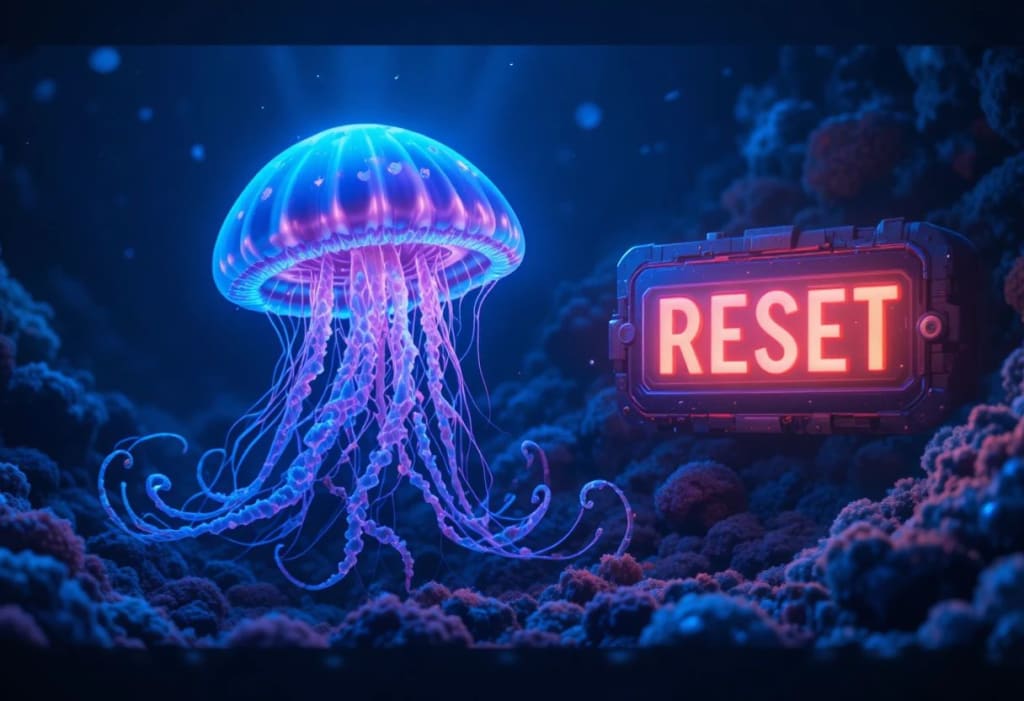
Now imagine a creature that actually does this.
Not metaphorically.
Not spiritually.
Biologically.
Meet the Immortal Jellyfish — the closest thing on Earth to a real-life cheat code for death.
The Jellyfish That Refuses to Die
Most animals follow the same brutal rule:
You’re born → you grow → you age → you die.
The immortal jellyfish (Turritopsis dohrnii) looked at that system and said, nah.
When it gets injured, starved, stressed, or just feels like it’s time, this jellyfish reverts its body back to a juvenile state. Not metaphorically. Literally.
It goes from adult → baby → adult again.
Over and over.
In theory, this cycle can repeat forever.
The Ultimate Biological Reset Button
Here’s the wild part: this jellyfish doesn’t just heal itself. It rewrites itself.
The process is called transdifferentiation, which sounds like sci-fi because it basically is.
Transdifferentiation means:
One fully developed cell transforms directly into a completely different type of cell.
Skin cells become nerve cells.
Muscle cells become reproductive cells.
Specialized cells say, “Actually, I’d like a career change.”
That’s like your brain cells deciding to become heart cells because your body needs a reboot.
Humans? We can’t do that.
This jellyfish? Casual Tuesday.
Life, But Played Like a Video Game
If life had stats, the immortal jellyfish figured out how to reload a save file.
Think about it:
- Aging = game over
- Injury = fatal error
- Starvation = reset sequence initiated
uence initiatedInstead of dying, the jellyfish collapses into a blob, attaches itself to a surface, and rebuilds its entire body from scratch.
No respawn timer.
No permadeath.
Just endless retries.
It’s biological speedrunning.
Immortal… But Not Invincible
Before you assume jellyfish are about to rule the planet, reality check:
- They can still be eaten
- They can still get diseases
- They can still be destroyed by environmental changes
So no, they’re not gods.
But if nothing kills them?
They don’t age out. Ever.
Which makes them functionally immortal — a term scientists use very carefully, and only in rare cases like this one.
Why Scientists Are Obsessed With This Thing
The immortal jellyfish isn’t just a cool ocean flex. It’s a biological goldmine.
Scientists study it to understand:
- Aging
- Regenerative medicine
- Cellular reprogramming
- Cancer resistance
- Tissue repair
If humans could safely control transdifferentiation, it could mean:
- Reversing organ damage
- Regenerating spinal cords
- Slowing or even halting age-related decline
Basically, everything sci-fi promises but biology usually denies.
The Darkly Ironic Twist
Humans are desperate to unlock immortality.
Meanwhile, an animal that already has it is:
- Smaller than a fingernail
- Mostly transparent
- Accidentally spreading across the globe via ship ballast water
Yep — the immortal jellyfish isn’t rare anymore.
Thanks to human shipping, it’s quietly invading oceans worldwide, proving once again that immortality doesn’t come with wisdom.
The Bigger Question
The immortal jellyfish forces an uncomfortable realization:
Death isn’t inevitable for all life.
It’s just how we evolved.
Aging isn’t a universal rule — it’s a biological design choice.
And somewhere in the ocean, a creature figured out how to uninstall it.
Final Thought
You don’t need to live forever to appreciate this jellyfish.
But knowing that nature already solved a problem we think is impossible?
That should mess with your head a little.
Immortality isn’t science fiction.
It’s just… already taken.
About the Creator
Reality Has Glitches
Reality Has Glitches explores the strangest bugs, hacks, and cheat codes hiding in nature, technology, and the future.
Keep reading
More stories from Reality Has Glitches and writers in Lifehack and other communities.
The Power of Being Alone: Why Solitude Is Becoming the Secret Weapon of the Modern Mind
The modern world is loud. Notifications buzz, videos autoplay, conversations scroll endlessly across screens, and opinions arrive faster than most people can process them. Silence has become so rare that many now associate it with discomfort instead of peace. The moment there is nothing to listen to, watch, or respond to, the hand instinctively reaches for a phone. But beneath all this noise lies a forgotten skill — the ability to be alone without feeling lonely. Solitude is not the same as isolation. Isolation is being cut off from others against your will. Solitude is choosing to step away, even briefly, to reconnect with yourself. This difference is small in definition but massive in impact. Psychologists have found that moments of intentional solitude can improve creativity, emotional regulation, and problem-solving. When the brain is no longer reacting to external stimuli, it begins to wander inward. This is where ideas form, where feelings are processed, and where deeper understanding takes shape. Many of history’s most influential thinkers, artists, and leaders had one thing in common: they valued time alone. Writers walked long distances to think. Scientists sat quietly with unsolved problems. Philosophers spent hours in reflection. These weren’t escapes from reality — they were ways of understanding it more clearly. Today, however, solitude is often misunderstood. Being alone can be seen as antisocial or unproductive. In a culture that celebrates constant connection, stepping back can feel like falling behind. But in truth, the opposite is often happening. When people never pause, they don’t just lose time — they lose direction. Without moments of reflection, it becomes easy to live on autopilot. Goals are inherited instead of chosen. Opinions are adopted instead of examined. Emotions are suppressed instead of understood. Over time, this can create a quiet sense of dissatisfaction, even when life looks successful on the surface. Solitude acts as a mental mirror. In silence, you begin to notice what actually matters to you. You recognize patterns in your behavior. You become aware of the thoughts you normally drown out with distraction. This awareness can be uncomfortable, but it is also powerful. There is also a growing connection between solitude and focus. In an age of constant interruption, the ability to concentrate deeply has become a competitive advantage. People who can work without checking their phone every few minutes often produce better results in less time. This kind of focus doesn’t come from willpower alone — it comes from training the mind to be comfortable without stimulation. Even emotional resilience is shaped in quiet moments. When you sit alone with a difficult feeling instead of escaping it, you learn that discomfort doesn’t destroy you. You learn that emotions rise and fall like waves. This understanding builds inner stability that no external validation can replace. Of course, humans are social by nature. Connection, community, and relationships are essential for a healthy life. The power of solitude doesn’t come from replacing these things, but from balancing them. It’s in solitude that you figure out what you want to bring back to the world. Small practices can make a big difference. A short walk without headphones. A few minutes of journaling in the morning. Sitting quietly before starting the day. These moments don’t need to be dramatic. They just need to be intentional. Over time, something changes. The noise of the world becomes easier to navigate. Decisions feel clearer. Reactions become calmer. You begin to act from understanding instead of impulse. In a society that is constantly speaking, posting, and performing, choosing silence can feel radical. But that is exactly why it is so powerful. Because sometimes, the strongest voice you can listen to is your own.
By Hazrat Usman Usman5 days ago in Lifehack



Comments
There are no comments for this story
Be the first to respond and start the conversation.